
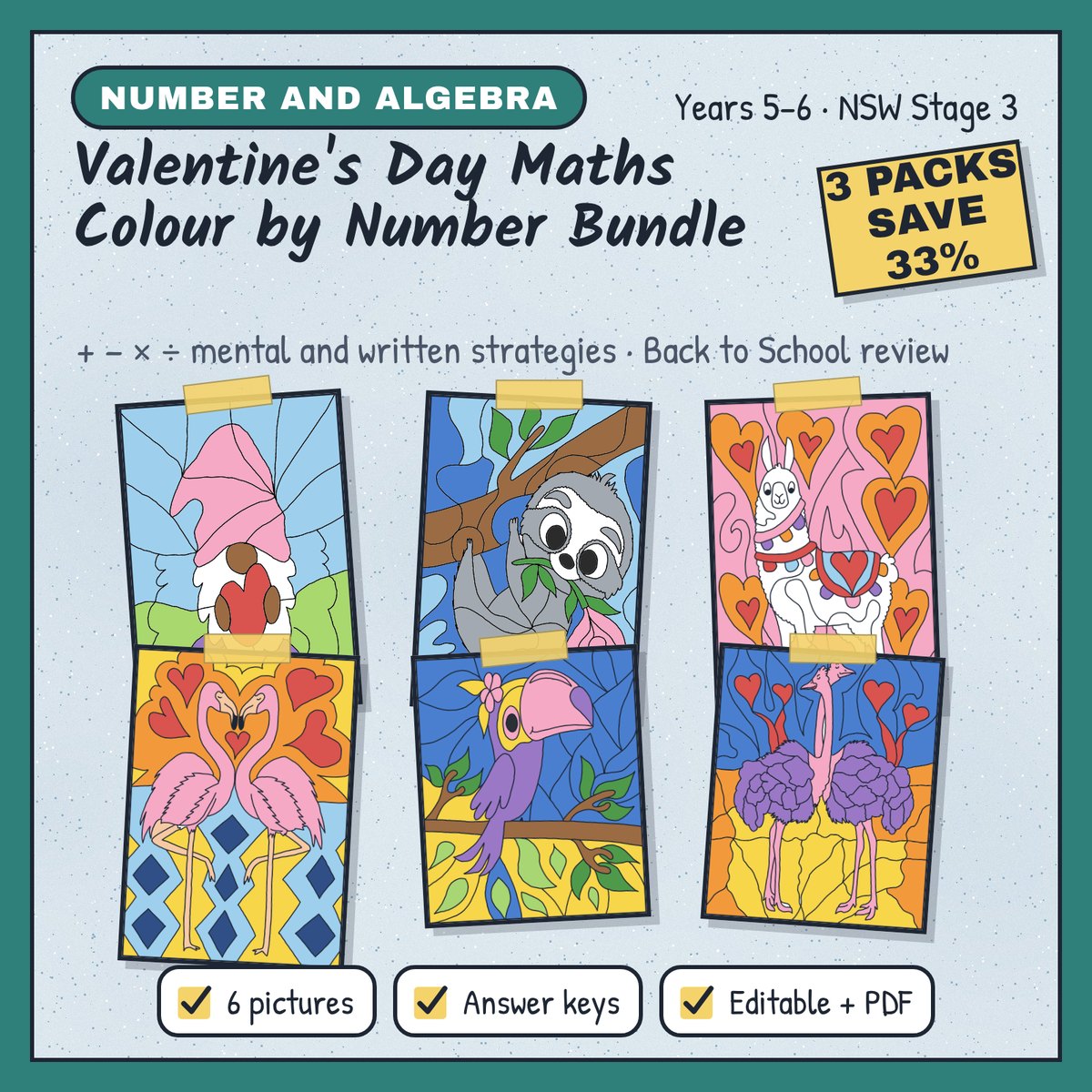
In Australia, Valentine's Day falls in the first two or three weeks of the school year. That's the same time I'm trying to work out where my new class is up to with the four operations. I don't want to start the year with a test, so I use mystery pictures.
Why mystery pictures work for a review
Every part of the picture has its own question. As students work, I walk around and see exactly where each one is: who is solid on mental addition, who still counts on fingers for 7 × 8, who can set out short division and who can't yet. It's diagnostic information without the stress of a test, and at the end everyone has a bright picture for the wall.
The questions in my packs are written inside the picture itself, the way I first drew them in 2022. Small parts have quick mental questions and big parts have room for a written algorithm.
Two levels in every pack
Each pack has two pictures, and each picture is a level:
- [Addition and Subtraction](/shop/valentines-day-addition-subtraction-colour-by-number-years-5-6): a gnome holding a heart (addition) and a sloth with a rose (subtraction), 98 questions.
- [Multiplication](/shop/valentines-day-multiplication-colour-by-number-years-5-6): a llama with hearts (mental strategies) and two flamingos (written algorithms, including 2-digit × 2-digit and 3-digit × 2-digit), 108 questions.
- [Division](/shop/valentines-day-division-colour-by-number-years-5-6): a toucan with a flower (mental strategies) and two emus (short division of 3- and 4-digit numbers), 146 questions.
The strategies behind it
These match MA3-AR-01 and MA3-MR-01 in the NSW syllabus. Before students colour, I revise the strategies with the worked examples on the slides:
- Addition and subtraction: compensation (47 + 29 is 47 + 30 − 1), counting up for subtraction, constant difference (82 − 39 is the same as 83 − 40), and the written algorithm for bigger numbers.
- Multiplication: doubling, × 10 then halve for × 5, partitioning (6 × 34 is 6 × 30 + 6 × 4), and the written algorithm.
- Division: using fact families (if 7 × 8 = 56, then 56 ÷ 7 = 8), halving, partitioning, and short division.
I ask students to estimate first. If a part says 398 + 207 and they colour it as if the answer is 505, a quick estimate (about 400 + 200 = 600) catches it.
How I run it
Lesson 1: warm-up and strategies, then the Level 1 picture. Lesson 2: the Level 2 picture, then everyone checks their pictures against the coloured answer keys. On the keys, every part shows its answer, so a wrong colour points straight to the question to recheck.
I usually run addition and subtraction in week 1, multiplication in week 2 and division in week 3. By Valentine's Day the display wall is full.
Try the free sample
The free Valentine's Day Colour by Number sample is a baby elephant hugging a heart, with 66 mixed questions covering all four operations. It's a good first-week activity on its own, and it shows you how the full packs work.
Resources that go with this post
- Valentine's Day Maths Colour by Number Bundle: all six pictures and 352 questions.
- Addition and Subtraction, Multiplication and Division packs on their own.
- Valentine's Day Colour by Number sample: free.