
December in a Year 5 or 6 classroom is a juggle. Reports are done, the carols concert needs rehearsing, and half the class is already mentally at the beach. I still want maths every day, but it has to be the kind students will sit down and do.
A good Christmas colour by number gets that balance right, as long as the maths is worth doing. Most of the free ones online are times tables all the way down, which my Year 6s finish in ten minutes. So I made mine around the skills that slip over summer.
What's worth revising in December
These are the Stage 3 skills I see go rusty by February:
- Order of operations (MA3-MR-02). 4 + 6 × 3 is 22, not 30. Brackets first, then × and ÷, then + and −.
- × and ÷ with bigger numbers (MA3-MR-01). Multiplying by multiples of 10 and 100, 3-digit by 1-digit, and short division.
- Fractions and percentages of amounts (MA3-RQF-02 and MA3-RN-03). A quarter of 64, 10% of 350, 75% of 80.
- Sale prices (MA3-RN-03). A $40 toy with 25% off: find a quarter ($10), then take it away ($30).
All of it is Stage 3, so it's genuine revision, not filler.
Three levels, three pictures
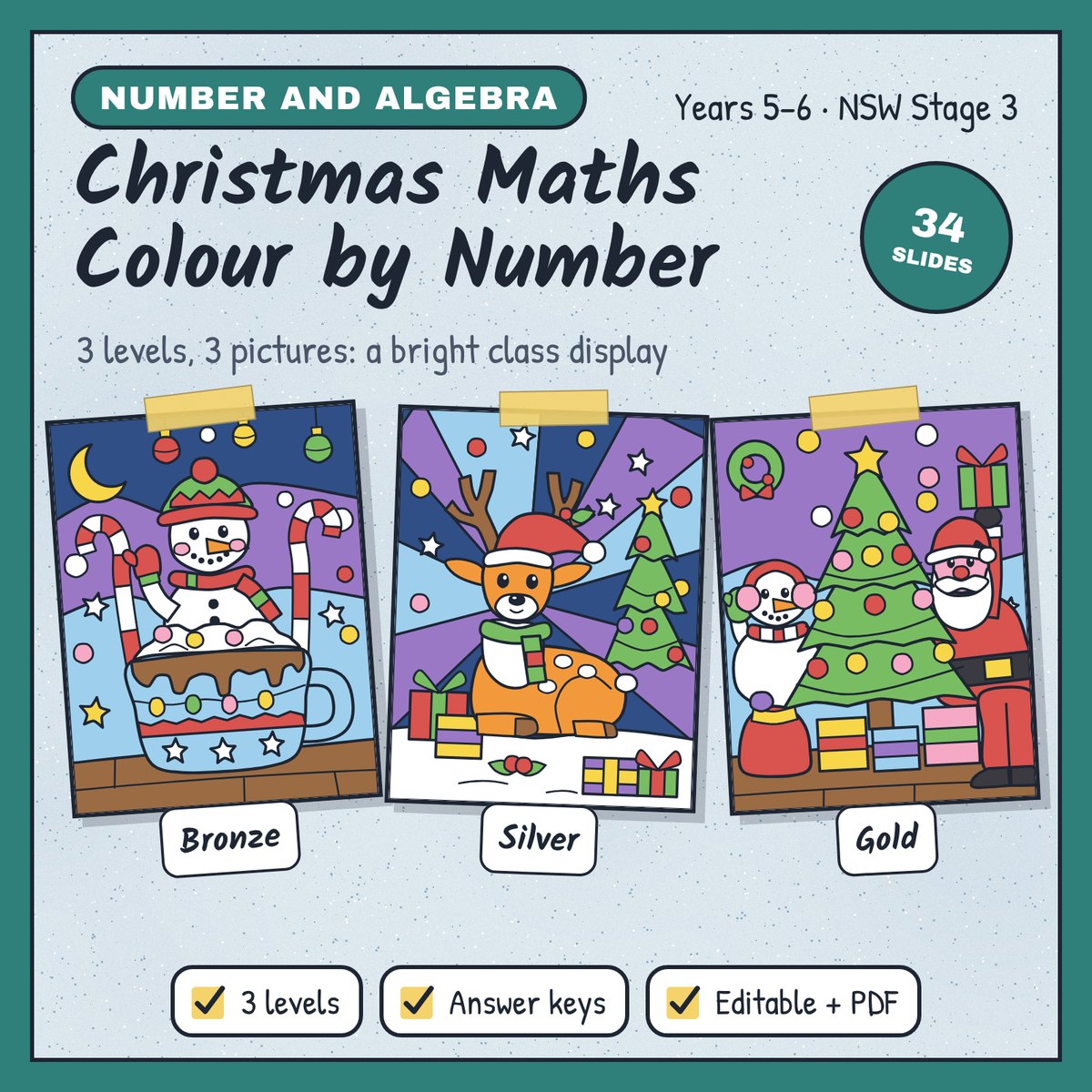
My Christmas Maths Colour by Number has three levels, each with its own questions and its own original picture:
- Bronze (12 questions): × and ÷ by multiples of 10 and 100, simple order of operations and 4-digit addition and subtraction. Picture: a snowman waving from a mug of hot chocolate.
- Silver (16 questions): brackets, 3-digit × and ÷, a quarter and a fifth of amounts, and 10%, 25% and 50%. Picture: a reindeer in a Santa hat.
- Gold (20 questions): longer order of operations, 2-digit × 2-digit, 4-digit ÷ 1-digit, 3/4 of amounts, 75%, decimals and multistep money problems. Picture: Santa and a snowman around the Christmas tree.
Because each level has a different picture, nobody can copy colours from the person next to them, and the finished pictures make a great display. A create-your-own page lets fast finishers write questions for a friend.
How I run it
I start with the opening page, a toy order from Santa's workshop. The order totals are written as number sentences, so we talk about which part to work out first. Then I model three worked examples on the slides: brackets first, divide before you subtract, and a sale price.
Students pick up their level and get going. When they finish colouring, they check against the answer picture on the slides. If a part is the wrong colour, its answer tells them which question to look at again.
The order of operations trap
The mistake I see most is working left to right. For 40 − 2 × 6, students write 38 × 6 = 228. I ask them to circle the × first and do it before anything else: 2 × 6 = 12, then 40 − 12 = 28. In a colour by number, the wrong answer simply isn't in the key, which is a gentle nudge to check.
Try it free
The Christmas Maths Colour by Number Free Sampler has 12 new questions and its own gingerbread house picture, so you can try the format before you buy. It's a one-lesson activity you can print today.
Resources that go with this post
- Christmas Maths Colour by Number: three levels, three Christmas pictures, 48 questions, slides and answer keys.
- Christmas Maths Colour by Number Free Sampler: free, one level.
- Summer Holidays Maths Colour by Number: remainders, missing numbers and rates for the last week of term or the first week back.