
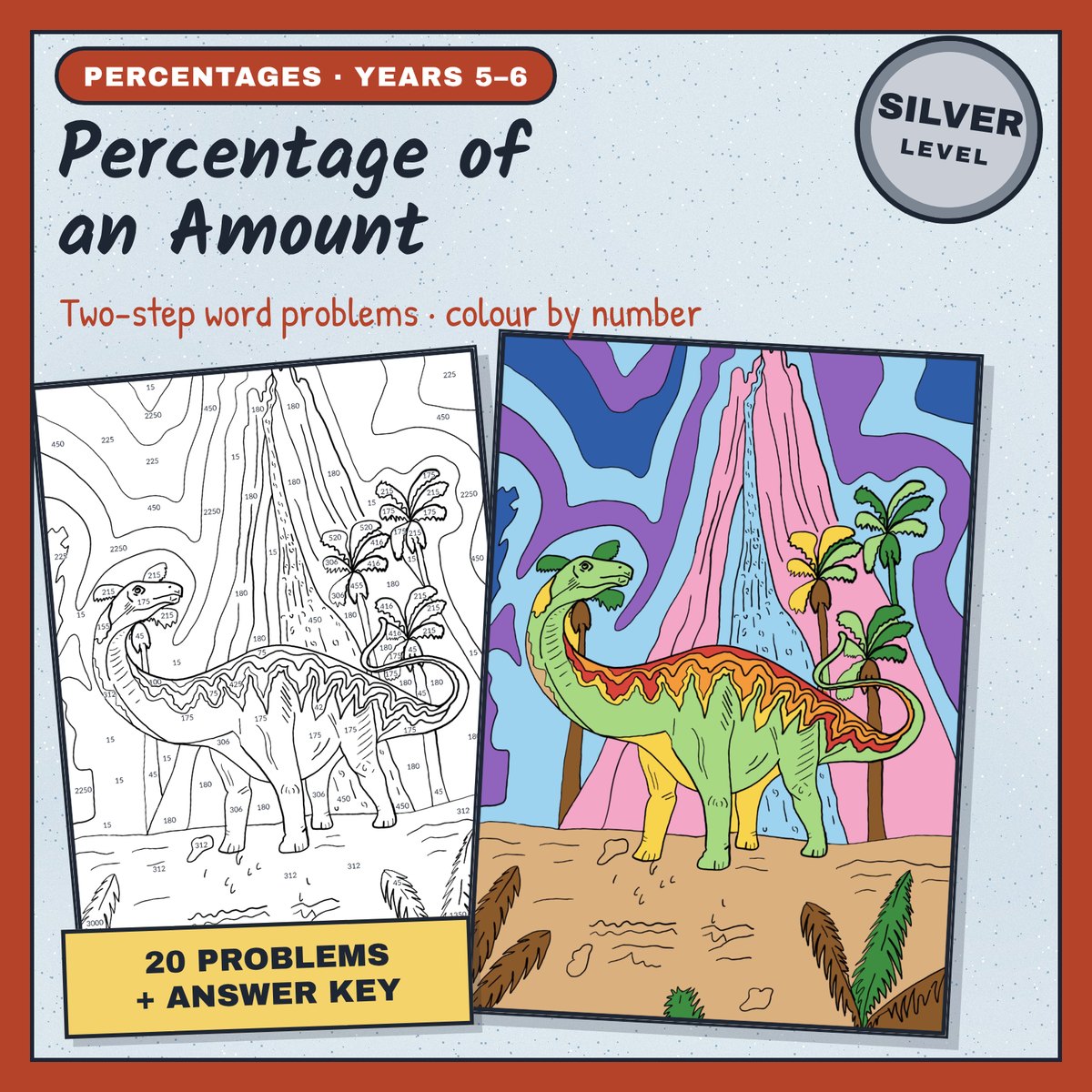
Percentage word problems are where students show whether they really understand percentages or are just following a rule. Here are examples I use with Year 5 and Year 6, from one-step to multi-step, with worked answers. They all use the Stage 3 benchmark percentages: 10%, 25%, 50% and 75%.
One-step percentage word problems
These ask for a percentage of an amount and nothing more.
- A soccer match lasts 90 minutes. Zara plays 50% of the match. How many minutes does she play?
50% is half. 90 ÷ 2 = 45 minutes.
- Year 5 has 300 coloured pencils. 10% need sharpening. How many is that?
10% is one tenth. 300 ÷ 10 = 30 pencils.
- There are 500 g of nuts in the pantry. A recipe needs 75% of them. How many grams is that?
25% of 500 = 500 ÷ 4 = 125, so 75% = 125 × 3 = 375 g.
Watch for: students multiplying by the percentage (500 × 75). Ask, "Can 75% of something be bigger than the whole?"
Two-step problems: discounts and sale prices
The second step is where most mistakes happen.
- A dinosaur fossil kit costs $60. It is on sale with 25% off. What is the sale price?
Discount: 25% of $60 = $60 ÷ 4 = $15. Sale price: $60 − $15 = $45.
- A fruit shop has 2500 pieces of fruit. 10% are apples. How many pieces are not apples?
10% of 2500 = 250. 2500 − 250 = 2250 pieces.
- 600 people are at the school concert. 50% are parents. Of the other people, 25% are grandparents. How many grandparents are there?
50% of 600 = 300 parents, so 300 other people. 25% of 300 = 300 ÷ 4 = 75 grandparents.
Watch for: stopping after step one. In question 4, plenty of students write $15. I ask, "Would a shop sell a $60 kit for $15 in a 25% sale?" They laugh, and go back to finish.
Multi-step percentage word problems
Students need a plan before they calculate.
- 40 volunteers each collect $150 for an animal shelter. 25% of the total pays for running costs. How much is left for the animals?
Total: 40 × $150 = $6000. 25% of $6000 = $1500. $6000 − $1500 = $4500.
- A farmer collects 400 eggs. She sells 25% at the market, then gives 10% of the eggs that are left to her neighbours. How many eggs does she have now?
25% of 400 = 100, so 300 are left. 10% of 300 = 30. 300 − 30 = 270 eggs.
- A school has 800 students. 50% are in Years 3 to 6. 25% of those students walk to school. How many Years 3 to 6 students walk?
50% of 800 = 400. 25% of 400 = 100 students.
Watch for: taking the second percentage of the wrong amount. In question 8, the 10% is of the eggs that are left (300), not of all 400. A quick bar model helps students see which amount the percentage is "of".
Tips for teaching percentage word problems
- Teach the benchmarks as division first: 50% divide by 2, 25% divide by 4, 10% divide by 10, 75% divide by 4 then multiply by 3.
- Ask students to underline what the question is asking: how many are sold, left, or saved?
- Get them to estimate first. 75% should be more than half but less than the whole.
- Always write the unit: kg, L, minutes or dollars.
Want 60 more, with answers?
My Percentage of an Amount colour by number series has 20 word problems at each level, and the answers colour a hand-drawn dinosaur picture, so students can check their own work.