
Hand a Year 5 student a kitchen scale with a dial and ask what the parcel weighs. Most will read the nearest number and stop. "About 2." Two what? Two kilograms? And what about the four little marks after the 2?
Reading scales is where mass gets real in Stage 3, and it's the part I see rushed most often. Converting units on a worksheet is easy to check. Reading a dial that goes up in 25 g steps is a different skill, and it's the one students need when they actually measure something.
What the NSW syllabus asks for in Stage 3
Mass sits in the Non-spatial measure focus area, outcome MA3-NSM-01: students select and use the appropriate unit and device to measure the masses of objects. Across Parts A and B that includes:
- choosing the right unit and device, and estimating with benchmarks
- recognising situations where mass is measured in tonnes
- measuring with scales and recording to three decimal places (like 1.375 kg)
- seeing that 1375 g, 1.375 kg and 1 kg 375 g are the same mass
- converting between grams and kilograms, and kilograms and tonnes
- solving problems with different units of mass
Comparing masses written as decimals links to MA3-RN-02 (compare and order decimals up to 3 decimal places).
Mass or weight?
Students will keep saying "weight", and in everyday talk that's fine. I still spend five minutes on the difference, because it stops a misconception before it starts. Mass is how much stuff is in an object. Weight is how hard gravity pulls on it. An astronaut on the Moon has the same mass as on Earth, but weighs about one-sixth as much. Scales in the classroom measure mass in grams and kilograms, so that's the word we use in maths.
Benchmarks before conversions
Before any converting, students need to know what a gram and a kilogram feel like. A paperclip is about 1 gram. A litre of water is 1 kilogram. A small car is about 1 tonne. I pass around a 1 kg bag of flour and a paperclip and ask for estimates of other things in the room. The free Metric Mass Match is a quick way to do this: students sort 15 everyday objects into grams, kilograms or tonnes, then estimate their masses.
Reading dial scales
This is the step that needs explicit teaching. I model it every time with the same three questions:
- What are the labelled numbers?
- How many spaces are there between two labels?
- So what is each space worth?
If the labels go 0, 1 kg, 2 kg and there are 4 spaces between each, every space is 250 g. The pointer three spaces past 1 kg reads 1.75 kg, or 1750 g. Students then practise reading dials and drawing pointers on blank dials, which is a great check because they can't guess.
Digital scales bring in the decimals. A reading of 0.450 kg is 450 g, and the zero at the end matters. I ask students to write the same mass three ways (grams, kilograms as a decimal, and kilograms and grams) after they weigh something real.
Converting g, kg and t
Converting is multiplying or dividing by 1000. The mistake I see most is moving the decimal point the wrong way. I ask one question before any calculation: "Will the number get bigger or smaller?" Kilograms to grams means smaller units, so more of them, so the number gets bigger. A place value chart helps students see that 2.4 kg is 2400 g, not 240 g.
Then I mix the units in word problems. A truck carries 6 t of sand and drops off 1250 kg. How much is left? Students have to choose one unit before they calculate, and that choice is the real learning.
Net and gross mass
This one is a little beyond the Stage 3 wording, but it's the most hands-on part of the unit and students love it. The gross mass is the food plus its packaging. The net mass is the food alone. Why does a 500 g jar of honey show 780 g on the scales? Because the jar has a mass of 280 g.
Not every set of scales has a TARE button, so I teach the method that works anywhere: weigh it full, weigh the empty container, subtract. Then students weigh the food in their own lunchboxes. They check their answer by weighing the food on its own.
Practice that sticks
Once the teaching is done, I use games and colour by number for practice. The Metric Mass Word Problems Millionaire Trivia is a clickable quiz-show game with 12 mass word problems, where each wrong option is a mistake students really make. In October, the Halloween Mass Colour by Number packs give every student converting practice at their own level.
Resources that go with this post
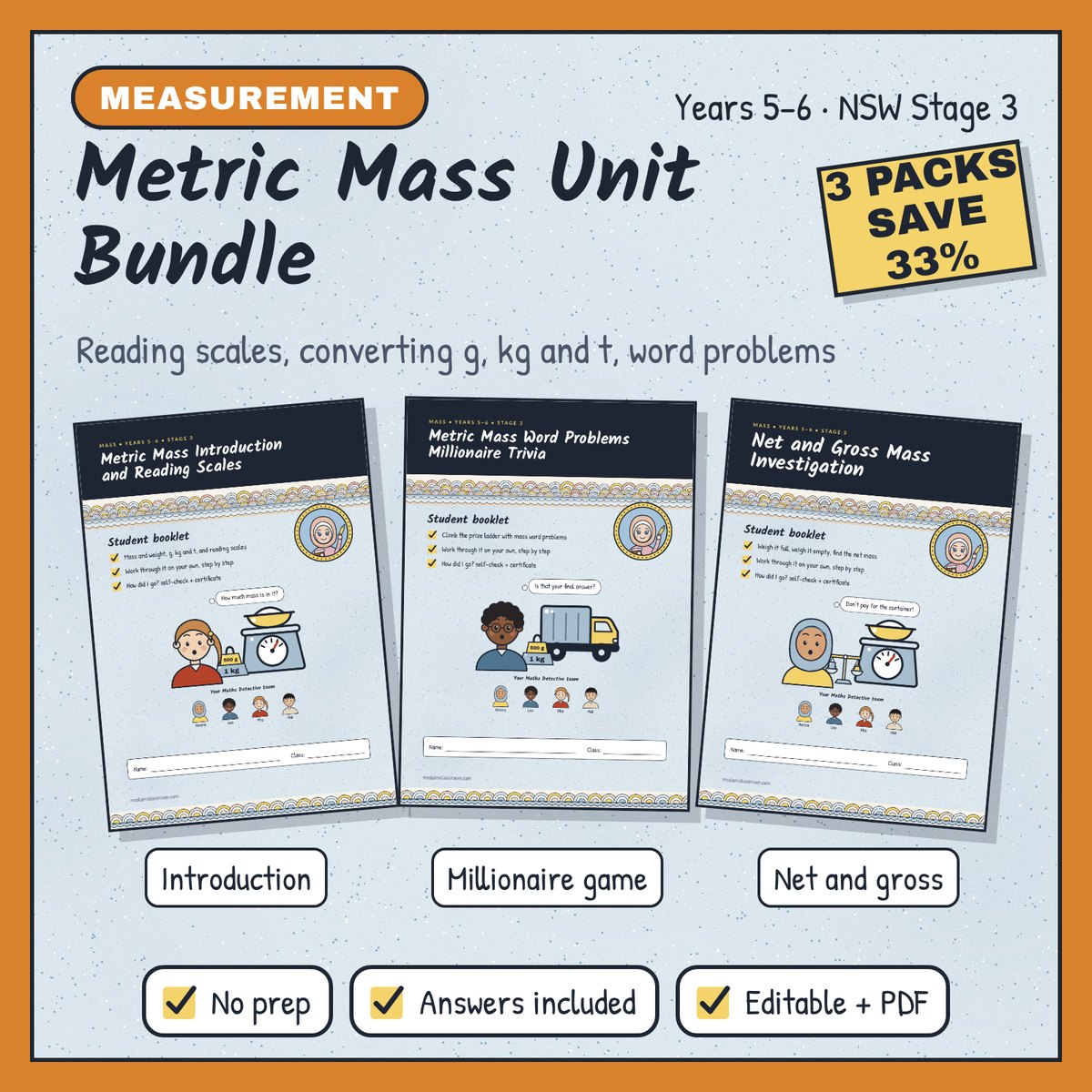
- Metric Mass Introduction and Reading Scales: mass vs weight, units, benchmarks, reading dial and digital scales (18 to read), converting with decimals, a pre-test and post-test.
- Metric Mass Word Problems Millionaire Trivia: a 12-question clickable game with task cards.
- Net and Gross Mass Investigation: two hands-on investigations with scales.
- Metric Mass Unit Bundle: all three together.
- Metric Mass Match: free, one lesson on choosing units.