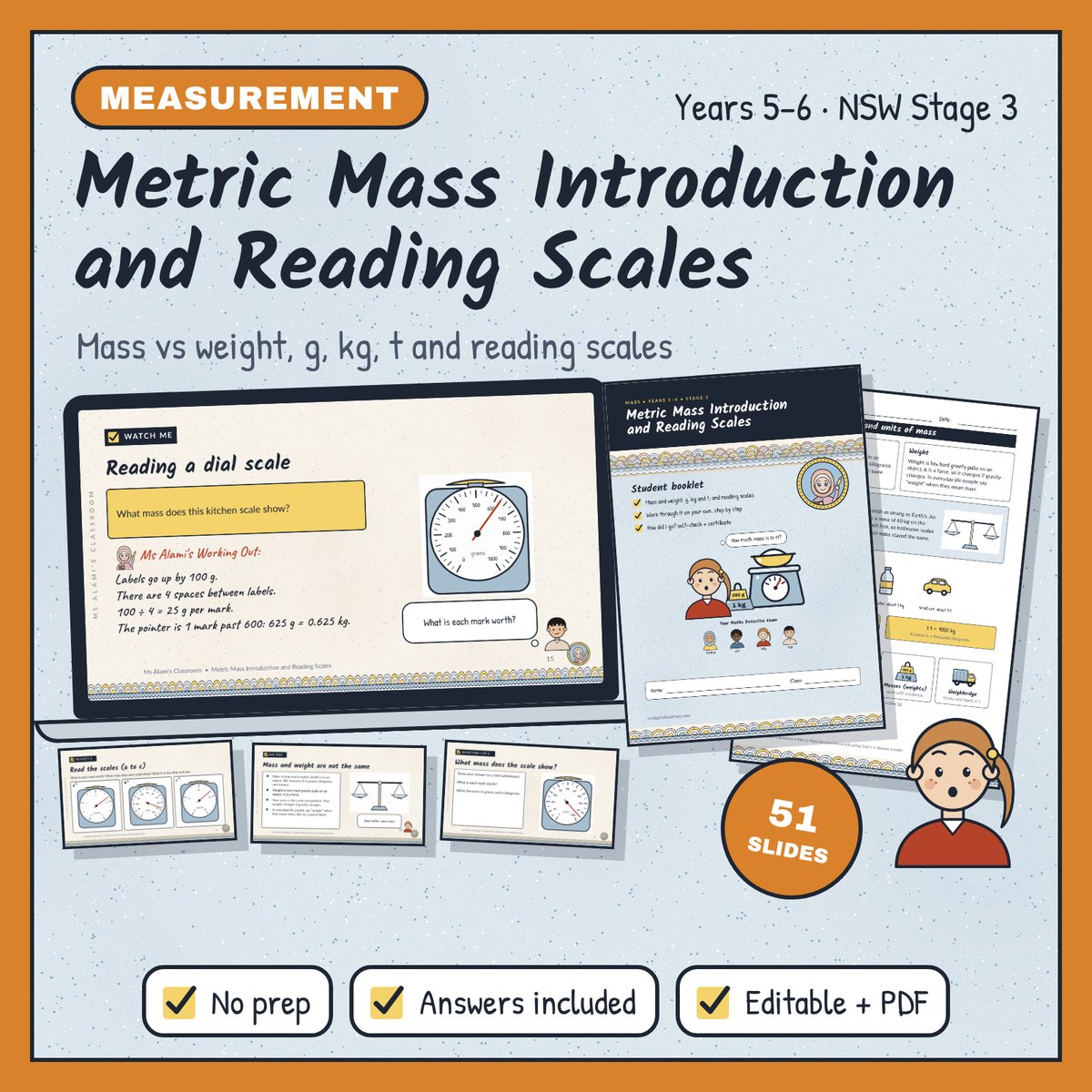
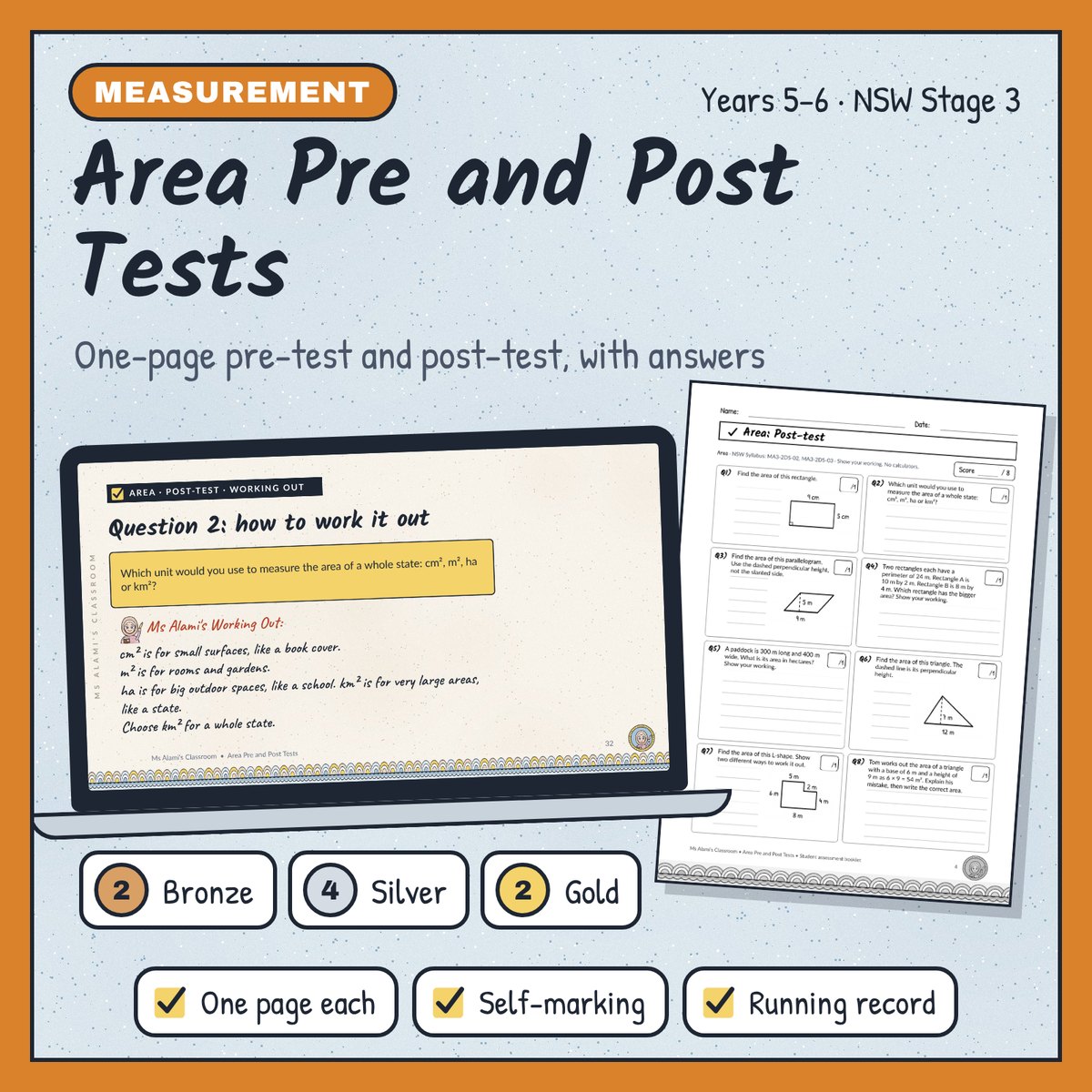
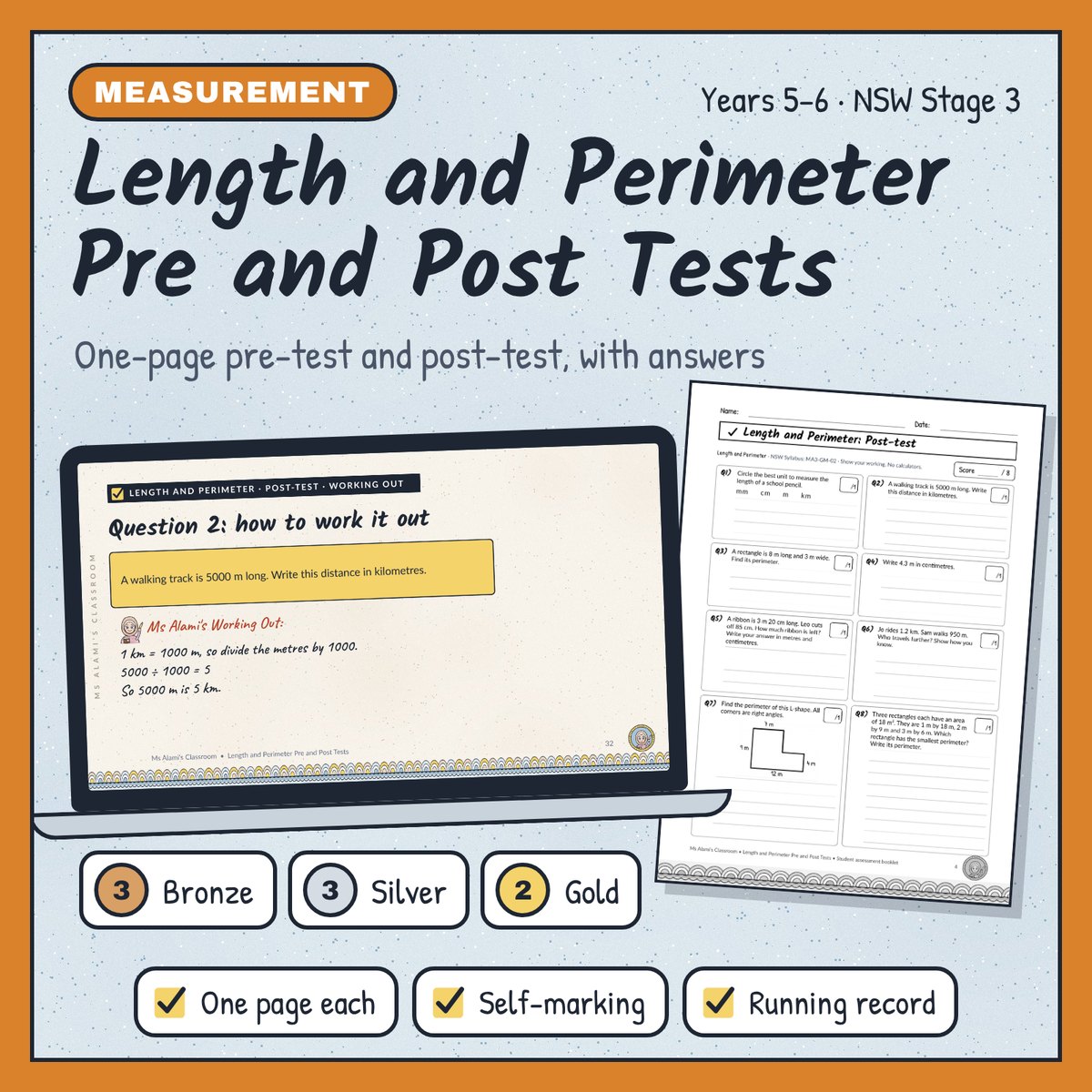
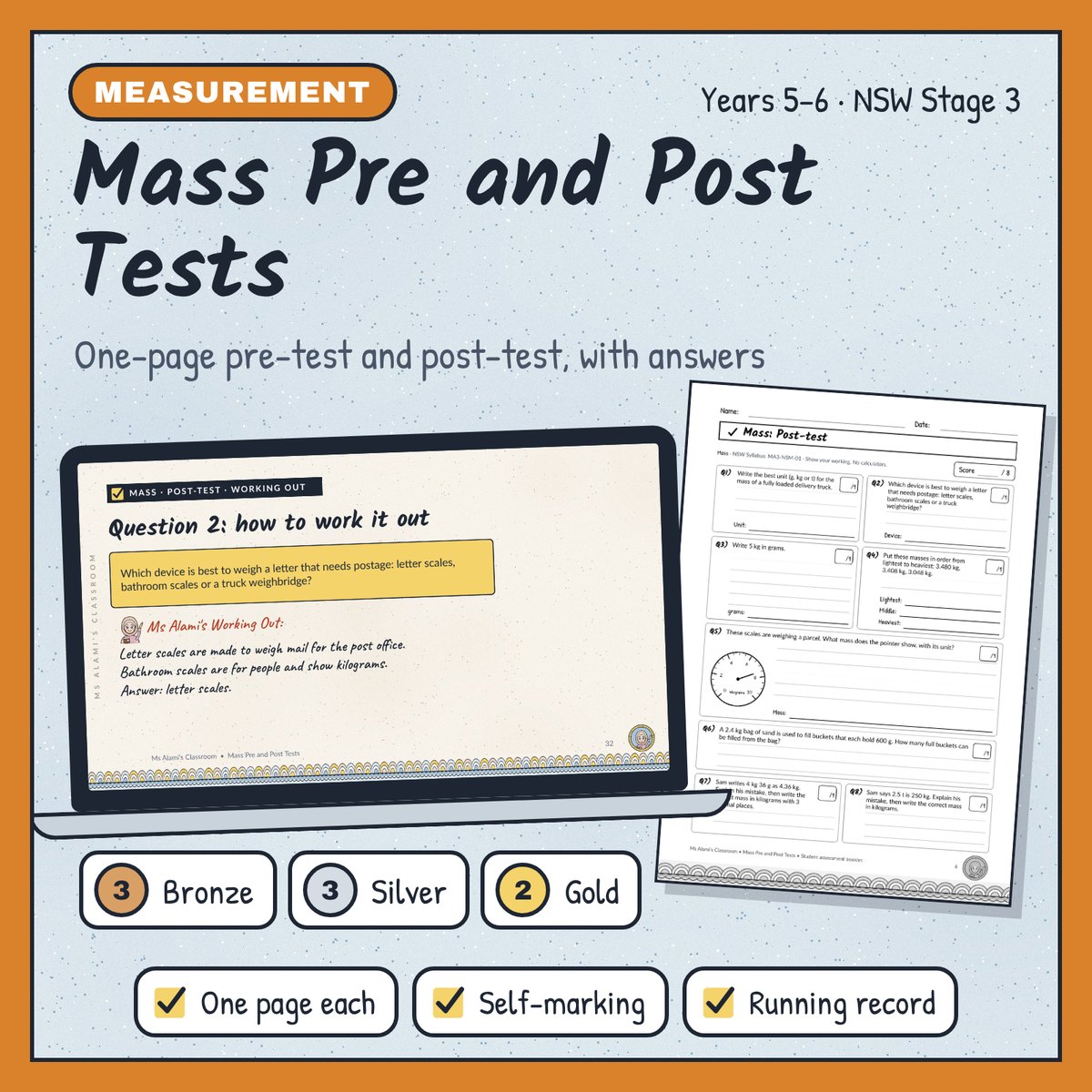
"It weighs 2 kilos." Students say it all the time, and they aren't wrong in everyday talk. This unit starts there and builds the maths underneath: what mass is (and why it isn't quite the same as weight), which unit to use, how to read a scale properly, and how to move between grams, kilograms and tonnes with decimals. It opens on a post-office parcel label.
How it runs
Three or four lessons of 45–60 minutes.
- Lesson 1: warm-up, key words, mass and weight (with a Moon example), a 13-question pre-test, units, benchmarks, devices and choosing a unit.
- Lesson 2: reading dial scales. I model one, then students read 6 dials, draw 6 pointers and play a quick-fire scale round on the board.
- Lesson 3: digital scales and decimals, a hands-on "measure it, then write it three ways" task, and converting g, kg and t at three levels.
- Lesson 4: gross and net mass, a rice-buying savings task, the case file, "Show what you know" and the post-test.
Every scale task teaches the method that works on any scales: weigh it full, weigh the empty container, subtract. ZERO/TARE is shown as a shortcut, not the only way.
Maths covered
- MA3-NSM-01: choose the right unit and device, measure with scales and record to 3 decimal places, recognise when tonnes are used, convert between g, kg and t, and solve problems with different units
- MA3-RN-02: compare and order masses written as decimals
- MA3-AR-01: solve multistep gross and net mass and money problems
Good to know
- No prep: print the booklet, or project the slides and go.
- Gross and net mass is labelled as going a little beyond the Stage 3 wording.
- Practise it next with the Mass Colour by Number packs or the Metric Mass Millionaire game. Or get all three teaching packs in the Metric Mass Unit Bundle.
- New to mass? Start with the free Metric Mass Match.