
"What's 25% of 80?" A lot of Year 6 students reach for a calculator, type 80 × 25 and get 2000. Then they stare at it. The problem isn't the calculating. They don't yet see that 25% is a quarter.
Percentages in Stage 3 are mostly about that connection. Once students know that 50% is a half, 25% is a quarter, 10% is a tenth and 75% is three quarters, percentage of an amount becomes division they can already do.
What the NSW syllabus covers in Stage 3
Percentages sit in MA3-RN-03 (Represents numbers B): students determine percentages of quantities and find equivalent fractions and decimals for benchmark percentage values. The content includes:
- recognising that % means "out of 100" and that 100% is the whole amount
- knowing the common equivalents: 50% = 1/2 = 0.5, 25% = 1/4 = 0.25, 75% = 3/4 = 0.75, 10% = 1/10 = 0.1
- using 10% as one-tenth of an amount
- calculating the sale price of an item after a discount of 10%, 25% or 50%
Other percentages, like 15%, 30% or 8%, and percentage increase are Stage 4. They make good extension questions, but they don't belong in the main task.
The four benchmarks as division
I write these on the board and leave them up for the whole unit:
- 50%: divide by 2
- 25%: divide by 4
- 10%: divide by 10
- 75%: divide by 4, then multiply by 3
Then we practise with quantities students can picture. 50% of 36 lollies, 25% of $60, 10% of 450 m. I want students saying "a quarter of 60 is 15" before they write anything down.
A hundred grid helps the ones who aren't there yet. Shade 25 squares out of 100 and ask how many quarters fit in the grid. The link between 25 out of 100 and one quarter usually clicks.
Discounts and sale prices
This is where the two-step problems come in. A $48 jumper is 25% off. What's the sale price? Students have to do two things: find the discount (a quarter of $48 is $12) and take it away ($48 − $12 = $36).
The mistake I see most is stopping after step one and writing $12 as the sale price. I ask, "Would a shop sell a $48 jumper for $12 with a 25% sale?" The answer makes them laugh, and they go back and finish the problem. Catalogues from the letterbox are a free source of real sale prices.
One-step, two-step, multi-step
I teach percentages in three rounds:
- One-step: find a benchmark percentage of a quantity.
- Two-step: find the percentage, then add or subtract (sale prices, how much is left).
- Multi-step: plan the steps first, like "25 students each bring $4. 10% goes to the canteen. How much is left?"
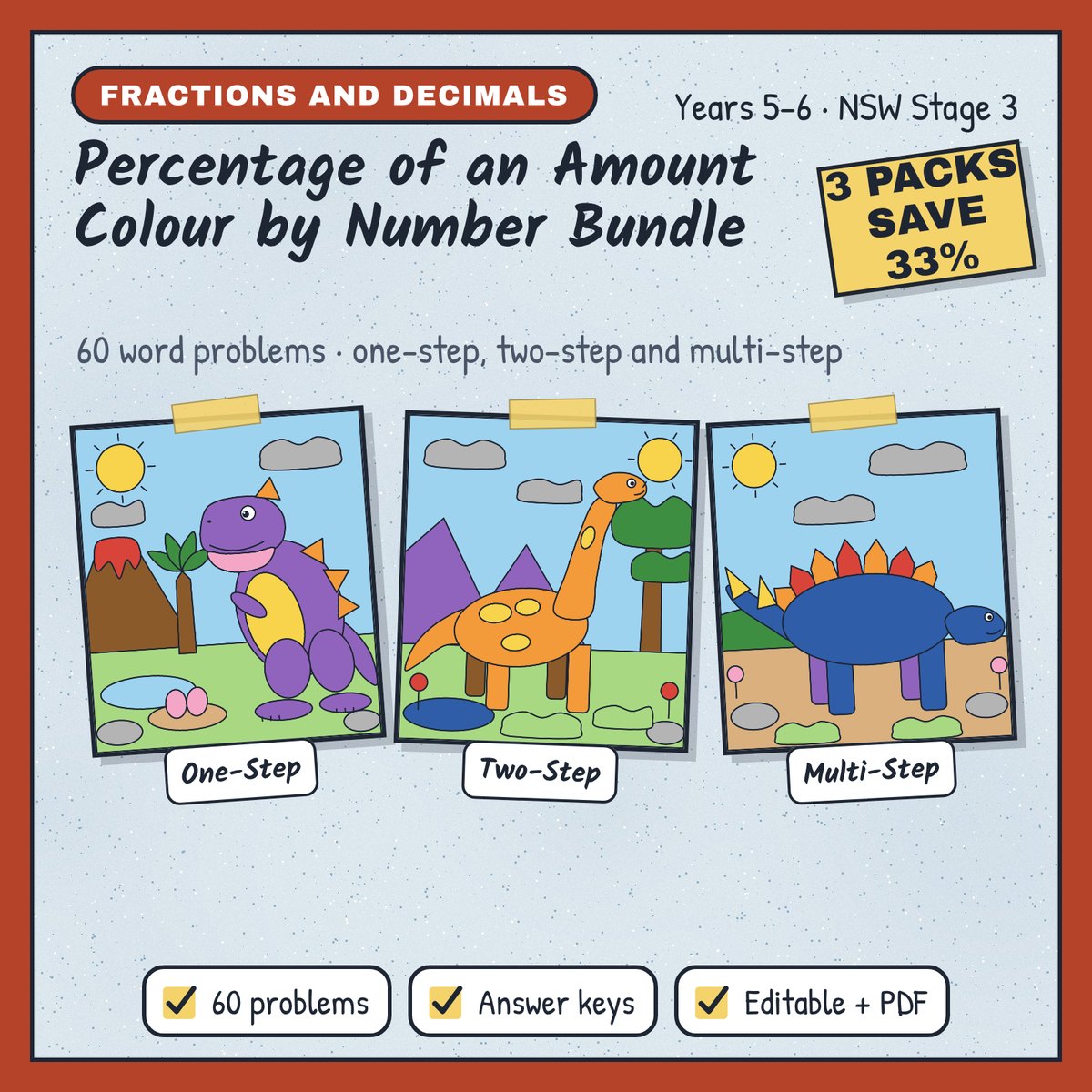
Splitting it this way means I can give each group the right level without changing the topic. My Percentage of an Amount colour by number sets follow the same order. Each has 20 word problems and an original dinosaur picture, and the answers become the colours. If a part of the picture has no matching answer, students know to check their working.
Resources that go with this post
- Percentage of an Amount One-Step Colour by Number: 20 one-step problems and a T. rex picture.
- Percentage of an Amount Two-Step Colour by Number: sale prices and discounts with a long-neck dinosaur.
- Percentage of an Amount Multi-Step Colour by Number: multistep problems with a stegosaurus.
- Percentage of an Amount Colour by Number Bundle: all three sets.
- Fraction Revisit: fractions of amounts and percentages, if you want to teach the fraction link first.