
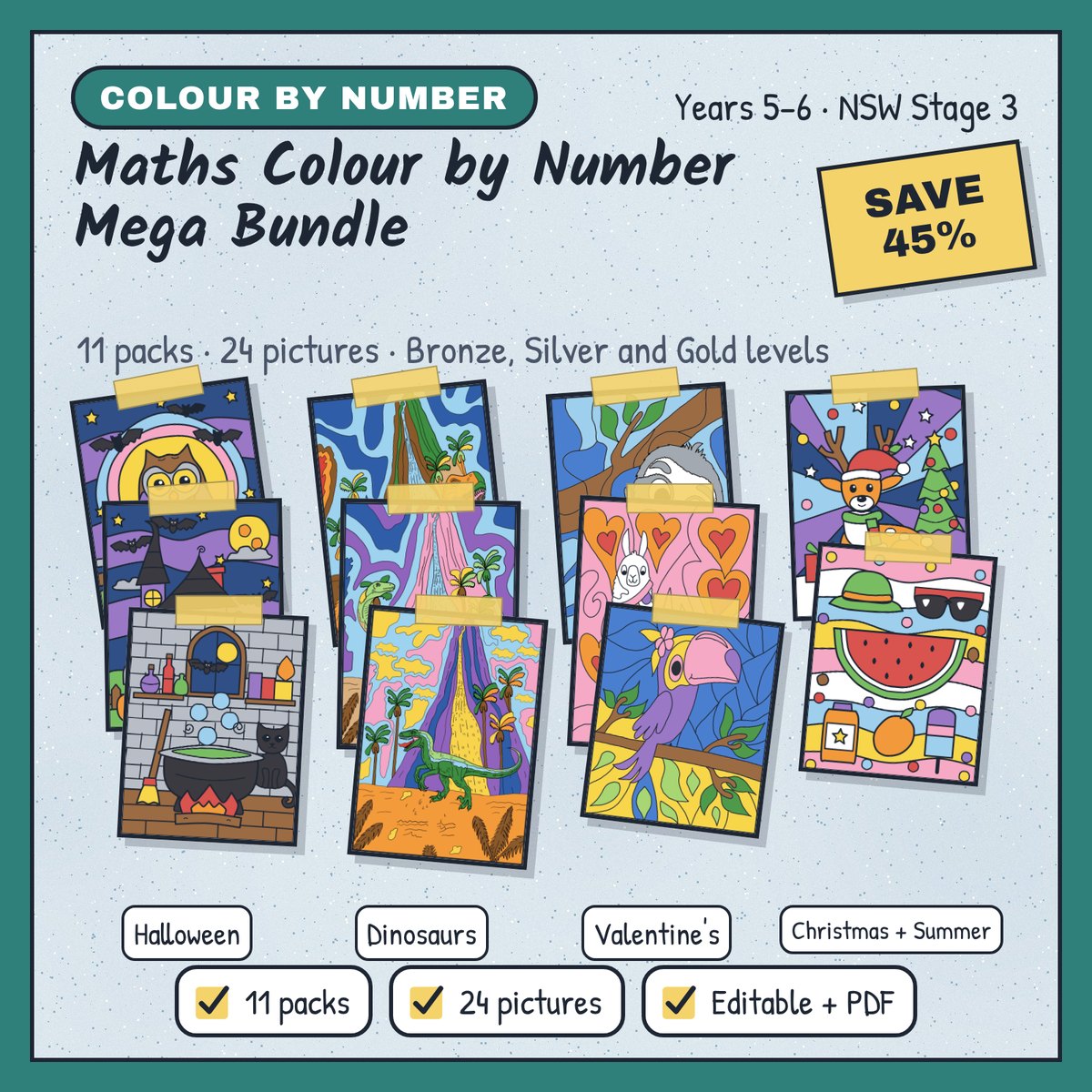
Colour by number has a reputation as a "filler" activity. In my Year 5 and 6 classes it's the opposite. When every answer has to match a number in the picture, students check their own work, and they care about getting it right because a wrong answer leaves a gap in the picture.
The trick is matching each one to a skill you've just taught. Here's how I spread maths colour by number across the school year.
Term 1: back to school with Valentine's Day
The first weeks back are for finding out what students remember. My Valentine's Day mystery pictures cover addition and subtraction, multiplication and division with mental and written strategies. Students don't know what the picture is until they've coloured it, which keeps them going to the last question. They make a great diagnostic too: the parts left blank show you exactly which strategy needs reteaching.
Any time: percentage of an amount
Percentages fit wherever your scope and sequence puts them. The Percentage of an Amount colour by number comes as three levels with hand-drawn dinosaurs:
- Bronze: one-step problems, like 25% of 36 km
- Silver: two-step problems with discounts and sale prices
- Gold: multi-step problems that need a plan
Everyone practises the same Stage 3 skill (MA3-RN-03), at the right level. For worked examples, see Percentage Word Problems for Years 5 and 6.
Term 4, October: Halloween mass
Converting between grams, kilograms and tonnes is easy to teach and easy to forget. The Halloween mass colour by number packs practise g ↔ kg and t ↔ kg at Bronze, Silver and Gold levels, with comparisons using <, > and = for the Gold students.
Term 4, December: Christmas and the last week of school
The end of the year is when students are least focused, which is exactly when a colour by number earns its place. The Christmas colour by number reviews order of operations, fractions and percentages of amounts. The Summer Holidays colour by number covers remainders, missing numbers, rates and multiplying and dividing decimals by 10, 100 and 1000. Both are revision of Stage 3 content rather than busy work.
How I keep it challenging
- Levels: I give each group Bronze, Silver or Gold. Nobody does "the easy sheet", and students ask to move up.
- Working first: answers go in the booklet with working shown, before any colouring.
- No calculators: the numbers are chosen so the mental strategies work.
- Early finishers: the colouring is the reward for finishing the maths, not the other way round.
Get every pack in one go
If you'd like a colour by number ready for every term, the Maths Colour by Number Mega Bundle has all 11 packs and 24 pictures in one download, with teacher slides, booklets and answer keys. It saves 45% on buying the packs separately.