
If you want to know where a class is with capacity, write 45 mL on the board and ask them to write it in litres. In most Year 5 and 6 classes a good number will write 0.45 L, and a few will write 4.5 L. The ones who write 0.045 L straight away often can't tell you why. They just know a rule about three places.
Students who write 0.45 L are treating decimals as "two places after the point", which comes from money. Capacity needs thousandths, and for many students that's new in Stage 3. This post covers converting litres and millilitres, the volume of rectangular prisms, the cubic metre and displacement, with the mistakes I see most and activities you can run with what's already in the room.
Where volume sits in the NSW syllabus
There's no Stage 3 focus area called "Volume and capacity". It sits inside Three-dimensional spatial structure, under MA3-3DS-02: "selects and uses the appropriate unit to estimate, measure and calculate volumes and capacities".
Part A covers choosing units for capacity (millilitres for a drinking glass, litres for a bucket), using displacement to investigate the volumes of irregular solids, and connecting decimals to the metric system. Part B covers the cubic metre, the layer structure of rectangular prisms, and calculating their volumes in cubic centimetres and cubic metres.
NESA's teaching advice says capacity isn't taught as a concept separate from volume until Stage 4, and K–6 students don't need formal definitions. I still use both words, because students hear both at home. Volume is how much space something takes up, capacity is how much a container holds, and we get on with measuring.
Converting litres and millilitres
Students need the fact that 1 L = 1000 mL, but they also need to understand that 1 mL is one-thousandth of a litre, so millilitres sit in the third decimal place.
A place-value chart with columns for litres, tenths, hundredths and thousandths does more than any rule. Write 375 mL in it and students can see 0.375 L. The syllabus examples work well as they are: 375 mL is the same as 0.375 L, 8.7 L is the same as 8 litres and 700 millilitres, and measurements are recorded to 3 decimal places, like 1.275 L.
The mistakes to expect:
- 45 mL = 0.45 L. It's 0.045 L. Put 45 in the chart and the zero in the tenths column shows up.
- 2 L 40 mL = 2.4 L. It's 2.040 L. 2.4 L is 2 L 400 mL.
- 0.06 L = 6 mL. It's 60 mL.
- 8.7 L = 8 L 7 mL. The 7 is in the tenths place, so it's 700 mL.
I'd rather hear "the digits move three places" than "add three zeros", which falls apart as soon as there's a decimal point.
For a quick activity, ask students to bring in clean empty containers or photos of labels. A 375 mL can, a 600 mL bottle and a 1.25 L bottle are a good start. Students write each capacity both ways, then order them. Finish on 1.2 L and 1020 mL, where the number that looks bigger is the smaller amount.
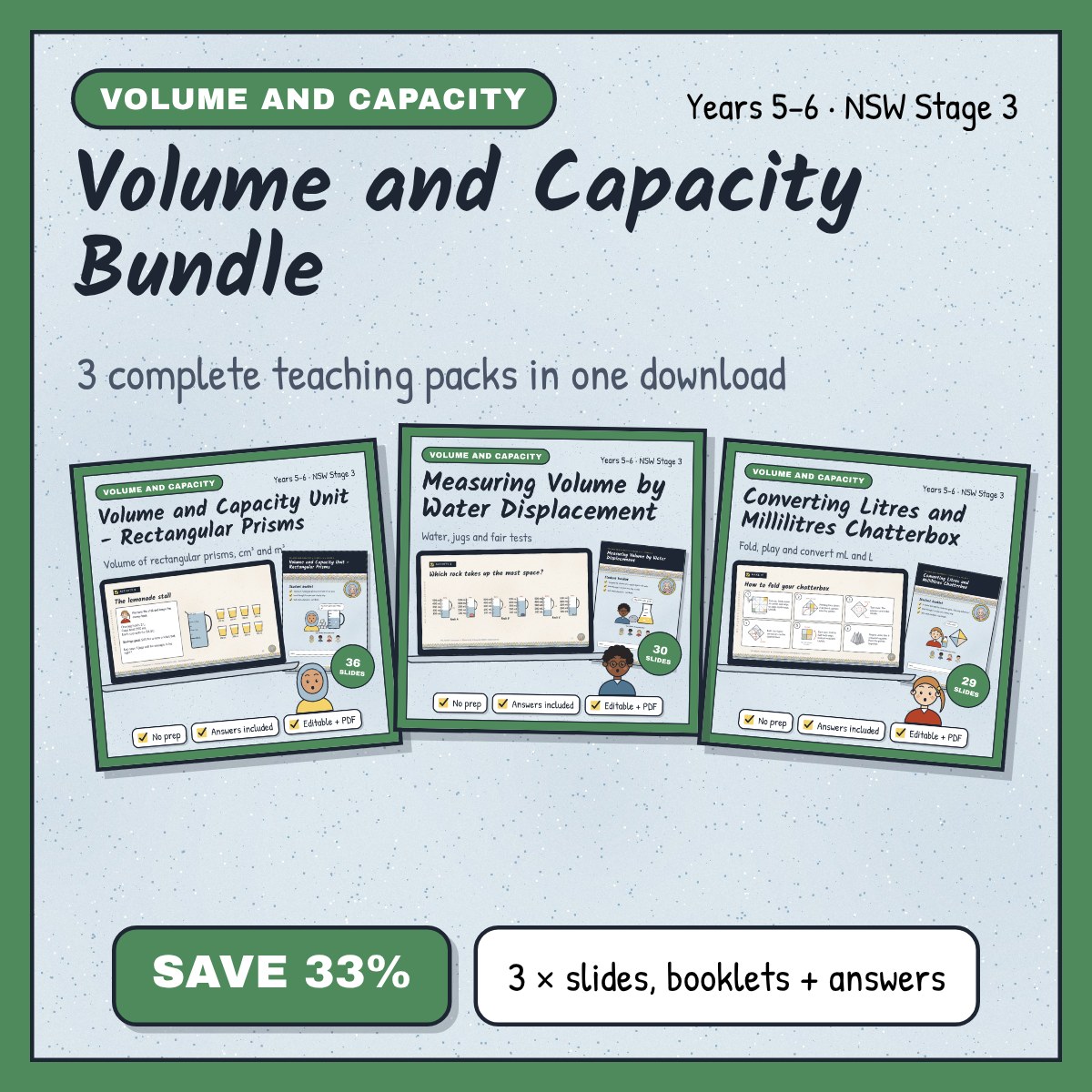
For more practice, the Converting Litres and Millilitres Chatterbox has students fold a chatterbox, play it with a partner and record their answers.
Volume of rectangular prisms
Before any formula, students should build. Give them cubic-centimetre blocks (or connecting cubes) and ask them to make a prism and describe it in layers. The syllabus example makes a good sentence starter: 5 layers of 8 cubic-centimetre blocks, where each layer is 4 rows of 2 blocks.
The big idea is the link between the number of cubes in one layer and the number of layers. The syllabus asks students to record the method in words, for example: volume of rectangular prism = number of cubes in one layer × number of layers. Plenty of them get to length × width × height on their own, which is fine if they can tell you why it works.
With drawn prisms, the common mistake is counting only the cubes you can see. A 3 × 2 × 2 prism drawn on paper gets an answer of 10 instead of 12. Building it and pulling it apart one layer at a time fixes this faster than explaining.
Then try the syllabus example of constructing volumes of 24 cubes. How many different rectangular prisms can you make with exactly 24? There are six: 1 × 1 × 24, 1 × 2 × 12, 1 × 3 × 8, 1 × 4 × 6, 2 × 2 × 6 and 2 × 3 × 4. Students see that prisms with the same volume can have different dimensions and look nothing alike.
One small thing: NESA's teaching advice says m³ is read as "cubic metres", not "metres cubed", and cubic centimetres are written cm³, not "cc".
The Volume and Capacity Unit goes in this order, from units and reading jugs to decimal capacities, layers of cubes and the 24 cm³ prisms.
The cubic metre
Ask how many centicubes it would take to fill the classroom. Millions. Now students can see why a bigger unit is needed.
Build one with twelve metre rulers and masking tape. Fit as many students inside the frame as you safely can, then ask them to name things bigger and smaller than a cubic metre: a fridge, the teacher's desk, the school bus.
Then estimate and calculate the volume of the classroom. If it's 8 m long, 7 m wide and 3 m high, one layer of cubic metres on the floor is 8 × 7 = 56, and there are 3 layers, so the volume is 168 m³.
Displacement
Part A asks students to recognise that an object's volume takes up space by watching the water level change, and to compare the volumes of two or more objects by marking the change in water level when each is submerged.
Start with a clear container, a rock and a whiteboard marker. Mark the level, lower the rock in, mark it again, then repeat with a second rock. The one that pushes the water up further takes up more space.
With measuring jugs, two problems come up. The first is the scale. If there are 5 spaces between 300 mL and 400 mL, each mark is 20 mL, but lots of students count every mark as 1 or 10. Get them to work out what one mark stands for before they read anything. The second is writing the "after" reading as the answer, when the change is after minus before. Talk about a fair test as well: the same jug, the same starting level, the object fully under the water.
The Measuring Volume by Water Displacement investigation has jug-reading practice, two investigations (your fist, and three irregular objects) and a class column graph.
Keep one idea for the extension box: 1 mL of water takes up 1 cm³. It's what turns a rise in water level into a volume in cubic centimetres, but 1 mL = 1 cm³ is Stage 4, along with 1 m³ = 1000 L = 1 kL. In Stage 3, displacement is for comparing.
Resources that go with this post
- Volume and Capacity Unit: Rectangular Prisms: units, reading jugs, decimal capacities, layers of cubes, the cubic metre and a memory game.
- Measuring Volume by Water Displacement: jug scales, comparing rocks, two investigations, a class column graph and a case file.
- Converting Litres and Millilitres Chatterbox: conversion practice, comparing capacities and three chatterboxes (the third is a Stage 4 extension).
- Volume and Capacity Bundle: all three together.