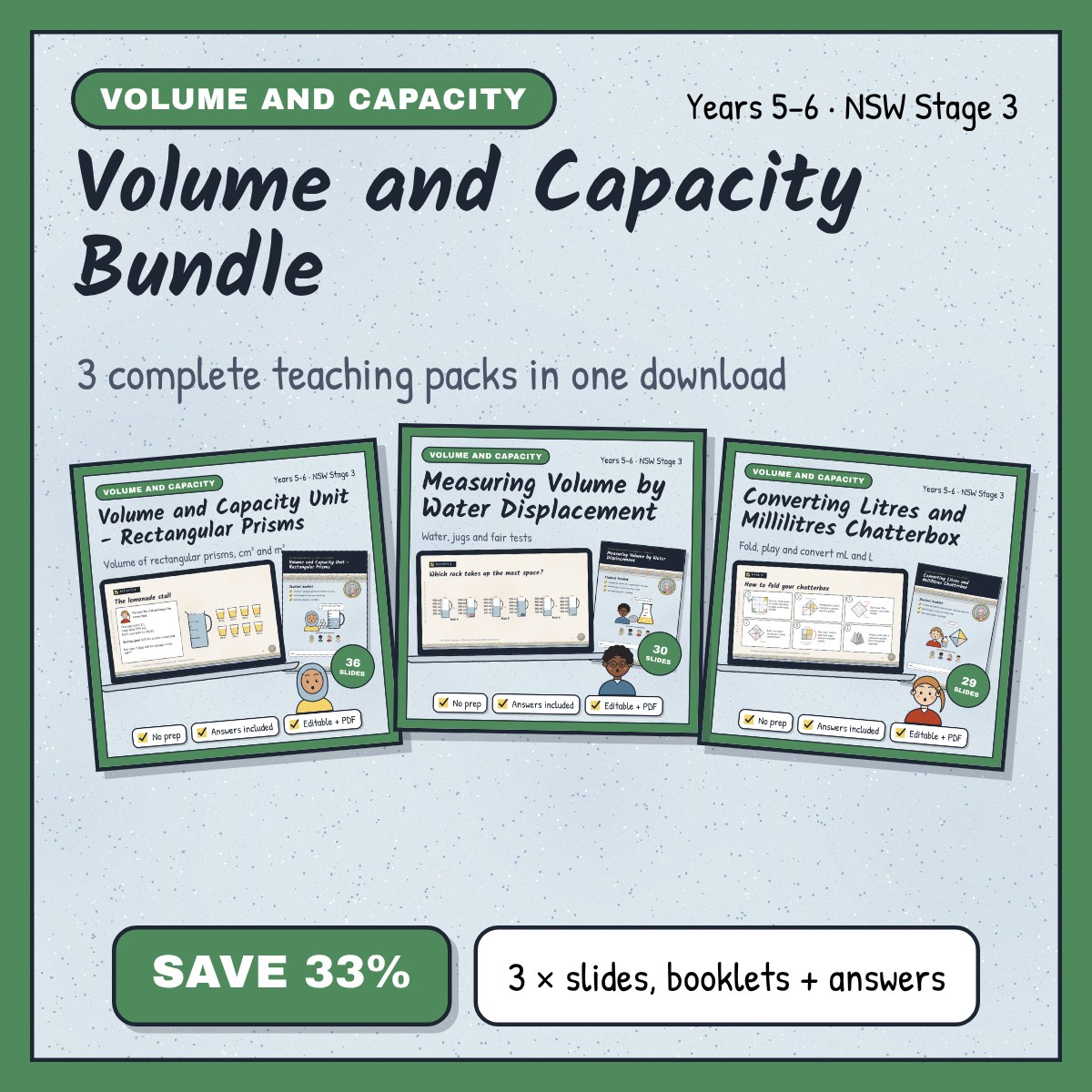
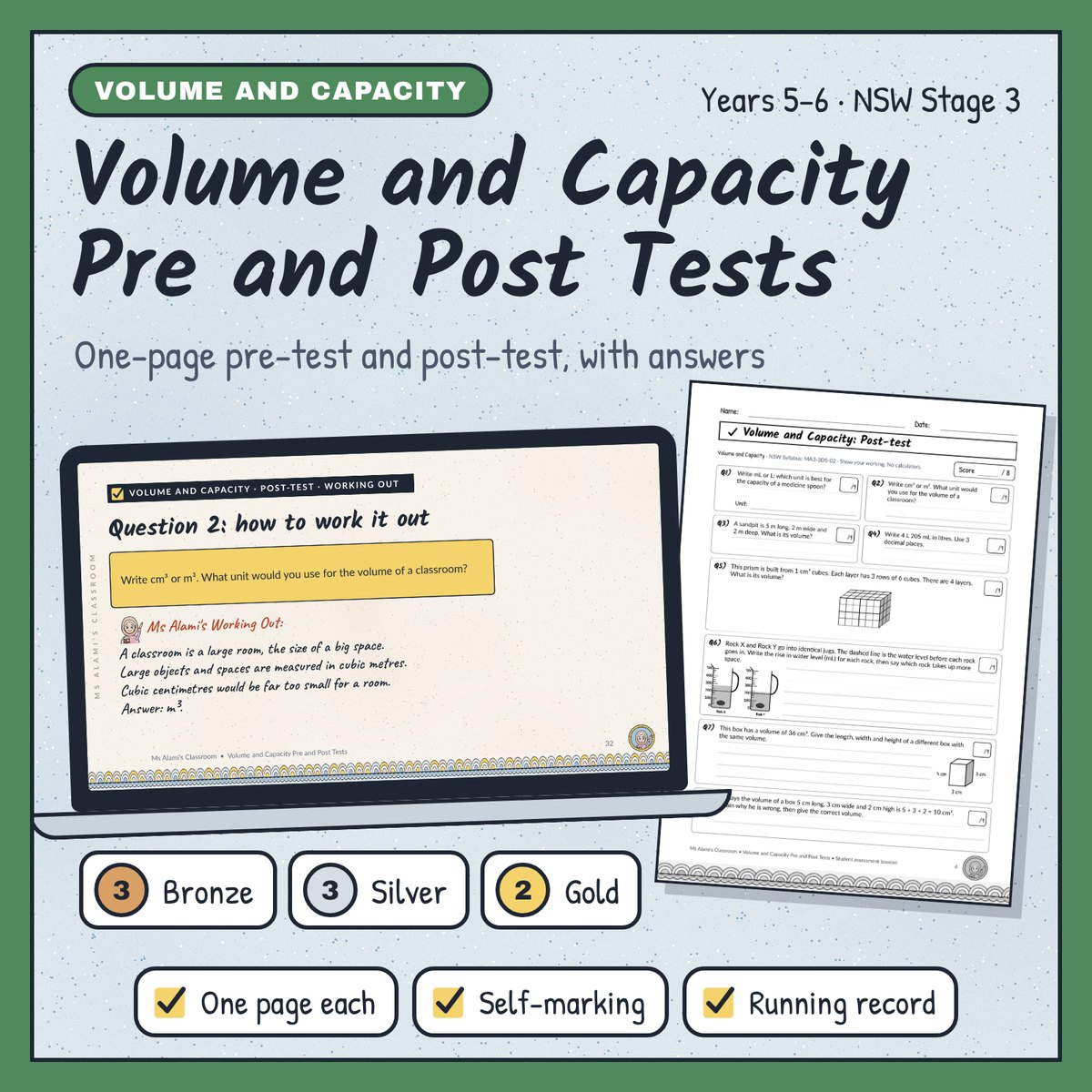
Volume makes more sense when students have cubes, jugs and water in front of them. In these three packs they build prisms from centicubes, drop rocks into measuring jugs and fold chatterboxes to convert mL and L.
How it runs
Teach the unit first, then use the investigation and the chatterbox to apply and practise. Together they give you 95 teacher slides and 47 booklet pages.
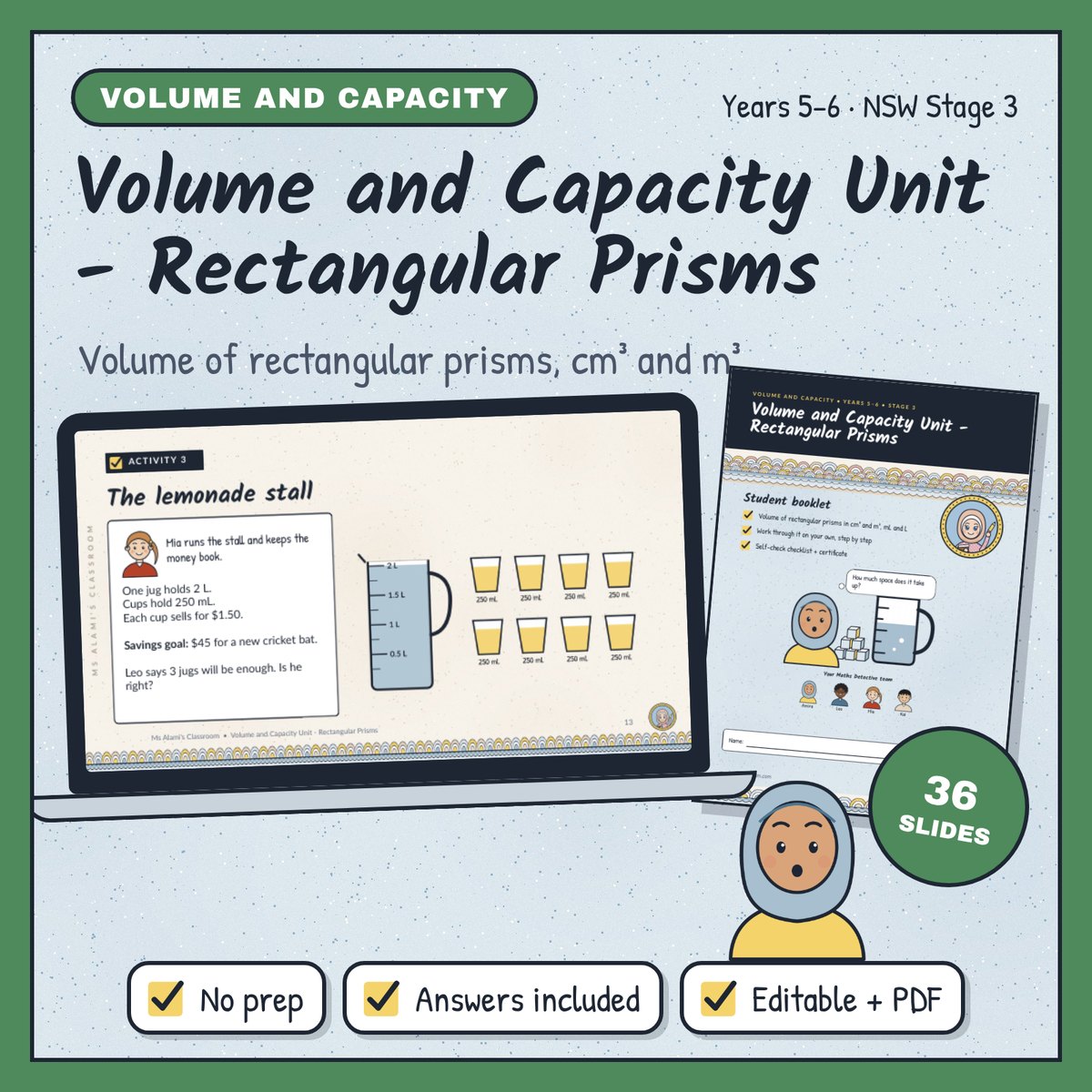
- Volume and Capacity Unit: Rectangular Prisms: volume vs capacity, decimal capacities, layers of cubes, cm³ and m³, a pre-test and a memory game (36 slides, 17 pages).
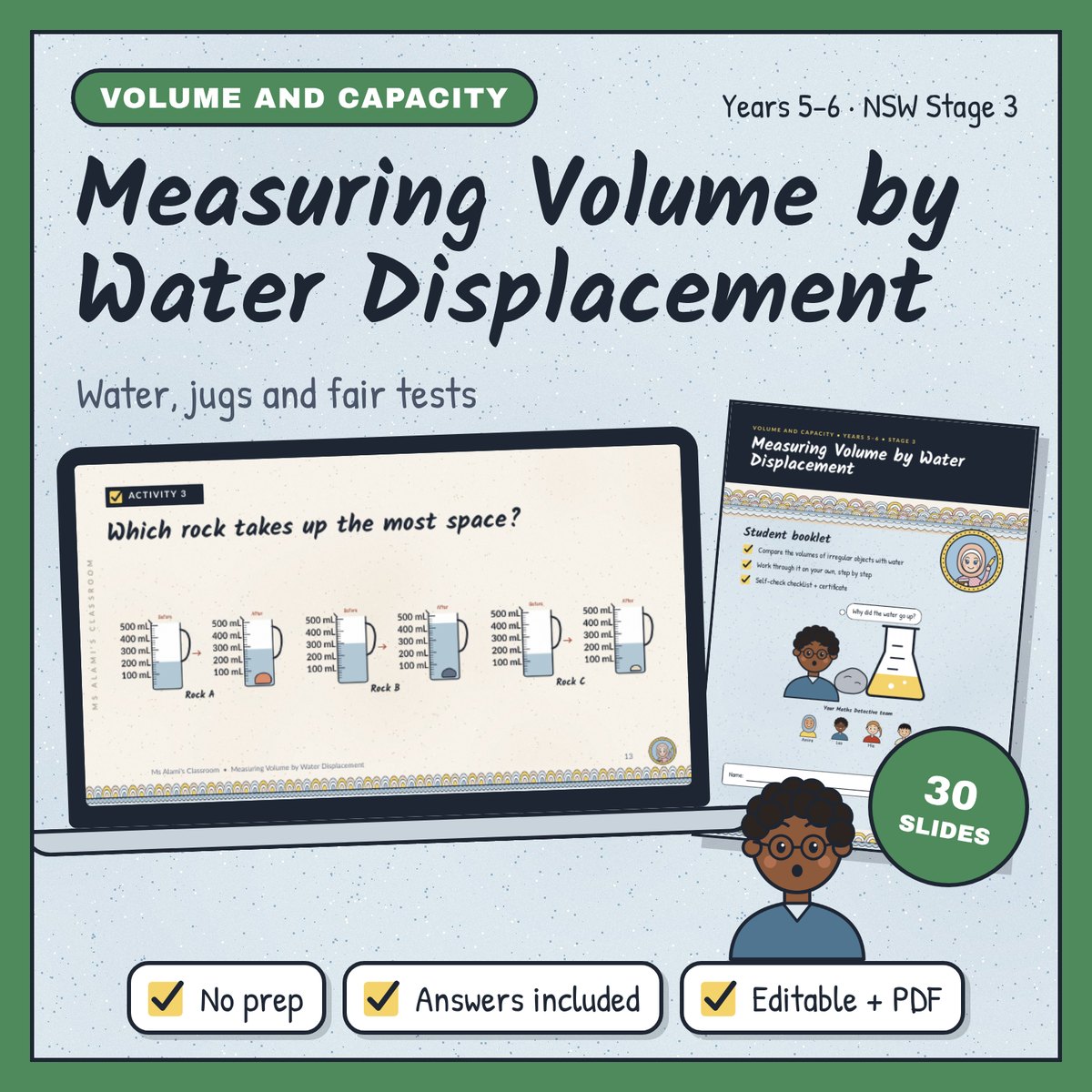
- Measuring Volume by Water Displacement: compare the volumes of irregular objects by the change in water level, with two investigations and a class column graph (30 slides, 14 pages).
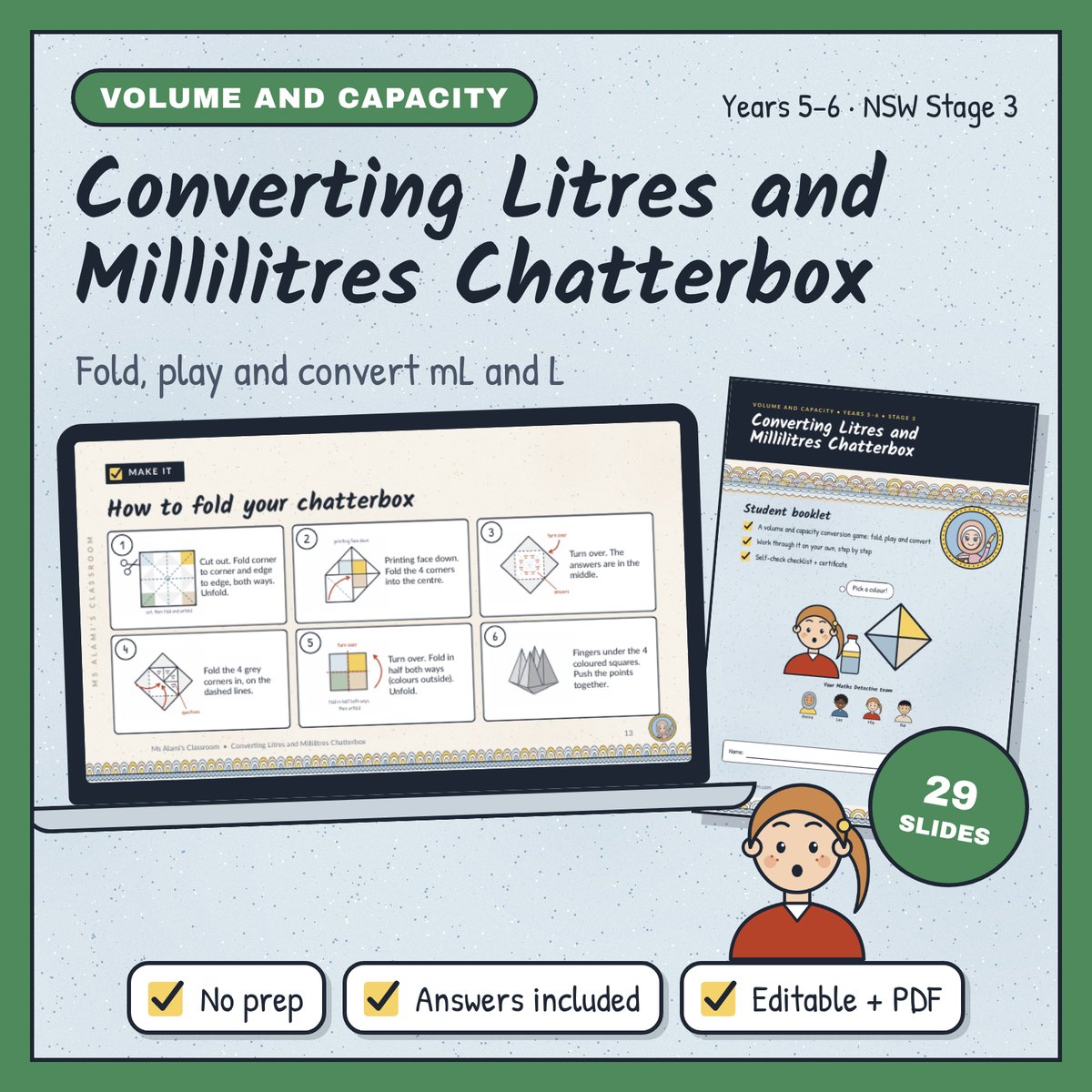
- Converting Litres and Millilitres Chatterbox: fold and play chatterboxes to convert mL and L, including decimals to 3 places (29 slides, 16 pages).
Maths covered
- MA3-3DS-02: choose units, read capacity scales, convert between mL and decimal litres, compare volumes by displacement, and estimate and calculate volumes in cm³ and m³
- MA3-MR-01: multiply the cubes in one layer by the number of layers to find volume
- Links to MA3-DATA-01 (column graph of class results) and MA3-RN-02 (ordering decimals)
- Extension (Stage 4): 1 mL = 1 cm³ and 1 L = 1000 cm³ appear only in clearly labelled boxes and a separate Extension chatterbox (MA4-VOL-C-01)
Good to know
- One download. Every pack has its own teacher slides with answers, colour and black and white booklets, editable PowerPoint booklets, a lesson plan, a detective case file, a "How did I go?" self-assessment page, a certificate, the Maths Detectives and Keynote fonts.
- The three packs cost $15 separately. The bundle is $10, a 33% saving.