
Write 17:00 on the board and ask what time it is. Someone will say “seven o’clock”. Then ask what 12:15 am looks like in 24-hour time. Half the class will write 12:15, which is lunchtime. Those two mistakes are the whole topic in a nutshell, so start there.
Why we have 24-hour time
An analogue clock goes around twice a day, so 7:15 could be breakfast or dinner. The NSW syllabus asks students to recognise that 24-hour time is used to avoid confusion between am and pm (MA3-NSM-02). Train timetables, flight boards, hospitals and the oven’s timer all use it for the same reason: nobody can mix up 07:15 and 19:15.
How to say it
Students should read 24-hour time aloud the way a train driver would:
- 07:05 is “oh seven oh five”
- 19:00 is “nineteen hundred” (or “nineteen hundred hours”)
- 21:45 is “twenty-one forty-five”
Saying it aloud helps, because “twenty-one” sounds nothing like “eleven”.
The two rules
12-hour to 24-hour
- am times keep their hour, with a 0 in front if needed: 7:40 am is 07:40.
- pm times add 12 to the hour: 3:25 pm is 15:25.
- The exceptions are the twelves. 12:35 am is just after midnight, so it is 00:35. 12:45 pm is just after midday, so it stays 12:45.
24-hour to 12-hour
- 00 to 11 are am. 00 becomes 12, so 00:05 is 12:05 am.
- 12 is pm: 12:30 is 12:30 pm.
- 13 to 23: take away 12 and write pm. 23:10 is 11:10 pm.
The classic slip is taking away 10 instead of 12, so 21:00 becomes “11 pm”. Ask students to check with the clock face: 21 is nine hours after midday.
Practice questions with answers
Write in 24-hour time.
- 7:40 am: 07:40
- 3:25 pm: 15:25
- 12:35 am: 00:35
- 8:50 pm: 20:50
- 12:45 pm: 12:45
Write in 12-hour time.
- 23:10: 11:10 pm
- 18:00: 6:00 pm
- 00:05: 12:05 am
- 13:30: 1:30 pm
- 09:55: 9:55 am
Timetable question
- The school bus leaves Banksia Park at 15:48 and reaches the station at 16:22. How long is the trip? 34 minutes (12 minutes to 16:00, then 22 more).
Using real timetables
The syllabus also asks students to read, interpret and use timetables from real-life situations, involving 12- and 24-hour time. Print your local train or bus timetable and ask:
- Which is the last train you could catch to be home by 6:00 pm?
- Which trains leave in the afternoon?
- Is the express faster? By how many minutes?
Questions like these make students convert both ways without being told to.
Mistakes to watch for
- Taking away 10 instead of 12 (21:00 becomes 11 pm).
- Writing 12:15 am as 12:15.
- Dropping the zero, so 07:05 becomes 7:05 with no am or pm.
- Reading an analogue clock and guessing am or pm without the context.
Resources that go with this post
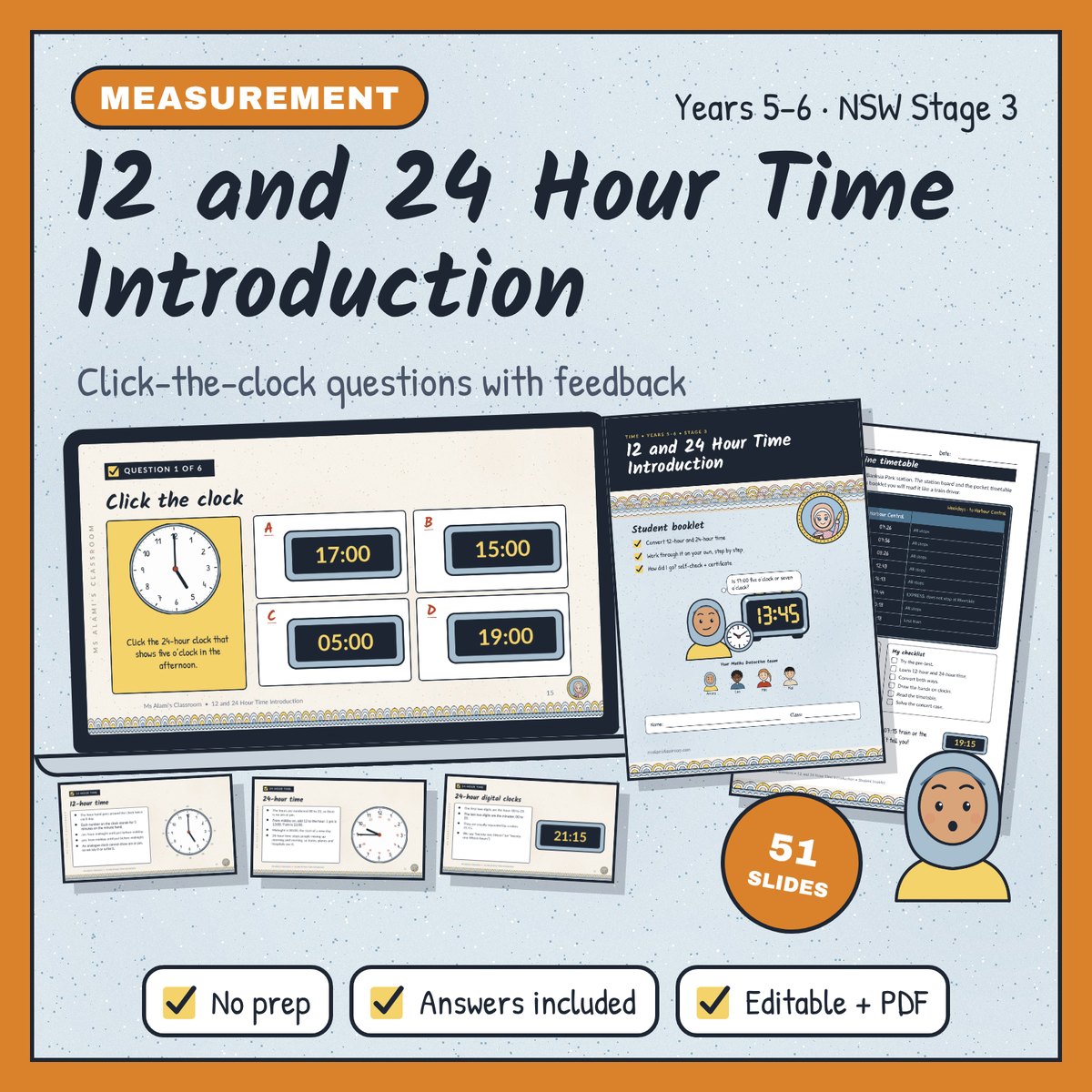
12 and 24 Hour Time has six clickable click-the-clock questions with worked feedback, the Banksia Line train timetable, a peak and off-peak fares task, a Detective check where students mark the detectives’ conversions right or wrong, and Bronze, Silver and Gold levels. It is also in the Time Unit Bundle with elapsed time, a Millionaire game and a time zones investigation.