
Give a Year 5 class this problem and count how many subtract: The school library has 4528 books. It has 863 fewer books than the town library. How many books does the town library have? The word “fewer” looks like a subtraction clue. But the school library is the one with fewer, so the town library has more: 4528 + 863 = 5391. Word problems are less about adding and subtracting and more about reading carefully.
What the NSW syllabus asks for
Under MA3-AR-01, Stage 3 students select and apply strategies to solve addition and subtraction problems, including multistep problems and problems with money. They estimate to check that an answer is reasonable and use the inverse operation to check their working. By Year 6 the numbers go well past four digits, and money has two decimal places.
Six detective steps
These are the steps my class uses for every word problem.
- Read the problem twice. What is the question actually asking?
- Find the clues. Underline the numbers you need and cross out the ones you don’t.
- Choose the operation. Altogether and in all often mean add; left, change and how many more often mean subtract. Then check the clue word against the story.
- Estimate. Round the numbers to get a rough answer first.
- Solve with a strategy: a jump, split, compensating or the written method.
- Check. Is your answer close to the estimate? Use the inverse operation.
The three traps to teach
- Clue words that point the wrong way. “Fewer than” and “less than” can mean you add, as in the library problem.
- Extra information. Students want to use every number. Teach them to cross out what the question doesn’t need.
- Working backwards. When the story gives you the end and asks for the start, use the inverse.
Word problems with answers
1. The school library has 4528 books. It has 863 fewer books than the town library. How many books does the town library have?
The school library has fewer, so the town library has more. 4528 + 863 = 5391 books. Estimate: 4500 + 900 = 5400 ✓
2. A netball club raised $1460 at a sausage sizzle and $875 at a trivia night. It spent $315 on new bibs. How much money is left?
Raised: $1460 + $875 = $2335. Left: $2335 − $315 = $2020.
3. Zara read 286 pages in Term 1 and 347 pages in Term 2. She also borrowed 9 audiobooks. How many pages did she read in the two terms?
The audiobooks are extra information. 286 + 347 = 633 pages.
4. After spending $48.75 on a scooter helmet, Ben had $63.40 left. How much did he have before?
Work backwards: put the $48.75 back. $63.40 + $48.75 = $112.15.
5. A stadium holds 42,500 people. 38,764 tickets have been sold. How many tickets are left?
42,500 − 38,764 = 3736 tickets. Check: 38,764 + 3736 = 42,500 ✓
6. A bakery made 640 bread rolls. It sold 385 in the morning and 172 in the afternoon. How many rolls are left?
Sold: 385 + 172 = 557. Left: 640 − 557 = 83 rolls.
7. Mount Kosciuszko is 2228 m high. Mount Everest is 8849 m high. How much higher is Mount Everest?
“How much higher” means find the difference. 8849 − 2228 = 6621 m.
8. Tom bought a book for $12.95 and a pen for $3.80. He paid with a $20 note. How much change did he get?
Spent: $12.95 + $3.80 = $16.75. Change: $20.00 − $16.75 = $3.25.
Turn it into a game
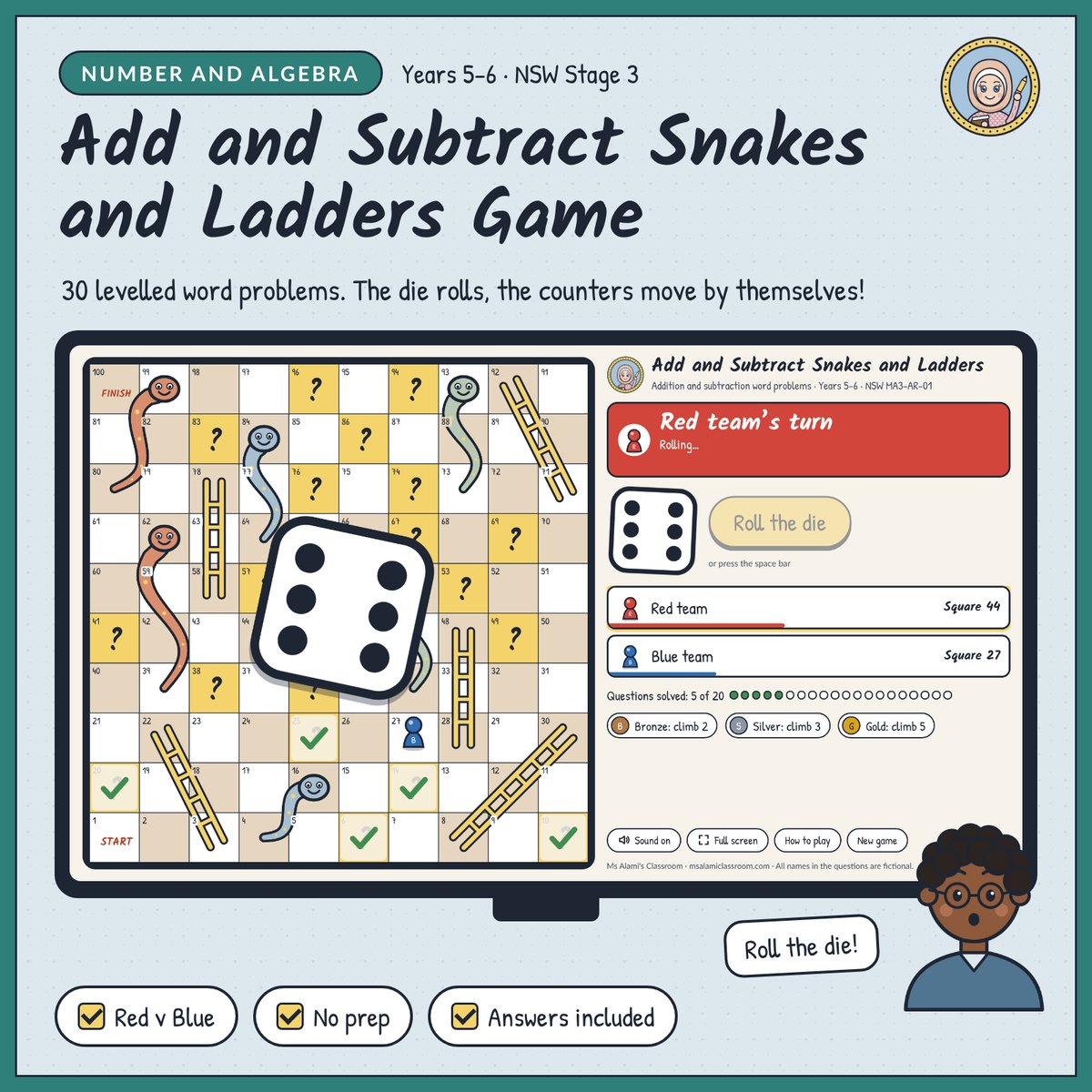
Word problems stick when students want to solve them. In my class we play snakes and ladders where every ? square is a word problem. The team picks a level (Bronze climbs 2 squares, Silver 3 and Gold 5), everyone solves it on a mini whiteboard, and a right answer climbs. A wrong answer gets a hint and one more try. The game does the counting, so the talk stays on the maths: why did you add? What did you cross out? How do you know it’s right?
Resources that go with this post
- Addition and Subtraction Word Problems Game: Snakes and Ladders: the game, 30 levelled word problems, printable task cards, a student booklet and teacher slides.