
If you tell a Year 6 class that the area of a triangle is "base times height divided by two", most of them will remember it until the test. If they cut a triangle out, copy it, turn the copy around and see a parallelogram, they will remember why. That is the approach the NSW syllabus asks for.
What the NSW syllabus asks for
In Two-dimensional spatial structure B (outcome MA3-2DS-03), students:
- show how to transform a parallelogram into a rectangle to find its area
- record, in words, a method for finding the area of any parallelogram
- investigate the area of a triangle by comparing it with a parallelogram with the same base and height
- establish that a triangle is half of the parallelogram made by duplicating and rotating it
- record, in words, a method for finding the area of any triangle
Writing these as formulas with letters (A = bh, A = ½bh) is Stage 4. In Stage 3 the methods are written in words.
Parallelograms: cut and slide
Give each student a parallelogram on grid paper. They draw the height from one top corner straight down to the base, cut along it, and slide the triangle to the other end. Now it is a rectangle with the same base and the same height, and nothing has been added or lost.
In words: the area of a parallelogram is its base times its perpendicular height.
The trap is the slanted side. A parallelogram with a base of 8 m, a slanted side of 5 m and a perpendicular height of 3 m has an area of 8 × 3 = 24 m². The 5 m is not needed. I ask students "which number did you not use?" on every parallelogram question.
Triangles: copy and turn
Students cut out a triangle, trace a copy, cut that out too, and turn the copy around. The two triangles fit together to make a parallelogram with the same base and the same perpendicular height. So the triangle is half of it.
In words: the area of a triangle is half of its base times its perpendicular height.
Try it with a right-angled triangle, an acute triangle and an obtuse triangle. It works every time, and seeing it work for the obtuse one is what convinces students.
Real-life examples
- A sail is a triangle. A right-angled sail with a base of 3 m and a height of 6 m needs 3 × 6 ÷ 2 = 9 m² of sailcloth.
- Roof gables, ramps and road signs are triangles.
- Slanted shelves and some paving bricks are parallelograms.
Practice questions
- A parallelogram has a base of 6 cm and a perpendicular height of 4 cm. What is its area?
- A triangle has a base of 10 cm and a perpendicular height of 6 cm. What is its area?
- Leo says a triangle with a base of 8 cm and a height of 5 cm has an area of 40 cm². What did he forget?
- A garden path is a parallelogram with a base of 6 m and a perpendicular height of 1 m. Its slanted side is longer than 1 m. What is its area?
Answers: 1) 24 cm² 2) 30 cm² 3) He forgot to halve it: 8 × 5 ÷ 2 = 20 cm² 4) 6 m²
Resource that goes with this post
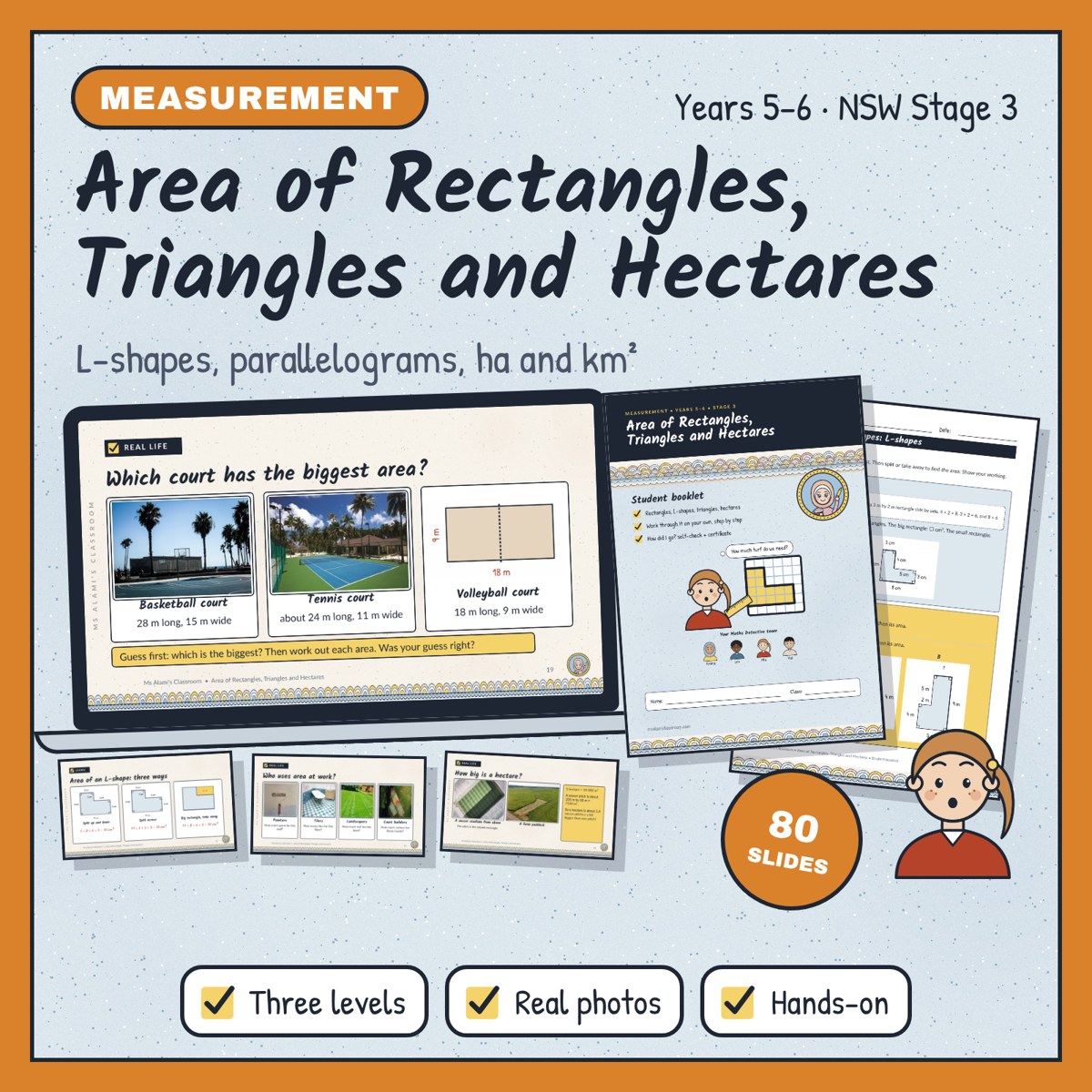
Area of Rectangles, Triangles and Hectares has cut-and-slide and copy-and-turn lessons, L-shapes three ways, hectares and square kilometres, real-life photo slides, a Kai's check and Bronze, Silver and Gold questions on every activity. It is also in the Length and Area Bundle.