
Every year a student asks why their cousin in Perth is still eating breakfast when it is morning tea in Sydney. That question is the start of a great investigation, as long as students are already confident with 24-hour time and elapsed time.
A note before you plan: time zones and daylight saving are not in the NSW 2022 Stage 3 maths syllabus (they were in the old Stage 4 content). Use them as an extension or a cross-curriculum project that practises Stage 3 time skills (MA3-NSM-02) in a real context.
Why the Earth has time zones
The Earth turns once every 24 hours, so the sun is overhead at different times in different places. Countries keep clocks close to the sun by using time zones, measured from Coordinated Universal Time (UTC). Places to the east are ahead; places to the west are behind.
Australia’s three standard time zones
- Australian Eastern Standard Time (UTC+10): NSW, the ACT, Victoria, Tasmania and Queensland
- Australian Central Standard Time (UTC+9:30): South Australia and the Northern Territory
- Australian Western Standard Time (UTC+8): Western Australia
A fun fact for the class: Broken Hill is in New South Wales but uses Central time, like South Australia.
Daylight saving 2026–27
NSW, Victoria, Tasmania, the ACT and South Australia move their clocks forward one hour from Sunday 4 October 2026 to Sunday 4 April 2027. Queensland, the Northern Territory and Western Australia don’t. So in summer Australia has five different times instead of three.
Practice questions with answers
It is midday in Sydney in June (no daylight saving). What time is it in:
- Perth? 10:00 am
- Adelaide? 11:30 am
- Brisbane? 12:00 pm
- Darwin? 11:30 am
It is midday in Sydney in December (daylight saving). What time is it in:
- Perth? 9:00 am
- Adelaide? 11:30 am (Adelaide moves forward too, so the gap stays half an hour)
- Brisbane? 11:00 am
- Darwin? 10:30 am
- Why is the Sydney–Brisbane difference 0 hours in June but 1 hour in December? NSW uses daylight saving and Queensland does not.
Questions that build Stage 3 skills
- A flight leaves Sydney at 14:20 and lands in Perth 5 h 10 min later. What time is it in Perth (June)? 14:20 + 5 h 10 min = 19:30 Sydney time, which is 17:30 in Perth.
- Plan a video call with a class in another time zone that happens during both schools’ hours.
These use elapsed time, 24-hour time and bridging, which are all Stage 3.
Resources that go with this post
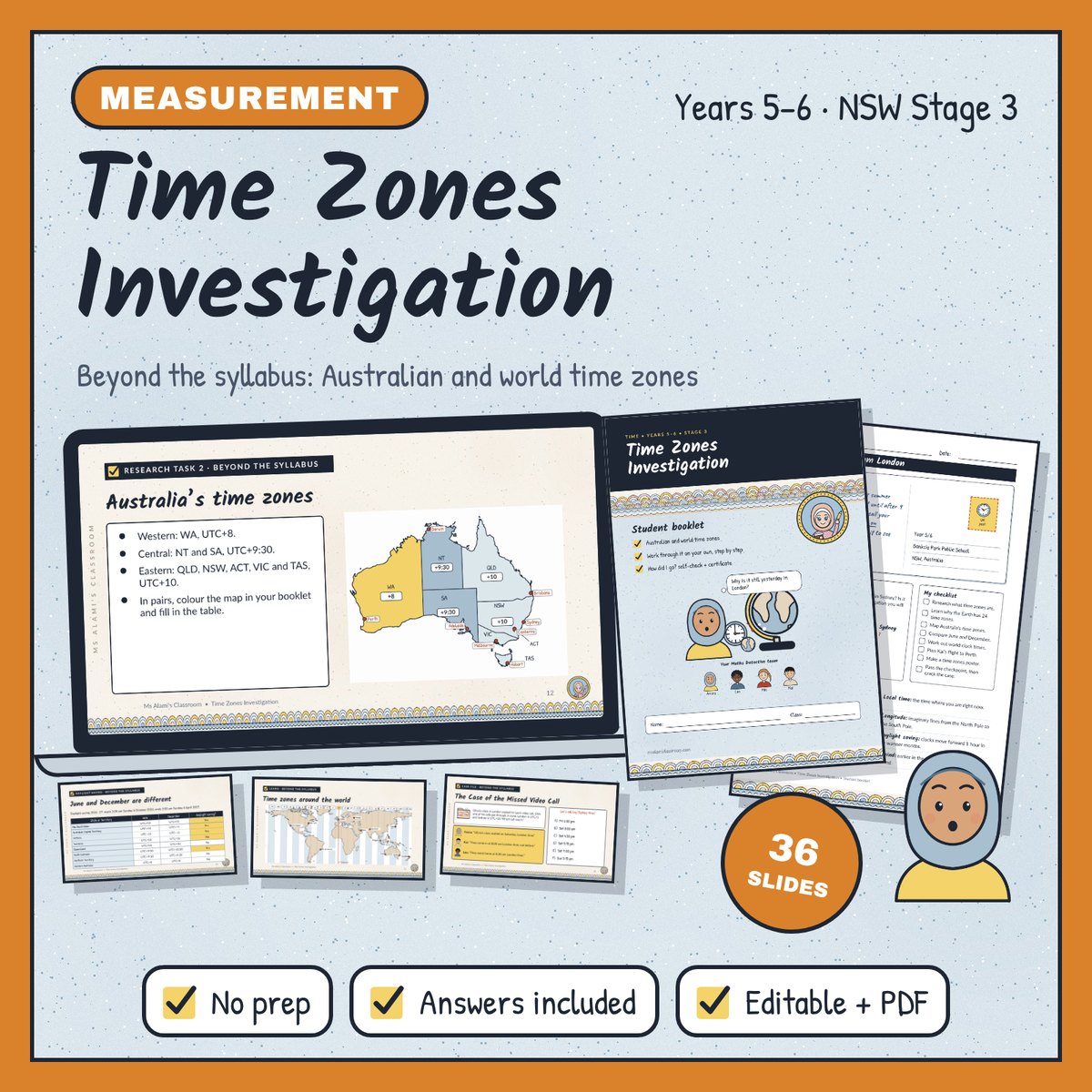
The Time Zones Investigation has research tasks, original maps of Australia’s and the world’s time zones, the 2026 daylight saving dates, world clocks, Kai’s flight to Perth with a savings goal and a case file, all clearly marked “beyond the syllabus”. Teach 12 and 24 Hour Time and Elapsed Time first, or get all four packs in the Time Unit Bundle.