
A student once told me a 3 m ribbon cut into 25 cm pieces makes "about 8" pieces. She had divided 3 by 25 and then guessed. Change the 3 m into 300 cm first and the answer, 12 pieces, is easy. Most length mistakes in Years 5 and 6 come from working with two different units at once.
The facts students need
- 10 mm = 1 cm
- 100 cm = 1 m
- 1000 m = 1 km
When you change a bigger unit into a smaller one, there are more of them, so you multiply. When you change a smaller unit into a bigger one, there are fewer, so you divide. I ask students to say it out loud: "Smaller units, more of them."
This is part of NSW outcome MA3-GM-02, which asks students to convert between common metric units of length, interpret and record decimal lengths, and convert to the same unit to compare.
Decimal lengths
1.6 m means 1 metre and 60 centimetres, because the 6 is in the tenths place and a tenth of a metre is 10 cm. The common mistake is writing 3 m 4 cm as 3.4 m. It is 3.04 m, because 4 cm is four hundredths of a metre.
A tape measure is the best tool for this. Have students measure each other's height in centimetres, then write it in metres: 145 cm = 1.45 m. Line the class up from shortest to tallest using the metre values.
Hands-on activities
- Make 1 km real. Walk 100 m with a trundle wheel and count your paces. Ten of those is a kilometre. A 400 m running track is 2.5 laps to 1 km.
- Standing long jump. Jump from a line, measure to the back heel in centimetres, and write the jump in metres.
- Guess the length. Put a blue whale (more than 30 m), the Sydney Harbour Bridge (1149 m) and Uluru (about 3.6 km) in order, and say which unit suits each one.
- Read a road sign. Distances on Australian road signs are in kilometres, often with decimals. How many metres is 1.5 km?
Practice questions
- 2.75 m = ___ cm
- 4 m 8 cm = ___ m
- 0.08 km = ___ m
- 85 mm = ___ cm
- Order from shortest to longest: 1.2 km, 950 m, 1050 m
- A 3 m ribbon is cut into 25 cm pieces. How many pieces?
Answers: 1) 275 cm 2) 4.08 m 3) 80 m 4) 8.5 cm 5) 950 m, 1050 m, 1.2 km (1200 m) 6) 300 ÷ 25 = 12 pieces
From length to perimeter
Once students convert confidently, perimeter is the next step: the distance around a shape, with every side in the same unit. A rectangle 7 m by 3 m has a perimeter of 2 × (7 + 3) = 20 m. A common slip is adding only one length and one width, giving 10 m.
Resource that goes with this post
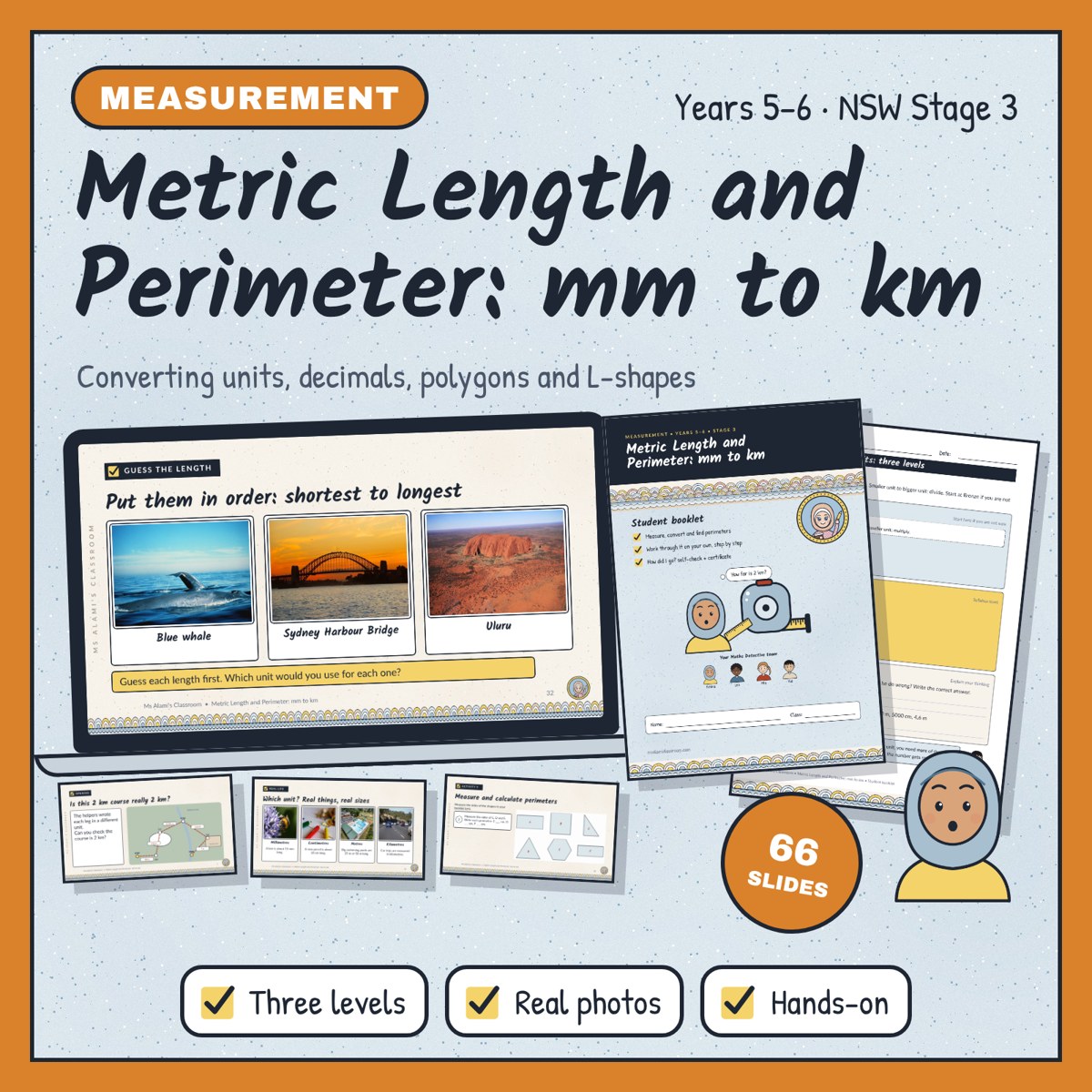
Metric Length and Perimeter has real-life photo slides, the fun-run course map, decimal lengths on a tape measure, hands-on measuring, perimeters of regular polygons and L-shapes, a Kai's check where students find the detectives' mistakes, and Bronze, Silver and Gold questions on every activity. It is also in the Length and Area Bundle.