
A minibus holds 8 people and 139 students are going on an excursion. Many Year 6 students will write 17 remainder 3 and stop. The school needs 18 minibuses. The division is the easy part. Deciding what the remainder means is the part that needs teaching.
What the NSW syllabus asks for
Under MA3-MR-01, students divide by one-digit numbers using multiplication facts and partitioning, estimate first, use and interpret remainders in word problems, and divide by two-digit numbers with a calculator. Written division by a two-digit divisor is not part of Stage 3.
The four things a remainder can mean
- Round up: the leftovers still need a place. 139 students, 8 per minibus: 18 minibuses.
- Round down: only full groups count. 75 cupcakes in boxes of 6: 12 full boxes, 3 cupcakes left over.
- The remainder is the answer: how many are left over? 75 cupcakes in boxes of 6: 3 left over.
- Share the remainder: split it into fractions or decimals. 9 pizzas shared by 4 friends: 2¼ pizzas each.
Dividing by partitioning
Split the number into parts that are easy to divide.
368 ÷ 4: 368 = 320 + 48. 320 ÷ 4 = 80 and 48 ÷ 4 = 12, so 368 ÷ 4 = 92.
517 ÷ 5: 517 = 500 + 17. 500 ÷ 5 = 100 and 17 ÷ 5 = 3 remainder 2, so 517 ÷ 5 = 103 remainder 2.
Check with the inverse: 103 × 5 = 515, and 515 + 2 = 517.
Word problems with answers
1. 139 students go on an excursion. Each minibus holds 8 students. How many minibuses are needed?
139 ÷ 8 = 17 remainder 3. 17 minibuses hold 136 students, so 3 students need another minibus. 18 minibuses.
2. A bakery packs 75 cupcakes into boxes of 6. How many full boxes are there?
75 ÷ 6 = 12 remainder 3. 12 full boxes, with 3 cupcakes left over.
3. A garden centre plants 250 seedlings in trays of 9. How many trays does it need?
250 ÷ 9 = 27 remainder 7. 27 trays hold 243 seedlings, so the last 7 need a tray too. 28 trays.
4. A 100 cm ribbon is cut into 7 cm pieces. How many pieces can be cut?
100 ÷ 7 = 14 remainder 2. 14 pieces, with 2 cm left over.
5. 4 friends share 9 pizzas equally. How much pizza does each friend get?
9 ÷ 4 = 2 remainder 1. The last pizza is cut into quarters. 2¼ pizzas each.
6. $95 is shared equally between 4 children. How much does each child get?
95 ÷ 4 = 23 remainder 3. The remaining $3 can be shared too: $3 ÷ 4 = $0.75. $23.75 each.
7. A school has 432 students in 6 equal teams. How many students are in each team?
432 = 420 + 12. 420 ÷ 6 = 70 and 12 ÷ 6 = 2. 72 students.
8. A school sets out 1000 chairs in rows of 24 for a concert. How many full rows are there? (Use a calculator.)
1000 ÷ 24 = 41.666… on a calculator, so there are 41 full rows. 41 × 24 = 984, so 16 chairs are left over.
9. Mia says 83 ÷ 9 = 8 remainder 11. What is wrong?
The remainder must be smaller than the divisor. 9 × 9 = 81, so 83 ÷ 9 = 9 remainder 2.
10. Why do 80 ÷ 4 and 40 ÷ 2 have the same answer?
Both numbers in 80 ÷ 4 have been halved to make 40 ÷ 2. Halving both numbers keeps the answer the same: 20.
Mistakes to watch for
- A remainder bigger than the divisor, as in question 9.
- Writing "r 3" with no thought about what the 3 means.
- Rounding down when the story needs rounding up (minibuses, trays, tables).
- Not checking with the inverse.
Resource that goes with this post
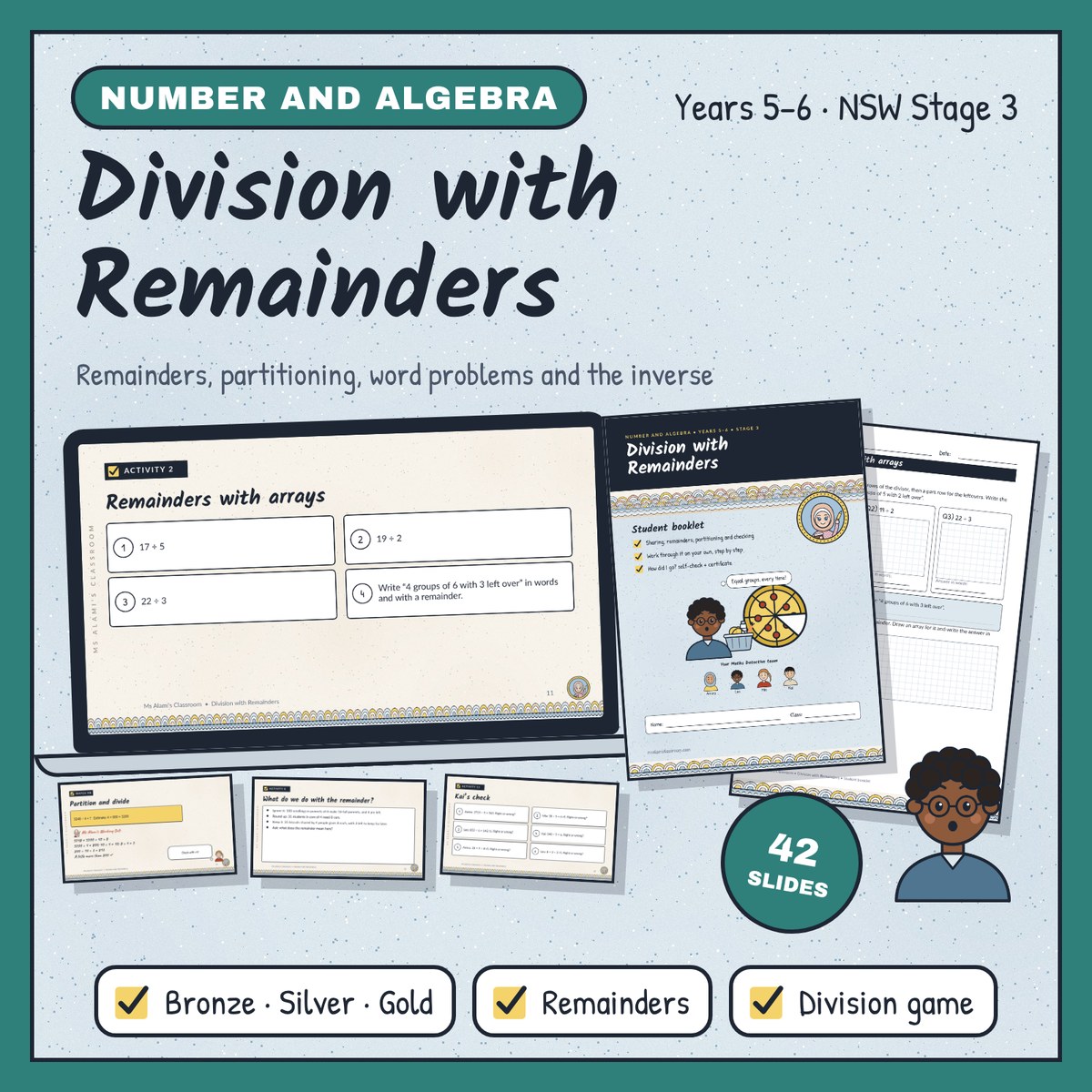
Division with Remainders has the garden centre seedling opening, arrays and fact families, partitioning, a full lesson on remainders in word problems, the Groups and Leftovers game and Bronze, Silver and Gold practice. Multiplication comes first in Multiplication, Factors and Prime Numbers, and both are in the Whole Number Unit Bundle.