The last week of October is a funny one in a Stage 3 classroom. Everyone is excited, a few costumes appear, and nobody wants to sit through a normal maths lesson. I still want real maths. A colour by number is how I get both.
The trouble with most Halloween colour by number sheets for older students is the maths. If it's 7 × 8 all the way down, Years 5 and 6 finish in ten minutes and learn nothing. So I built mine around a skill we actually need to practise in Term 4: converting units of mass.
Why mass works for colour by number
Converting grams, kilograms and tonnes has one clear answer, which is exactly what a colour by number needs. It also has plenty of room to make questions harder: whole numbers, then tenths, then up to three decimal places, then comparisons, then word problems. That means one topic can stretch across a whole class.
It covers MA3-NSM-01 (convert between units of mass and solve problems with different units) and MA3-RN-02 (compare decimals up to 3 decimal places), so it's not a filler lesson.
Three levels, three pictures
Each pack has three levels with their own questions and their own picture:
- Bronze (Beginner): 12 questions with whole numbers and tenths, easy comparisons and one-step word problems.
- Silver (Intermediate): 16 questions with tenths and hundredths and trickier comparisons using <, > and =.
- Gold (Expert): 20 questions up to 3 decimal places, with two-step word problems.
Because every level has a different picture, nobody can copy a neighbour's colours, and the finished pictures look great together on a wall. Every page has a small level badge, so you can hand out sheets without announcing who is on which level.
How I run it
Lesson 1: I start with a real object. Each pack opens with one: a bakery flour sack tag, a farmers' market pumpkin tag or a weighbridge ticket. We talk about what the numbers mean, then I model converting with a place value chart and do three worked examples (convert, compare and a word problem). Students start their level.
Lesson 2: students finish their questions and colour. When they're done, they check against the finished picture on the slides. If a part is the wrong colour, its answer tells them which question to look at again.
Lesson 3 (optional): fast finishers move up a level or try the More practice page, and we put the display up.
A tip for comparisons
The small parts of each picture are the <, > and = answers. Students find comparisons like 1.5 kg and 1050 g tricky because they look at the digits, not the size. I tell them to convert both to the same unit first, then compare. Once they've done it on paper, they rarely forget.
The pictures
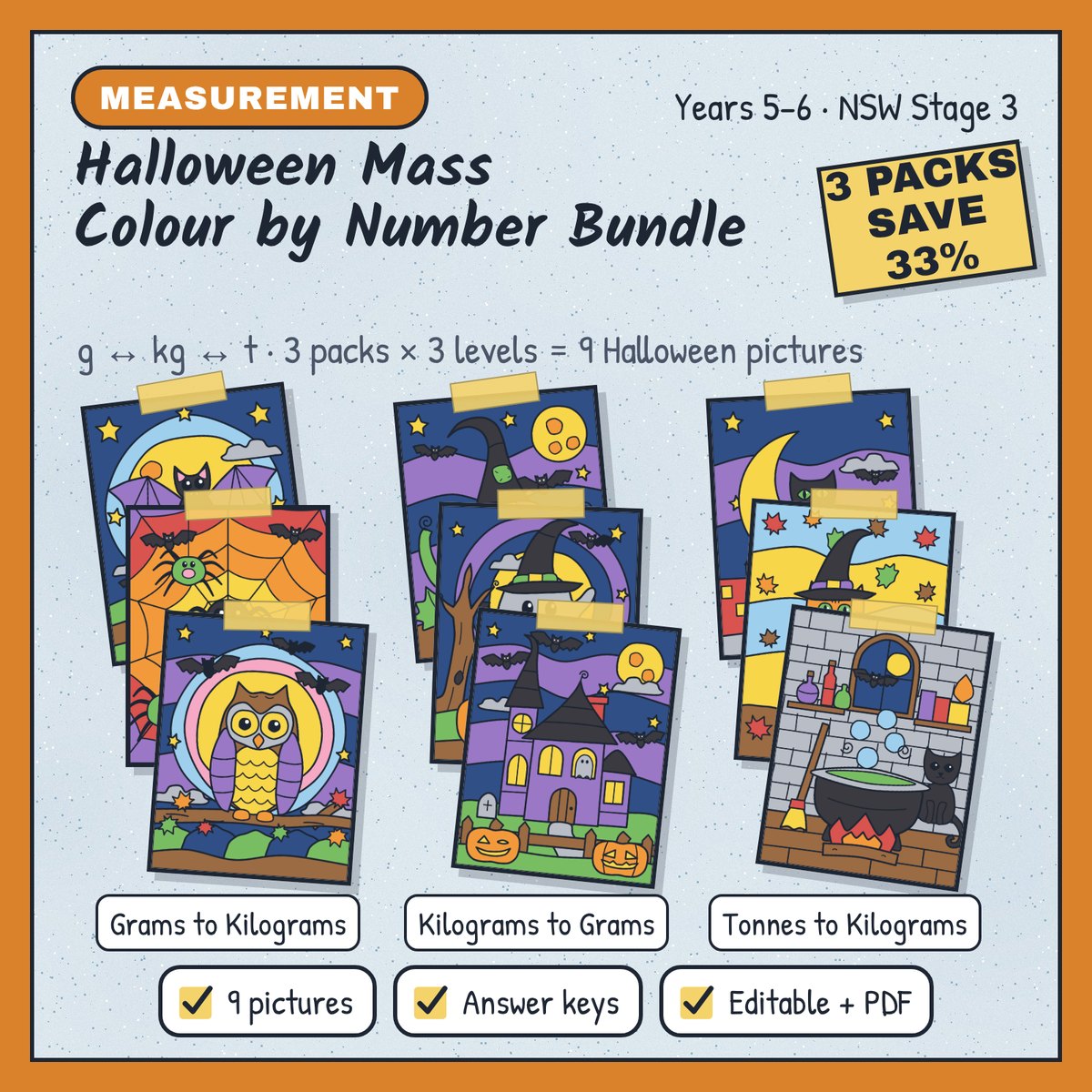
All nine pictures are original and friendly, not scary:
- Grams to Kilograms: a bat across the full moon, a spider family on a web and a wise owl.
- Kilograms to Grams Pumpkin: a jack-o'-lantern in a witch's hat, a friendly ghost and a haunted house.
- Tonnes to Kilograms: a black cat in the moon, a kitten in a witch's hat and a witch's kitchen.
Try it free first
If you'd like to see how it works before buying, the Halloween Mass Colour by Number Free Sampler has a Bronze worksheet with 12 brand-new questions and its own trick-or-treat lolly bag picture. It's a one-lesson activity you can print today.
Resources that go with this post
- Halloween Mass Colour by Number Bundle: all three packs, nine pictures, 144 questions.
- Halloween Mass Colour by Number Free Sampler: one free Bronze level.
- Metric Mass Introduction and Reading Scales: teach converting before the colouring.