
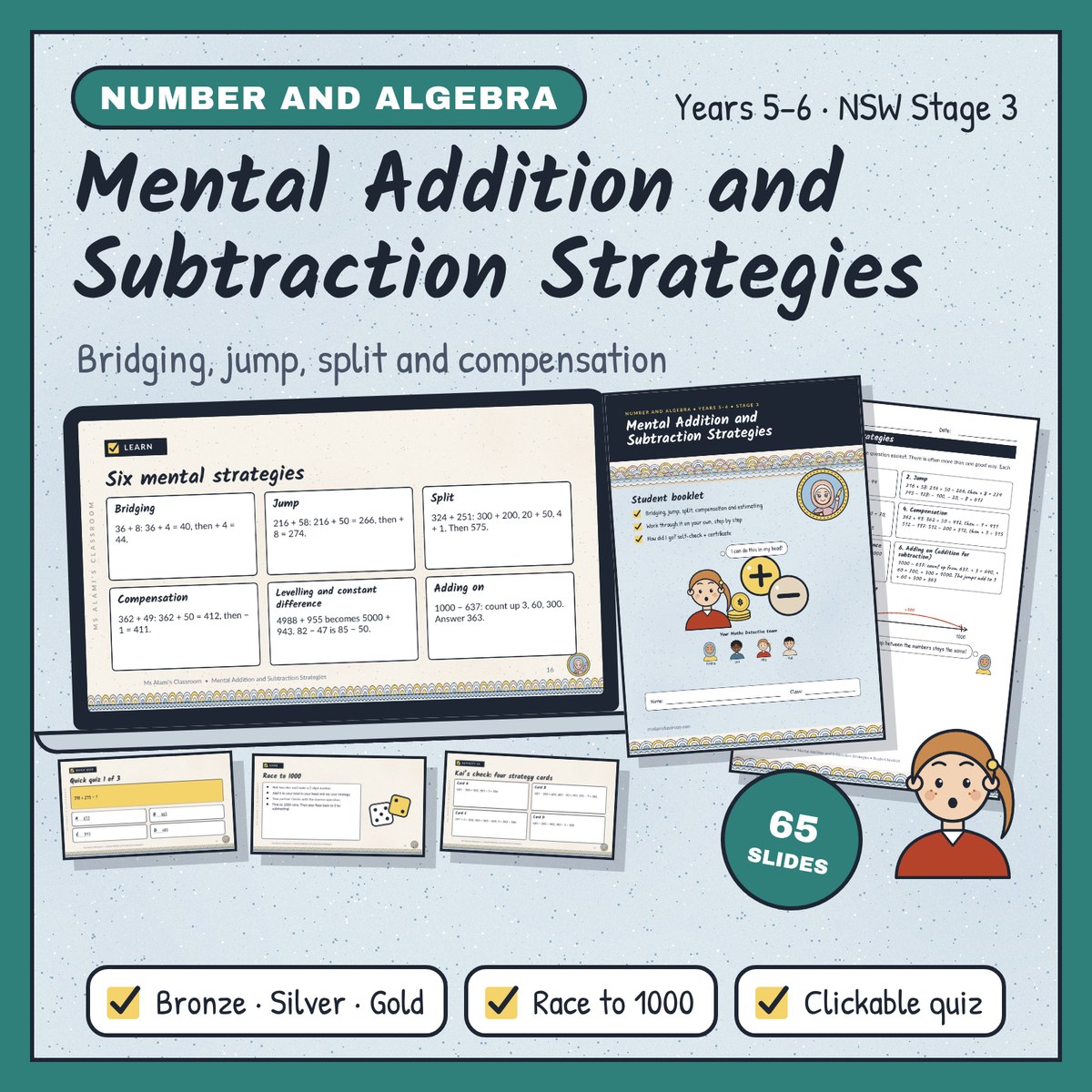
Give a Year 6 class 1000 − 637 and many students will set up a column subtraction, trade across two zeros and get it wrong. Adding on from 637 to 1000 takes a few seconds. The NSW syllabus asks students to choose efficient strategies, not just know a lot of them, so that is how I teach these.
The six strategies
1. Bridging through ten
Make a ten (or a hundred) first, then add the rest.
68 + 7: 68 + 2 = 70, then 70 + 5 = 75.
2. Jump
Keep the first number whole and jump along a number line in place value parts.
345 + 238: 345 + 200 = 545, 545 + 30 = 575, 575 + 8 = 583.
3. Split
Split both numbers into place value parts and add the parts.
345 + 238: 300 + 200 = 500, 40 + 30 = 70, 5 + 8 = 13. 500 + 70 + 13 = 583.
4. Compensation
Round one number to make it easy, then adjust.
458 + 199: 458 + 200 = 658, then take away 1 = 657.
724 − 298: 724 − 300 = 424, then add 2 back = 426.
5. Constant difference (levelling)
Add or subtract the same amount from both numbers. The difference stays the same, but the subtraction gets easier.
503 − 298: add 2 to both. 505 − 300 = 205.
6. Adding on
Count up from the smaller number to the larger one.
1000 − 637: 637 + 3 = 640, 640 + 60 = 700, 700 + 300 = 1000. 3 + 60 + 300 = 363.
Teach students to choose
After students know the strategies, give them a set of questions and ask which strategy is most efficient for each, and why. There is usually more than one good answer. What matters is that students can explain their choice.
- 2000 − 1996: adding on. 1996 + 4 = 2000, so the answer is 4.
- 367 + 298: compensation. 367 + 300 − 2 = 665.
- 6001 − 2999: constant difference. Add 1 to both: 6002 − 3000 = 3002.
- 1250 + 1250: doubling. Double 1250 is 2500.
Also ask when a calculator is more efficient. 48 372 + 19 865 + 7044 is a good time for a calculator or a written method, not mental maths.
Check with estimation and the inverse
Before calculating, round to estimate. After calculating, check with the inverse: if 1000 − 637 = 363, then 363 + 637 should be 1000.
Multistep word problems
A school bake sale raised $346 on Monday and $279 on Tuesday. The ingredients cost $185. How much profit did the bake sale make?
$346 + $279 = $625. $625 − $185 = $440. The profit was $440.
A library had 1200 books. It lent out 389 books and received 145 new books. How many books are on the shelves now?
1200 − 389 = 811 (adding on: 389 + 11 = 400, 400 + 800 = 1200). 811 + 145 = 956 books.
Mistakes to watch for
- Compensating in the wrong direction, such as 458 + 199 = 458 + 200 + 1.
- Using constant difference for addition. It only works for subtraction.
- Using the same strategy for every question, even when it is slow.
- Skipping the estimate, so a wildly wrong answer goes unnoticed.
Resource that goes with this post
Mental Addition and Subtraction Strategies has the six strategies with worked examples, a clickable quick quiz, efficient or inefficient tasks, multistep word problems, the Race to 1000 game and Bronze, Silver and Gold practice. Written methods come next in Written Addition and Subtraction, and both are in the Whole Number Unit Bundle.