
Give a Year 5 class this problem and watch how many multiply: A school orders 6 boxes of pencils. There are 144 pencils altogether. How many pencils are in each box? The words "boxes of" and "each" feel like multiplication, so plenty of students write 6 × 144 = 864. But the question already gives the total. It wants the size of each group: 144 ÷ 6 = 24 pencils. Most multiplication and division word problems go wrong at that first decision, not in the working.
What the NSW syllabus asks for
Under MA3-MR-01, Stage 3 students select and apply strategies to solve multiplication and division problems. That includes multiplying numbers of up to four digits by one- and two-digit numbers, dividing by one-digit numbers, deciding what to do with a remainder, and solving multistep problems with money. Students estimate first and check with the inverse operation. Dividing by two-digit numbers is not expected in Stage 3, so keep the divisors to one digit.
One question that decides the operation
Before anyone calculates, ask: what do I know?
- I know how many groups and how many in each group. I want the total: multiply.
- I know the total and how many groups. I want how many in each: divide.
- I know the total and how many in each group. I want how many groups: divide.
A quick bar model helps: draw the total as one long bar, split it into equal parts, and label what you know. The missing label tells you the operation.
Five steps for every problem
- Read it twice. What is the question actually asking for?
- Sort the numbers: total, number of groups or size of each group?
- Estimate. Round to get a rough answer first.
- Solve with a strategy: split one number (14 × 23 = 14 × 20 + 14 × 3), use a near ten, or the written method.
- Check with the inverse operation. If you divided, multiply back.
Word problems with answers
1. The canteen sells 38 sausage rolls a day. How many does it sell in 5 days?
Groups and the size of each are known, so multiply. 38 × 5 = 30 × 5 + 8 × 5 = 150 + 40 = 190 sausage rolls.
2. The hall has 252 chairs set out in rows of 9. How many rows are there?
The total and the size of each row are known, so divide. 252 ÷ 9 = 28 rows. Check: 28 × 9 = 252 ✓
3. A netball club buys 14 new balls at $23 each. How much does it spend?
14 × 23 = 14 × 20 + 14 × 3 = 280 + 42 = $322. Estimate: 14 × 25 = 350, so $322 is reasonable.
4. Four friends share a $96 pizza bill equally. How much does each friend pay?
96 ÷ 4 = $24 each. Check: 24 × 4 = 96 ✓
5. The library has 7 shelves with 46 books on each. 15 books are borrowed. How many books are left on the shelves?
Two steps. Books: 7 × 46 = 322. Left: 322 − 15 = 307 books.
6. 125 students are going on camp. Each cabin sleeps 8. How many cabins are needed?
125 ÷ 8 = 15 remainder 5. Fifteen cabins leave 5 students without a bed, so round up: 16 cabins.
7. Sam rides 18 km to training and back each school day. How far does he ride in 3 school weeks?
3 weeks × 5 days = 15 days. 18 × 15 = 18 × 10 + 18 × 5 = 180 + 90 = 270 km.
8. Year 6 raised $1284 selling cupcakes at $3 each. How many cupcakes did they sell?
1284 ÷ 3: 1200 ÷ 3 = 400 and 84 ÷ 3 = 28, so 428 cupcakes. Check: 428 × 3 = 1284 ✓
Turn it into a game
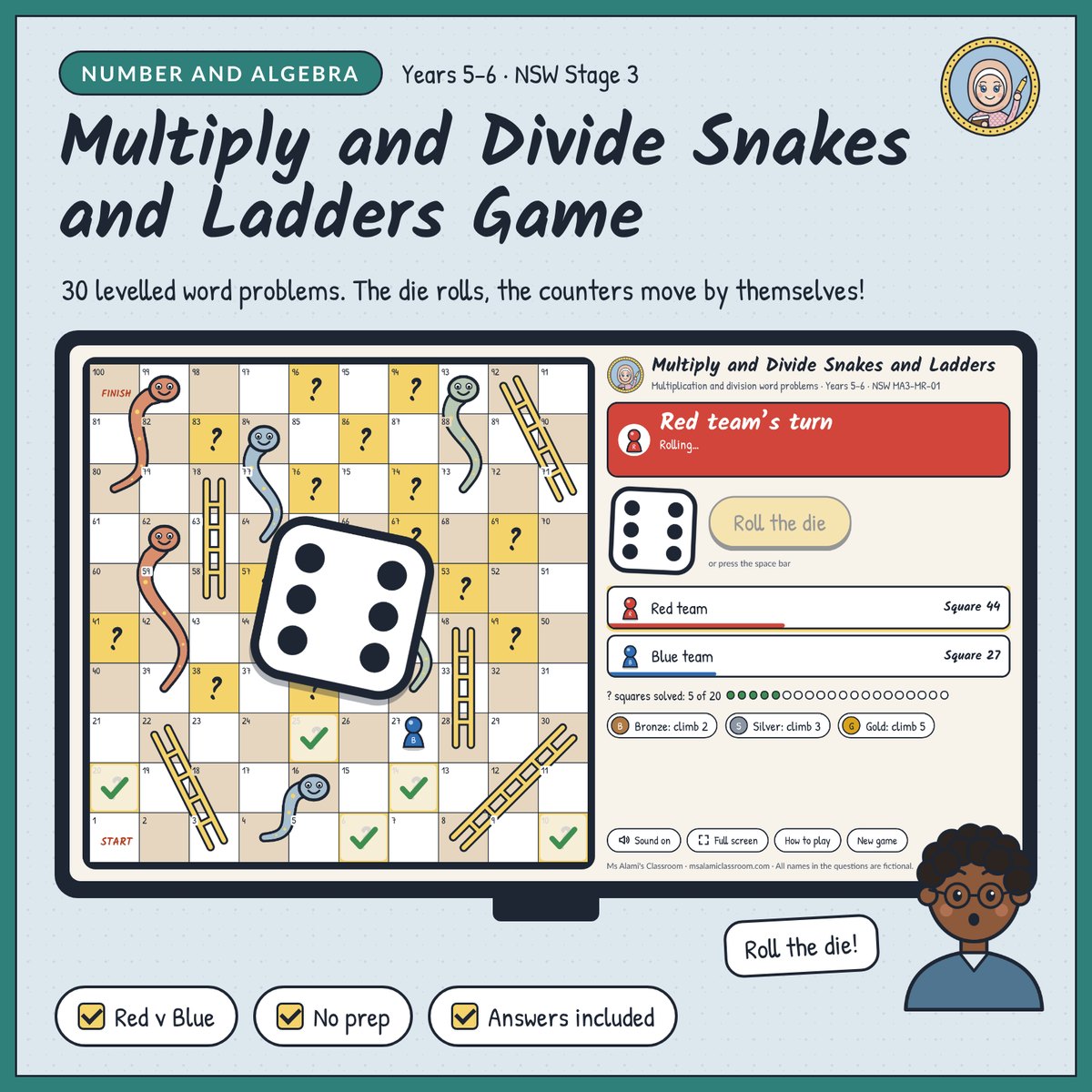
These problems stick better when students want to solve them. In my class we play snakes and ladders where every ? square is a word problem. The team picks a level (Bronze climbs 2 squares, Silver 3 and Gold 5), everyone solves it on a mini whiteboard, and a right answer climbs. A wrong answer gets a hint and one more try. Before anyone calculates, the team has to say "multiply" or "divide" and why. That one sentence does more than any worksheet.
Resources that go with this post
- Multiplication and Division Word Problems Game: Snakes and Ladders: the game, 30 levelled word problems, printable task cards, a student booklet and teacher slides.
- Division with Remainders Worksheets: practice deciding when to round up, round down or share the remainder.