
Negative numbers are a short part of the Stage 3 syllabus, and it is easy to teach too much. The NSW syllabus asks students to know what integers are, where negative numbers sit on a number line, and how they show up in real life. Adding and subtracting negative numbers comes later, in Stage 4.
What the NSW syllabus asks for in Stage 3
Under MA3-RN-01, students:
- use the term integers to describe positive and negative whole numbers and zero
- recognise where negative whole numbers sit in relation to zero on a number line
- interpret integers in everyday contexts, such as temperature
- recognise that a negative whole number can be the result of a subtraction
What is Stage 4 in NSW
Adding, subtracting, multiplying and dividing integers, and ordering negative numbers, are Stage 4 (MA4-INT-C-01). Rules like "two negatives make a positive" do not belong in a Year 6 lesson.
Start with contexts students know
Negative numbers make sense when students can see them:
- Thermometers: a winter morning in Canberra can be −3 °C. Ask where 0 °C is on the thermometer and whether −3 is above or below it.
- Lifts: the ground floor is 0. The car park levels below are −1 and −2. The floors above are 1, 2, 3.
- Height: sea level is 0. Places below sea level have negative heights.
In each case, zero is a reference point, not "nothing".
The number line
Draw a horizontal number line with 0 in the middle. Positive numbers go to the right and negative numbers go to the left. Each negative number is the same distance from zero as its positive partner: −4 is four steps left of zero and 4 is four steps right.
A useful activity is placing integers. Give students cards such as −6, −1, 0, 3 and 7 and ask them to place each one on a number line from −10 to 10. Then ask how many steps each one is from zero.
Subtraction can go below zero
This is the link to the rest of the number unit. Ask students to work out 4 − 7 by counting back on a number line. Start at 4, take 7 steps left, and you land on −3.
Context helps: the temperature was 4 °C at 6 pm and fell 7 degrees by midnight. It is now −3 °C.
Practice questions
1. What is an integer? A positive or negative whole number, or zero.
2. A lift starts on floor 2 and goes down 4 floors. Which floor is it on? Floor −2, two levels below the ground floor.
3. Count back on a number line: 3 − 5 = ? −2
4. The temperature is 1 °C and falls by 6 degrees. What is the new temperature? −5 °C
5. Which integer is 3 steps to the left of zero on a number line? −3
6. Is 0 an integer? Yes. Zero is neither positive nor negative, but it is an integer.
Mistakes to watch for
- Putting −5 to the right of −1 because 5 is bigger than 1.
- Thinking zero is not a number, or not an integer.
- Writing the negative sign after the number, as in 3−.
Rounding and ordering go first
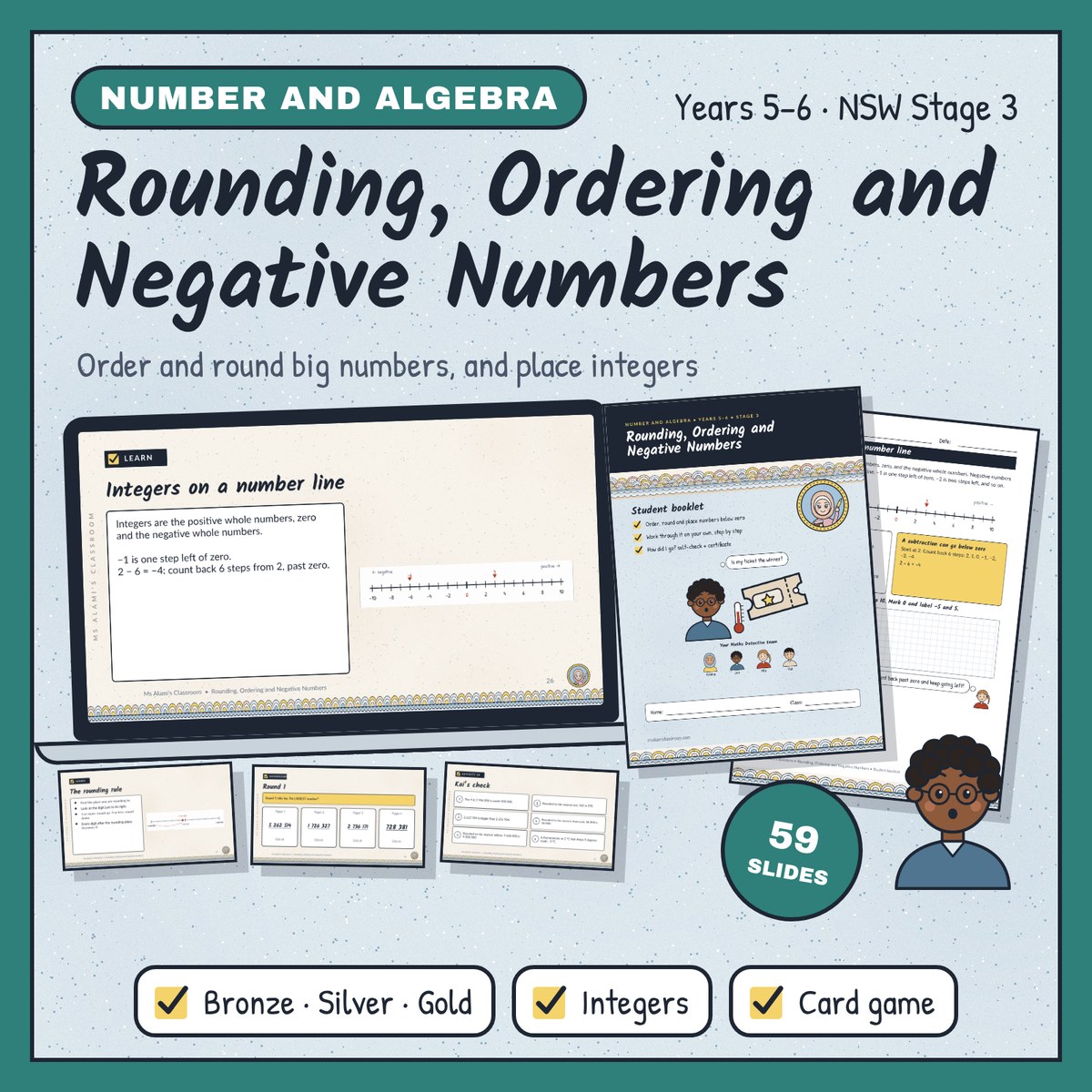
I teach integers straight after ordering and rounding large numbers, because both use the number line. Rounding, Ordering and Negative Numbers has the fete raffle ticket opening, ordering and rounding pages, an integers lesson with a number line and real-life contexts, the Number Showdown card game and Bronze, Silver and Gold practice. It is also in the Whole Number Unit Bundle.