
Write 3 + 4 × 5 on the board and ask for the answer. You will get 35 from the students who worked left to right and 23 from the students who multiplied first. Let them argue for a minute. Then ask: if the same number sentence can give two answers, how would a shop work out your bill?
That is the point the NSW syllabus wants students to reach: we need to agree on an order, so every number sentence has one answer (MA3-MR-02).
The order
- Brackets first.
- Then × and ÷, working from left to right.
- Then + and −, working from left to right.
So 3 + 4 × 5 = 3 + 20 = 23. If you want 35, you write the brackets: (3 + 4) × 5 = 35.
Why I don't teach BODMAS
NESA's advice is to avoid BODMAS-style memory rules in Stage 3. The "O" (or the "I" in BIDMAS) stands for powers and roots, which are Stage 4. The bigger problem is that "DM" and "AS" make students think division always comes before multiplication and addition before subtraction. They don't. 12 ÷ 3 × 2 is worked left to right: 4 × 2 = 8, not 12 ÷ 6 = 2.
Brackets in real life
Brackets make the most sense with money.
Amira buys 4 apples at $2 each and 3 muffins at $3 each. What does she pay? 4 × 2 + 3 × 3 = 8 + 9 = $17. No brackets needed, because both multiplications happen before the addition.
4 friends share a $30 pizza and $6 of drinks equally. How much does each pay? (30 + 6) ÷ 4 = 36 ÷ 4 = $9. Without the brackets, 30 + 6 ÷ 4 gives 31.5, which makes no sense for this story.
Practice questions with answers
1. 9 + 6 × 2 = 21
2. 30 − 18 ÷ 3 = 24
3. (9 + 6) × 2 = 30
4. 24 ÷ (2 + 4) = 4
5. 7 × 3 − 4 × 2 = 13
6. 45 − (5 + 4) × 3 = 18
7. 36 ÷ 6 + 2 × 5 = 16
8. 16 − 6 − 4 = 6. Work left to right: 10 − 4 = 6, not 16 − 2 = 14.
9. 24 ÷ 4 ÷ 2 = 3. Left to right: 6 ÷ 2 = 3, not 24 ÷ 2 = 12.
Put the brackets in
Add brackets to make each number sentence true.
10. 3 + 5 × 2 = 16 (3 + 5) × 2 = 16
11. 20 − 8 − 2 = 14 20 − (8 − 2) = 14
12. 18 + 6 ÷ 3 = 8 (18 + 6) ÷ 3 = 8
Mistakes to watch for
- Working strictly left to right, so 3 + 4 × 5 becomes 35.
- Doing all the + before the −, so 16 − 6 + 4 becomes 6 instead of 14.
- Doing ÷ before × just because of a memory rule.
- Ignoring the brackets when they are at the end, as in 24 ÷ (2 + 4).
A good discussion: try 3 + 4 × 5 on a few calculators. Some basic calculators work left to right and some follow the order of operations.
Resource that goes with this post
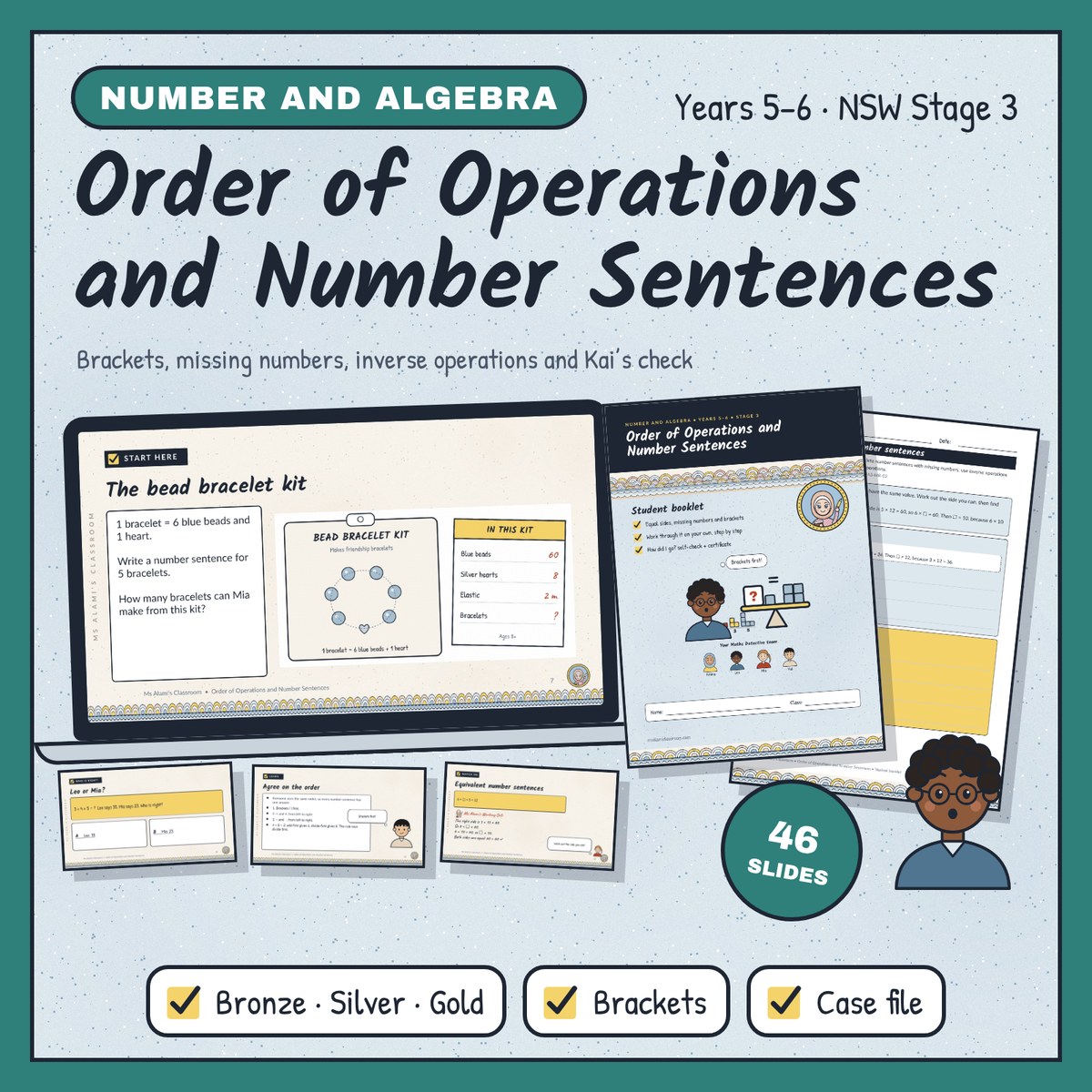
Order of Operations and Number Sentences has the "Leo or Mia?" clickable question, brackets in real life, equivalent number sentences, missing numbers, a Kai's check where students find the broken rule, and Bronze, Silver and Gold questions on every activity. It is also in the Patterns and Algebra Bundle.