
Ask a class whether 1 is a prime number and many students will say yes. Ask them why and the answer is usually "because it can only be divided by 1 and itself". The definition they learnt is not quite right, and arrays fix it.
Start with factors and multiples
Before prime numbers, students need three words:
- Product: the answer to a multiplication. 24 is the product of 4 and 6.
- Factor: a whole number that multiplies with another whole number to make the product. 4 and 6 are factors of 24.
- Multiple: the product of a number and a whole number. 24 is a multiple of 4 and of 6.
Use arrays
Give students 12 counters and ask how many different rectangles they can make.
- 1 row of 12
- 2 rows of 6
- 3 rows of 4
So the factors of 12 are 1, 2, 3, 4, 6 and 12.
Now give them 13 counters. The only rectangle is 1 row of 13. The factors of 13 are 1 and 13.
The definitions
- A prime number has exactly two factors: 1 and itself. 13 is prime.
- A composite number has more than two factors. 12 is composite.
- 0 and 1 are neither. 1 has only one factor (itself). 0 cannot be made into a rectangle at all.
"Exactly two factors" is better than "can only be divided by 1 and itself", because the second one sounds as if 1 fits.
The prime numbers less than 30 are 2, 3, 5, 7, 11, 13, 17, 19, 23 and 29. 2 is the only even prime number, because every other even number has 2 as a factor.
Practice questions
1. List all the factors of 36. 1, 2, 3, 4, 6, 9, 12, 18, 36
2. Is 51 prime or composite? Composite. 51 = 3 × 17.
3. Is 29 prime or composite? Prime. Its only factors are 1 and 29.
4. Is 1 prime, composite or neither? Neither. It has only one factor.
5. Write three multiples of 7 between 40 and 70. Any three of 42, 49, 56, 63
6. Is 91 prime or composite? Composite. 91 = 7 × 13. Many students guess prime because it is odd and not in the times tables they know.
7. How many different rectangles can you make with 18 counters? Three: 1 × 18, 2 × 9 and 3 × 6.
Mistakes to watch for
- Calling all odd numbers prime. 9, 15, 21, 27 and 51 are all composite.
- Calling 1 prime.
- Missing factor pairs. Work through 1, 2, 3 and so on, and stop when the pairs start repeating.
- Mixing up factors and multiples. Factors of 12 are 12 or smaller. Multiples of 12 are 12 or bigger.
What is Stage 4 in NSW
Prime factorisation (writing 36 as 2 × 2 × 3 × 3 or 2² × 3²), divisibility tests and index notation are Stage 4 (MA4-IND-C-01). Highest common factor is also Stage 4. They make good extension work, but label them that way.
How factors help with multiplication
Factors are not just a vocabulary lesson. Factorising helps with mental multiplication: 16 × 25 = 4 × 4 × 25 = 4 × 100 = 400. That leads into the area model, partial products and the multiplication algorithm.
Resource that goes with this post
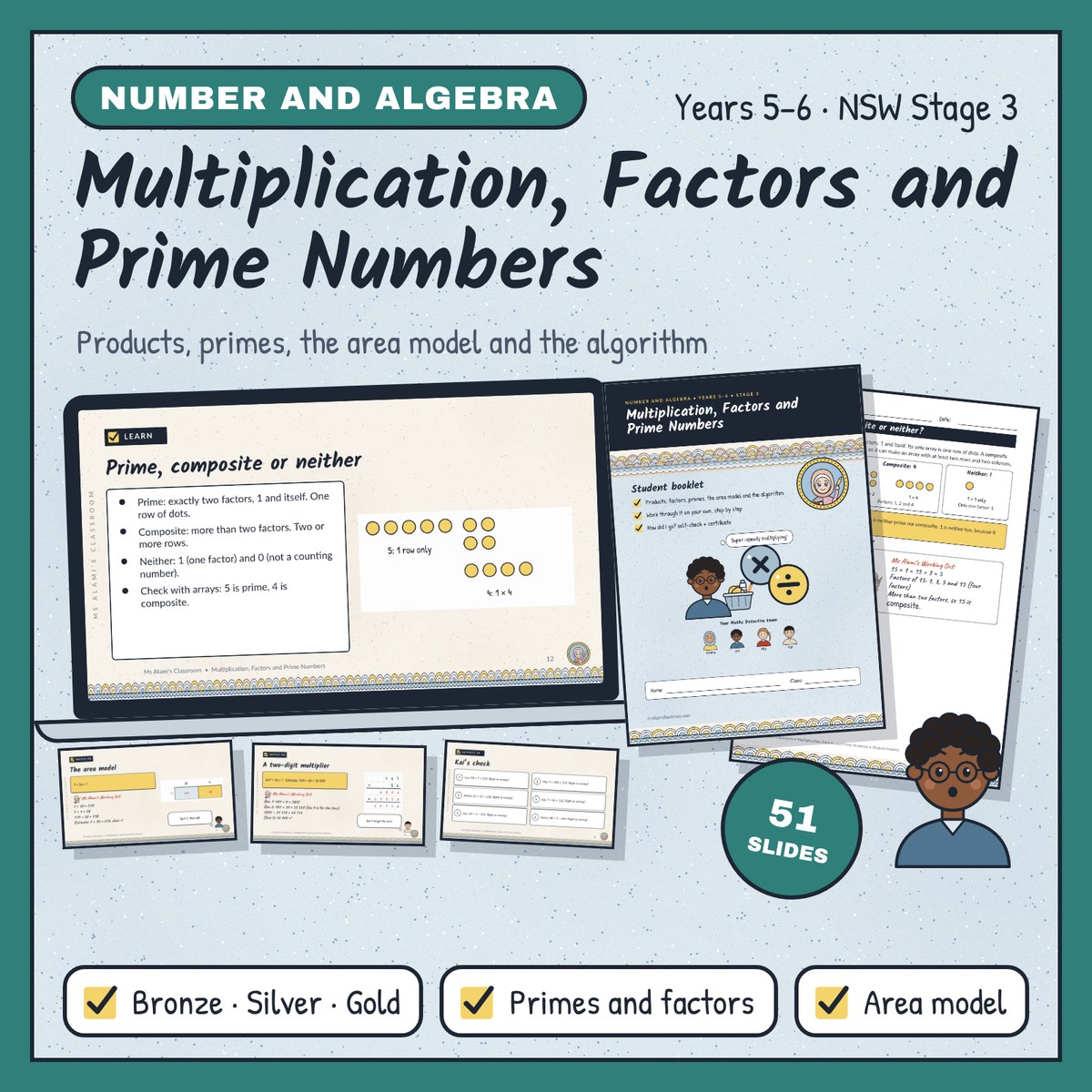
Multiplication, Factors and Prime Numbers has the orchard crate opening, factors and multiples, prime and composite with arrays, the area model, partial products, the algorithm and Bronze, Silver and Gold practice. It is also in the Whole Number Unit Bundle.