
Ask a Year 5 student to add up a list of prices and you'll get a worksheet answer. Ask them to plan a week of lunches with $30 and still save $3, and they start making real decisions: Do I really need the drink? Is the meal deal cheaper? That's why budgeting is one of the best ways to teach money maths in Stage 3. The maths has a purpose, and students can see where it fits in their lives.
This post covers a simple routine for teaching budgeting, three real-life tasks that use it, and ways to bring graphing and differentiation in along the way.
Why budgeting fits Stage 3 maths so well
One budgeting task covers a lot of the NSW Mathematics K–10 syllabus at once:
- Additive relations (MA3-AR-01): adding prices, finding totals, working out change and what's left
- Multiplicative relations (MA3-MR-01): quantity × price, such as 25 tickets × $14
- Data (MA3-DATA-01 and MA3-DATA-02): making a column graph of spending and asking whether a graph tells the truth
Students also practise estimating and rounding, checking their working, and explaining their choices. These are the skills they need for real financial decisions.
A simple routine for every budgeting task
Students cope much better with a long task when it always follows the same steps:
- Read the task and the money words. Make sure everyone knows budget, expense, total and leftover before they start.
- Look at a worked example together. Model one line of the plan, saying your thinking out loud.
- Plan. Students choose what to buy and write each line: item, quantity, price and cost.
- Check. Add the totals and compare them with the budget. If they're over, what will they swap?
- Save. Every task has a savings goal, so students learn to put money aside, not just spend it.
- Graph. Turn the spending into a column graph.
- Reflect. One question to finish, such as "When will you need to make a budget in real life?"
Make saving part of the plan
The most useful habit you can teach is to set the savings goal first, then plan the spending with what's left. A piggy-bank goal turns "spend it all" into a trade-off. Students who go over budget can't just cross something out. They have to decide what matters most.
Activity 1: Grocery Shopping Budget (free)
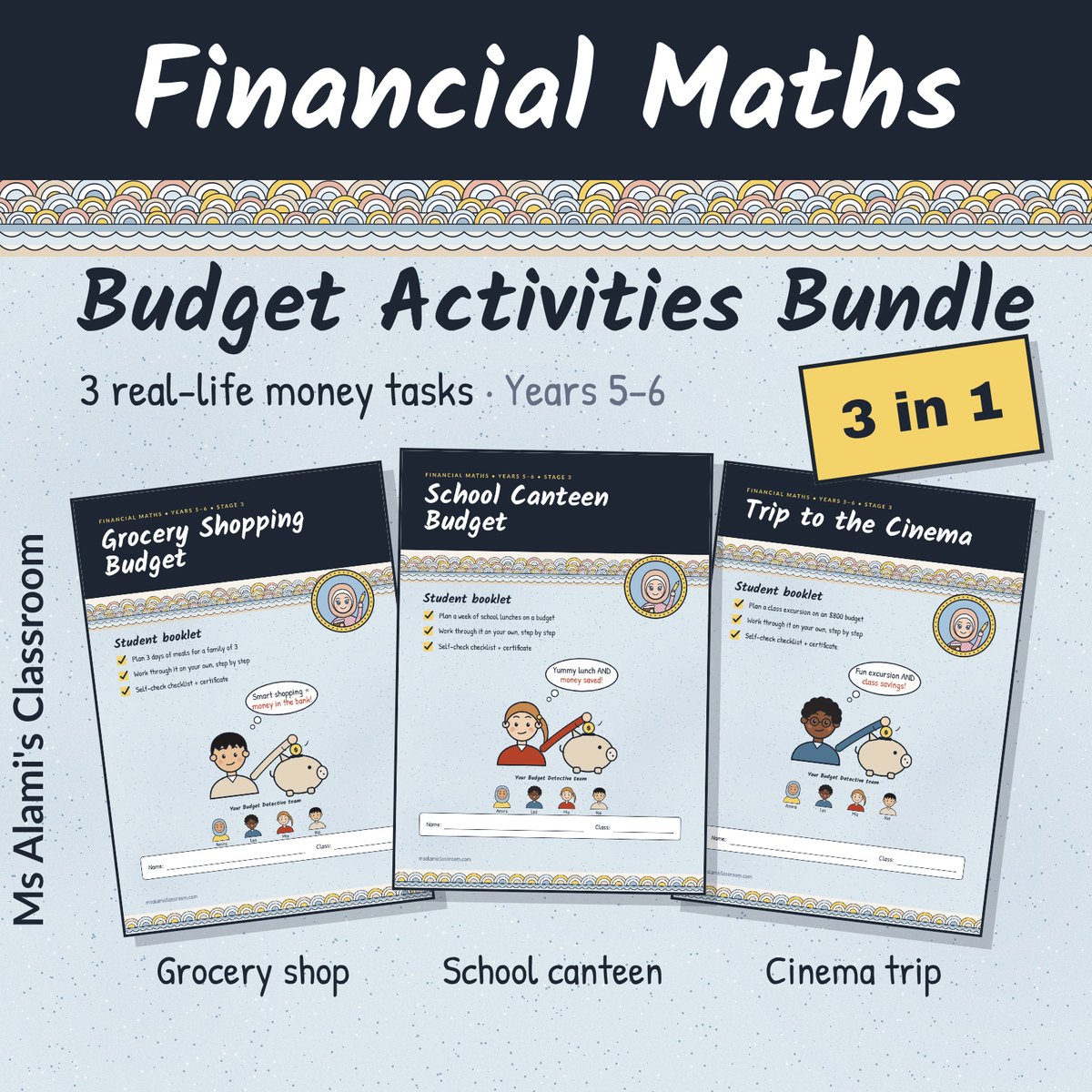
Students do the grocery shopping for a family of 3 (two adults and a 12-year-old). They plan breakfast, lunch and dinner for 3 days, write a shopping list with prices, and stay within $150 while keeping at least $10 for the family piggy bank.
The worked example plans one dinner: two packs of pasta at $2.00, a jar of sauce at $3.50 and beef mince at $8.00. That's (2 × $2.00) + $3.50 + $8.00 = $15.50 for the whole family. Students can use a real online supermarket such as Coles or Woolworths, or the price list included in the resource. Then they graph their shopping by food group.
Get the Grocery Shopping Budget free
Activity 2: School Canteen Budget
Students have $30 for school canteen lunches from Monday to Friday, and the goal is to keep at least $3 for their piggy bank. They read a realistic canteen menu with meal deals and work out each day's total and the week's total.
In the worked example, Mia buys a sandwich for $4.50 and a fruit cup for $1.50 on Monday. That's $6.00, so she'll need cheaper lunches on other days to reach her savings goal. Students also graph what the canteen sold using a many-to-one scale, and solve two detective case files using the clues in a lunch-order bag.
Activity 3: Trip to the Cinema
A class of 25 is going to the movies with an excursion budget of $800. Every student needs a ticket and a way to get there. If there's money left over, the class can buy snacks, but everyone must get the same snacks, and the class wants to save at least $25 for the end-of-year party.
This is where multiplication does the heavy lifting. Tickets cost $14 each, so 25 × $14 = $350. A good mental strategy is 25 × 10 + 25 × 4 = 250 + 100. Students then compare hiring a bus for $250 with public transport at $4 per student, and decide how much is left for popcorn.
See the Trip to the Cinema budget
Bring in graphing and misleading graphs
Once students have their spending, a column graph is a natural next step. Totals in budgets are often too big for a scale of one, so it's a good time to teach many-to-one scales, where one unit on the axis stands for $5 or $10. Remind students to label both axes and give the graph a title.
Then show a graph whose vertical axis doesn't start at zero, so one bar looks twice as tall as another. Ask: Is this graph telling the truth? Spotting misleading graphs is part of the Stage 3 data outcomes, and students enjoy catching the trick.
Differentiation ideas
- Support: allow calculators for checking, shorten the plan (3 days instead of 5), or give a partly completed list.
- Extension: change the budget, add a 10% discount, compare two supermarkets, or ask students to plan the cheapest possible week that still includes something they enjoy.
- Early finishers: have them write their own case file for a partner to solve.
Get all three activities
Each activity comes with editable teacher slides, an A4 student booklet in colour and black and white, an editable PowerPoint copy of the booklet, case files and answers. The Grocery Shopping Budget is free. The canteen and cinema tasks are $5 each, or you can get all three in the Budget Activities Bundle for $8.
Need help opening the files? See the Help page.