
"1/2 + 1/4 = 2/6." I see it on mini whiteboards every year in Year 5 and 6. The student isn't being careless. They've treated the top and bottom as two whole numbers and added each pair, which makes sense if a fraction looks like two numbers stacked up.
Most Stage 3 fraction mistakes come from the same place: treating a fraction as two separate numbers instead of one. So most of my fractions teaching in Years 5–6 is about getting students to see a fraction as a quantity with its own place on a number line.
What the NSW syllabus covers in Stage 3
Fractions sit in the Representing quantity fractions focus area. MA3-RQF-01 "compares and orders fractions with denominators of 2, 3, 4, 5, 6, 8 and 10" and MA3-RQF-02 "determines 1/2, 1/4, 1/5 and 1/10 of measures and quantities". Percentages link in through MA3-RN-03.
Part A covers the number 1 as the whole, comparing unit fractions to ½, ordering unit fractions on a number line, adding and subtracting with the same denominator (including answers greater than one) and the complement principle, such as 1 − 1/3.
Part B covers a fraction as a division (3/4 represents 3 divided by 4), ordering fractions with related denominators, subdividing a rectangle by length and width, equivalent fractions for one-half, building up the whole from a part, adding and subtracting with related denominators, and fractions of quantities, including 2/5 of 30 with a tape diagram.
Multiplying a fraction by a fraction, dividing by a fraction, and adding with unrelated denominators (like 2/3 + 1/4) are all Stage 4, and so is simplifying with the highest common factor. If your scope and sequence for fractions in Year 6 says "multiplying and dividing fractions", check what it means. In NSW Stage 3, multiplying shows up as a fraction of a quantity, and dividing shows up as a fraction being a division.
Mixed numerals need a note too. The syllabus has answers greater than one (4/5 + 3/5 = 7/5) and 3 ÷ 2 = 3/2. I do show students that 7/5 is 1 2/5, but mixed numerals aren't a listed Stage 3 content point, and calculating with them is Stage 4.
Start with the whole
The syllabus has a good opener. Jake ate 1/4 of a cake and Kate ate 1/2 of a different cake. Jake said he ate more than Kate. How could he be correct? If Jake's cake was much bigger, he could be right.
I use pizzas. Two large pizzas, one cut into 4 and one into 8: which slice is bigger? Then a small pizza cut into 4 and a large one cut into 8. Students soon work out that "Which is bigger, 1/4 or 1/8?" needs the words "of the same whole". For fractions as numbers, that whole is 1. The Fractions Introduction opens with a pizza box and an order docket built around this idea.
Number lines over pie pieces
Circles are hard to cut into fifths and don't help much with ordering. Number lines do. Draw a line from 0 to 1 and split it into equal jumps, and the denominator is the number of jumps.
Number lines fix "1/8 is bigger than 1/4 because 8 is bigger than 4". When students mark 1/2, 1/3, 1/4, 1/5, 1/8 and 1/10 on lines of the same length, they can watch the jumps shrink.
For a quick activity, give everyone 20 cm paper strips. Fold them into halves, quarters and eighths and label the folds. For fifths and tenths, use a ruler: tenths are 2 cm, fifths 4 cm and halves 10 cm. Students end up with a fraction wall they made, and they can see 2/4, 4/8 and 5/10 line up with 1/2. That's the syllabus point about making equivalent fractions for one-half by re-dividing the whole.
To compare with ½, ask whether a fraction is more or less than a half, and how they know. 5/8 is more, because 4/8 is half. 2/5 is less, because half of 5 is 2.5.
Adding and subtracting
Start with the same denominator. The denominator names the size of the pieces, and adding doesn't change the size of the pieces, so 2/8 + 4/8 = 6/8. If a student writes 6/16, have them shade both answers on fraction bars. They've added two amounts of pizza and got an answer smaller than one of them.
The syllabus example 7/8 − 2/8 = 5/8 adds an interpreting step: the difference is more than one-half. It's quick, and it's easy to skip.
The complement principle is taking a unit fraction from a whole number. 1 − 1/3 = 2/3. For 3 − 1/4, break one whole into quarters, so you have 2 wholes and 4/4. Take away 1/4 and 2 and 3/4 is left.
Then related denominators (2, 4 and 8; 3 and 6; 5 and 10). From the syllabus: Jake ate 1/8 of a cake and Kath ate 1/4 of the cake. What fraction remains? Rename 1/4 as 2/8, so 3/8 is eaten and 5/8 remains. I want to see the fraction strips, not just the answer.
Fractions of quantities
MA3-RQF-02 asks students to find quarters and fifths of whole numbers that are multiples of the denominator, using a tape diagram. For 2/5 of 30, draw a tape for 30, cut it into 5 equal parts of 6, and shade 2 of them to get 12.
The wrong answers I see for 2/5 of 30 are 6 (they found one-fifth and stopped) and 75 (they divided by the numerator and multiplied by the denominator). Drawing the tape stops both.
Students also find ½, ¼, 1/5 and 1/10 of collections, with remainders as decimals, so a quarter of 10 is 2.5, not "2 remainder 2". This connects to fractions as division. Share 7 chocolate fingers equally between 4 people and each person gets 7 ÷ 4, or 7/4, which is 1.75.
Through MA3-RN-03, students link 50% to a half, 25% to a quarter and 10% to a tenth, and calculate sale prices after 10%, 25% and 50% discounts. A $24 book at 25% off is $6 off, so the sale price is $18. Catalogues from the letterbox are a free supply of questions.
The Fraction Revisit covers most of this Part B content around a shared block of chocolate, from the fraction wall and related denominators to building the whole, fractions of amounts and percentage discounts.
Where the Millionaire games fit
I use quiz-show games for review. The Add and Subtract Fractions Millionaire Trivia has 12 questions with the same and related denominators, and each wrong option is based on a mistake students really make, like 6/16.
The multiplying and dividing games keep the names of my 2021 versions, but the main questions are Stage 3. The Multiplying Fractions Millionaire Trivia is fractions and percentages of quantities, with Questions 10–12 as a labelled Stage 4 extension. The Dividing Fractions Millionaire Trivia is fractions as division, remainders and finding the whole, with Questions 9–12 as a labelled Stage 4 extension.
Resources that go with this post
- Fractions Introduction: unit fractions, number lines, fractions as division, equivalent fractions and mixed numerals.
- Fraction Revisit: the fraction wall, related denominators, fractions of amounts and percentages.
- Add and Subtract Fractions Millionaire Trivia: a clickable 12-question game with task cards.
- Multiplying Fractions Millionaire Trivia: fractions and percentages of quantities.
- Dividing Fractions Millionaire Trivia: fractions as division and fair shares.
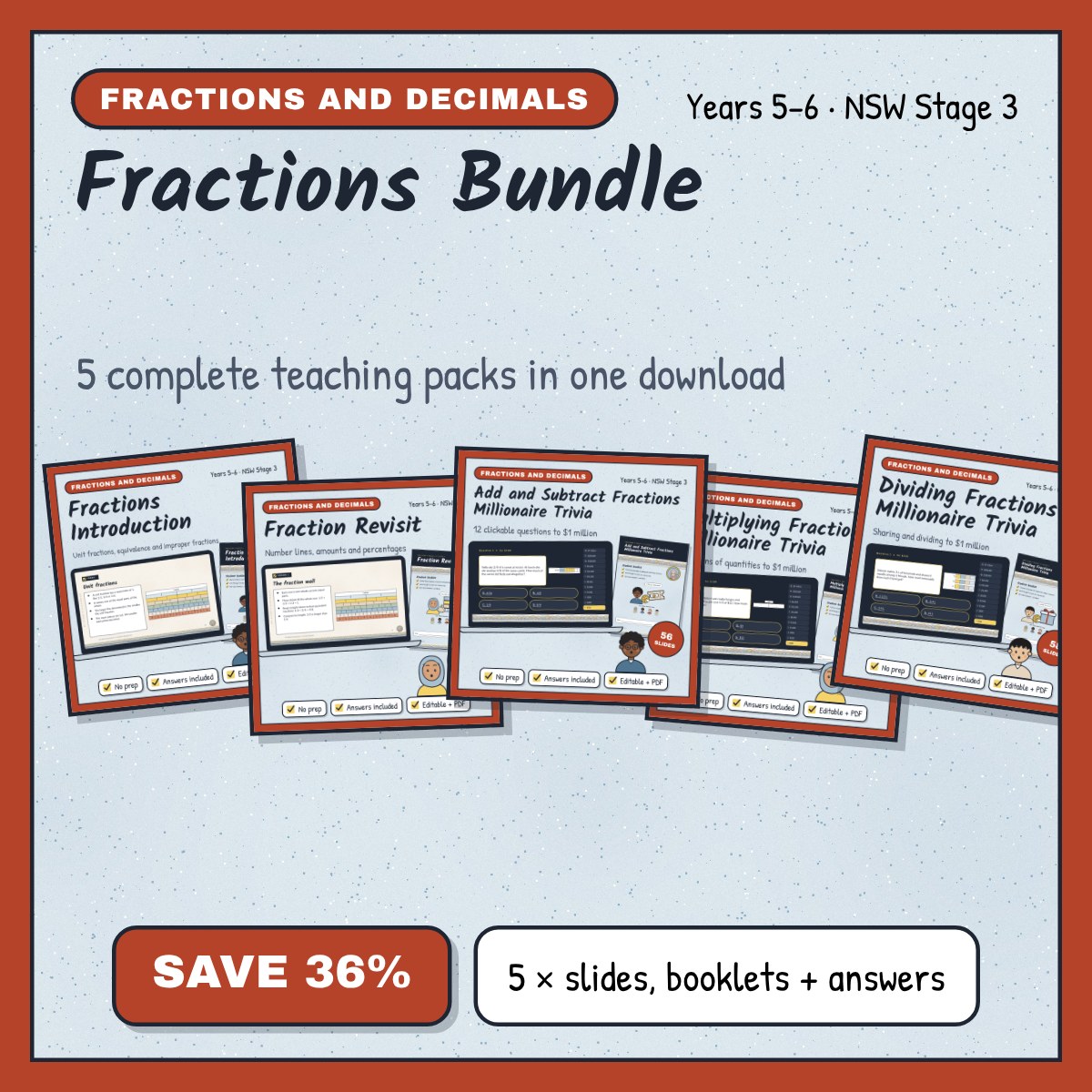
- Fractions Bundle: all five together.