A student can position a protractor correctly and still read the wrong scale. For Year 5 and Year 6 angles lessons, the useful question is: “Which zero belongs to my starting arm?” Combine that question with an estimate and students have a way to check their answer.
Start with angle types and benchmark turns
Use the corner of a page as a 90° benchmark. Compare smaller and larger turns before introducing acute, right, obtuse, straight and reflex angles. Include a revolution so students connect 360° with a full turn.
Ask students to describe the amount of turn. Drawing longer arms does not make an angle larger. Rotating the diagram does not change the angle either. A door, scissors or a clock face gives students an everyday example to discuss.
Teach a repeatable protractor routine
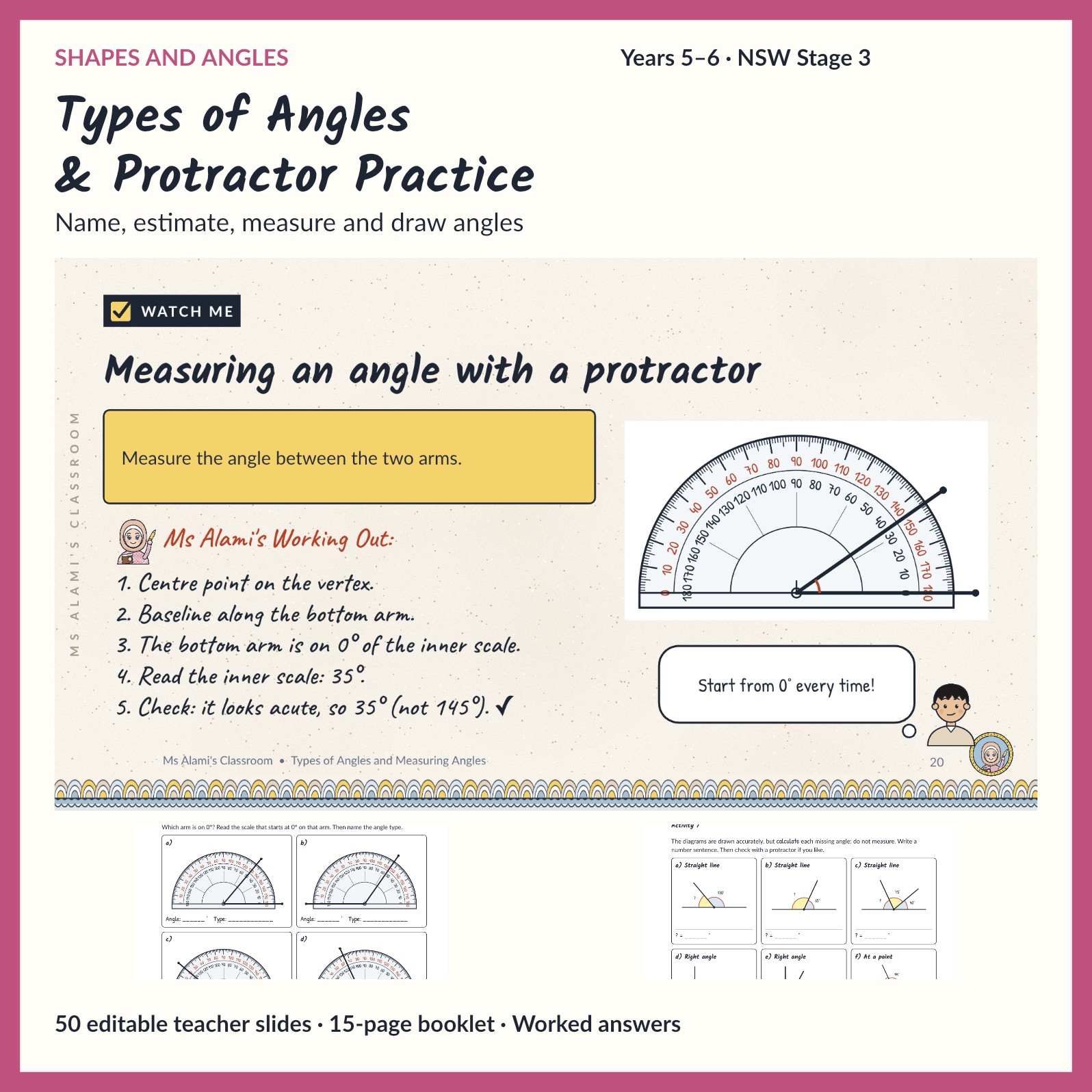
Place the centre point on the vertex and align the baseline with one arm. Find the zero on that arm, follow that scale, and read where the other arm crosses it. Finally, compare the reading with the estimate.
For example, if an angle looks acute and the two scales show 35° and 145°, 35° is the sensible reading. Students should explain why, rather than choose a smaller number automatically: an obtuse angle needs the larger reading.
Give examples starting from both sides of the protractor. Once students can read those reliably, show an angle whose arms are at 20° and 95° on the same scale. The angle between them is 95° − 20° = 75°.
Estimate before measuring
Ask students to estimate six angles using 90° and 180° as benchmarks, then measure and record the difference. Discuss the angle with the greatest difference. Was the estimate unreasonable, or was the protractor slightly off the vertex?
To measure a reflex angle, measure the smaller angle on the other side and subtract from 360°. If that smaller angle is 125°, the reflex angle is 360° − 125° = 235°.
Connect measurements to angle relationships
Adjacent angles forming a straight line total 180°. An angle beside 130° is therefore 180° − 130° = 50°. Angles making a complete turn about a point total 360°. If two of them are 100° and 140°, the missing angle is 360° − 100° − 140° = 120°.
Always ask students to add the angles back together as a check. Keep vertically opposite angles as an optional extension when that suits your class.
A lesson sequence with printable practice
Types of Angles and Measuring Angles includes 50 editable teacher slides, a 15-page booklet, six protractor questions with answer slides, colour and black & white worksheets, and worked answers. Its Mixed-up Protractor detective case file asks students to find incorrect readings and justify the corrections.
A practical sequence is to introduce types and everyday examples, then teach measuring and drawing, and finish with straight-line and point relationships. The main angle work supports NSW Stage 3 MA3-GM-03. The NSW Department of Education’s geometric measure activities provide further context for angle measurement and turns.
Continue with classifying and measuring triangles or use quarter turns in translation, reflection and rotation activities.