
Ask a class to chant the 7 times tables and most students mouth along. Turn it into a race between two teams, with a buzzer for a wrong answer and a chime for a right one, and suddenly everyone is working out 7 × 8 in their head before their team mate can.
That is the idea behind a good times tables game: every student has a reason to recall the fact quickly, and a wrong answer is a chance to learn a strategy rather than a dead end.
Why games beat drills for multiplication facts
The NSW syllabus asks Stage 2 students to recall multiplication facts and use fact families (MA2-MR-01), and Stage 3 students to use those facts to find products, factors and multiples (MA3-MR-01). Fluency comes from many short, focused goes at the same facts. A game gives you those goes without the groans:
- Every card is a decision. Students have to commit to an answer, not copy the person next to them.
- Feedback is instant. A right answer is celebrated straight away; a wrong one is corrected straight away.
- Teams carry the quieter students. Everyone wants their team's counter to move, so everyone is working out the fact.
How to run a times tables team race
- Split the class into two teams, Red and Blue. They take turns.
- Turn over a mystery card, such as 8 × 7 = ?
- The team has one try. They choose an answer from a board of 24 answers. Put a few near misses on the board (54 and 63 next to 56) so guessing doesn't pay.
- Right answer: one point, and the team's counter moves one space along the track.
- Wrong answer: no point. Show a strategy for that fact and the answer, then the other team gets the next card. One try per card means the winning team really did know more facts.
- After 24 cards, the team with the most points wins.
Add star spaces on the track for a bonus question, such as “say the fact family for 7 × 8”.
6 strategies to teach for the tricky facts
When a team gets a card wrong, show one of these instead of just the answer. Over a few games, students start using them on their own.
- × 2: double it. 2 × 9 is double 9.
- × 4: double, then double again. 4 × 7: 7, 14, 28.
- × 5: half of × 10. 5 × 8 is half of 80.
- × 9: × 10, then take away one group. 9 × 6 is 60 − 6.
- × 6, × 7, × 8: start at × 5, then add groups. 8 × 7 is 8 × 5 = 40, plus two more 8s.
- × 11 and × 12: start at × 10, then add groups. 12 × 7 is 70 + 14.
The fact family helps too: if you know 7 × 8 = 56, you also know 8 × 7, 56 ÷ 7 and 56 ÷ 8.
Ready-made: Mystery Card Race
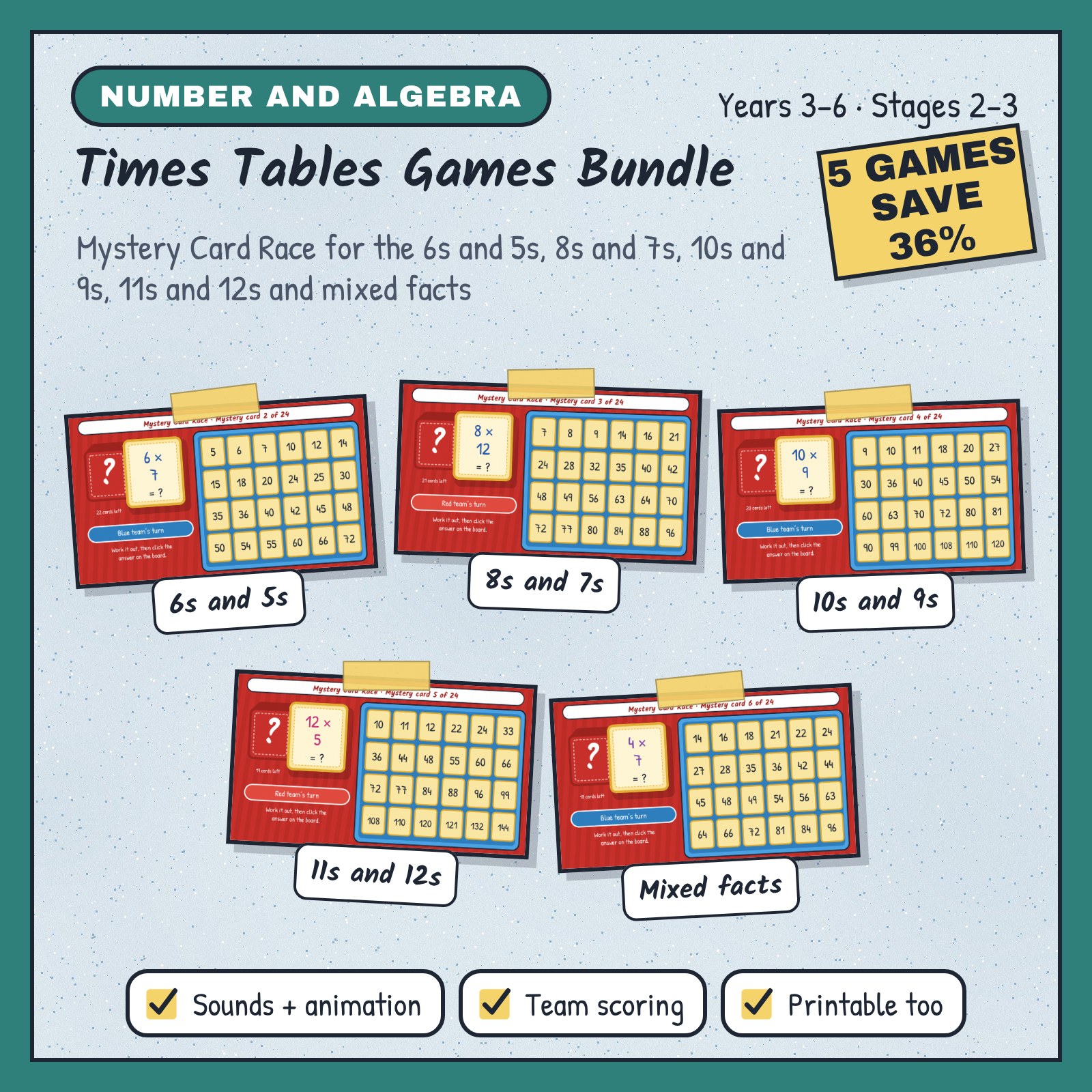
If you'd rather not make the cards and board yourself, Mystery Card Race is a ready-to-play version of this game:
- Red team vs Blue team, one try per card, 24 mystery cards.
- A chime and a hopping counter for a right answer, and a hint then the answer for a wrong one.
- Plays in Keynote, Google Slides and PowerPoint, and comes with a browser version that keeps the score.
There is one for each group of tables:
- 2, 3 and 4 Times Tables Game
- 6 and 5 Times Tables Game
- 8 and 7 Times Tables Game
- 10 and 9 Times Tables Game
- 11 and 12 Times Tables Game
- Mixed Times Tables Game
- All Tables 1 to 12 Times Tables Game: four decks and a table picker
All seven are in the Times Tables Games Bundle. Each pack also includes printable boards for a “guess the mystery card” clue game, detective cases and a Stage 3 challenge on factors and primes.
Quick tips for game day
- Turn the sound up. The chime and the hopping counter are half the fun.
- Keep score on the board with tally marks, so every point is visible.
- Rotate who clicks. A different student from the team answers each card.
- Finish with the fact families for any card the class got wrong.
Short, regular games add up: five minutes at the start of a maths lesson, three times a week, is a lot of times tables practice over a term.