
Try this one on a Year 6 class: I'm thinking of a number. I double it and add 7. The answer is 35. What is my number? A lot of students double 35 and add 7, because those are the steps in the question. Others guess and check until something works. The quickest way is to work backwards and undo each step in reverse order: 35 − 7 = 28, then 28 ÷ 2 = 14. Check: 14 × 2 + 7 = 35 ✓
What the NSW syllabus asks for
Under MA3-MR-02, Stage 3 students construct and complete number sentences involving multiplication and division and apply the order of operations to calculations. The same content area asks them to describe number patterns formed by multiples and use a geometric pattern to make a table of values. There is no separate algebra outcome in Stage 3, so "patterns and algebra" in Years 5 and 6 means this: rules, tables, missing numbers and working backwards.
Three ideas to teach
- Undo it backwards. If the last step was "add 7", the first thing you undo is subtract 7. My class calls this "shoes off before socks".
- Multiply before you add. In 5 + 3 × 4, the multiplication comes first, so the answer is 17, not 32. Brackets change that: (5 + 3) × 4 = 32.
- Balance the number sentence. In 7 × 8 = 50 + ☐, both sides must be equal. Work out the side you can, then find what's missing.
Questions with answers
1. I'm thinking of a number. I multiply it by 3, then add 4. The answer is 25. What is my number?
Undo backwards: 25 − 4 = 21, then 21 ÷ 3 = 7. Check: 7 × 3 + 4 = 25 ✓
2. 6 × ☐ = 54. What is the missing number?
Use the inverse: 54 ÷ 6 = 9.
3. 48 ÷ ☐ = 8. What is the missing number?
How many 8s make 48? 8 × 6 = 48, so the missing number is 6.
4. Mia gave away 12 stickers, then shared the rest equally between 3 friends. Each friend got 9 stickers. How many stickers did Mia start with?
Work backwards: 9 × 3 = 27 stickers shared, then 27 + 12 = 39 stickers.
5. What is 5 + 3 × 4?
Multiply first: 3 × 4 = 12, then 5 + 12 = 17.
6. What is (20 − 8) ÷ 4?
Brackets first: 20 − 8 = 12, then 12 ÷ 4 = 3.
7. The chairs for a class party follow the rule chairs = tables × 4 + 2. How many chairs are needed for 9 tables?
9 × 4 + 2 = 36 + 2 = 38 chairs.
8. 7 × 8 = 50 + ☐. What is the missing number?
7 × 8 = 56. 56 = 50 + 6, so the missing number is 6.
Turn it into a game
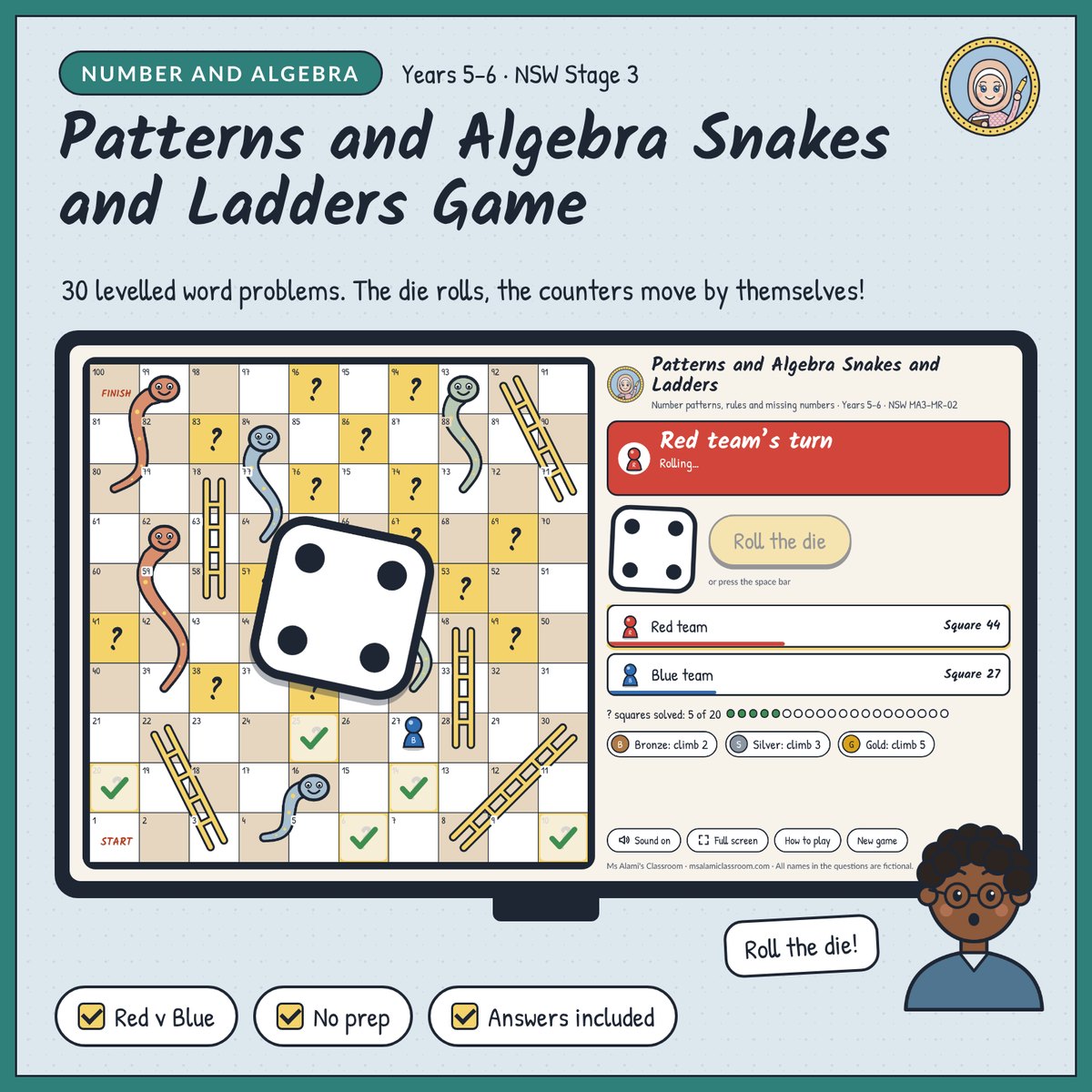
Missing number problems are perfect for a game, because a team can check its own answer by putting it back into the question. In my class we play snakes and ladders where every ? square is a pattern, rule or missing number problem. The team picks a level (Bronze climbs 2 squares, Silver 3 and Gold 5), everyone solves it on a mini whiteboard, and a right answer climbs. A wrong answer gets a hint and one more try.
Resources that go with this post
- Patterns and Algebra Word Problems Game: Snakes and Ladders: the game, 30 levelled questions, printable task cards, a student booklet and teacher slides.
- Number Patterns and Tables of Values Worksheets: matchstick patterns, rules and function machines.