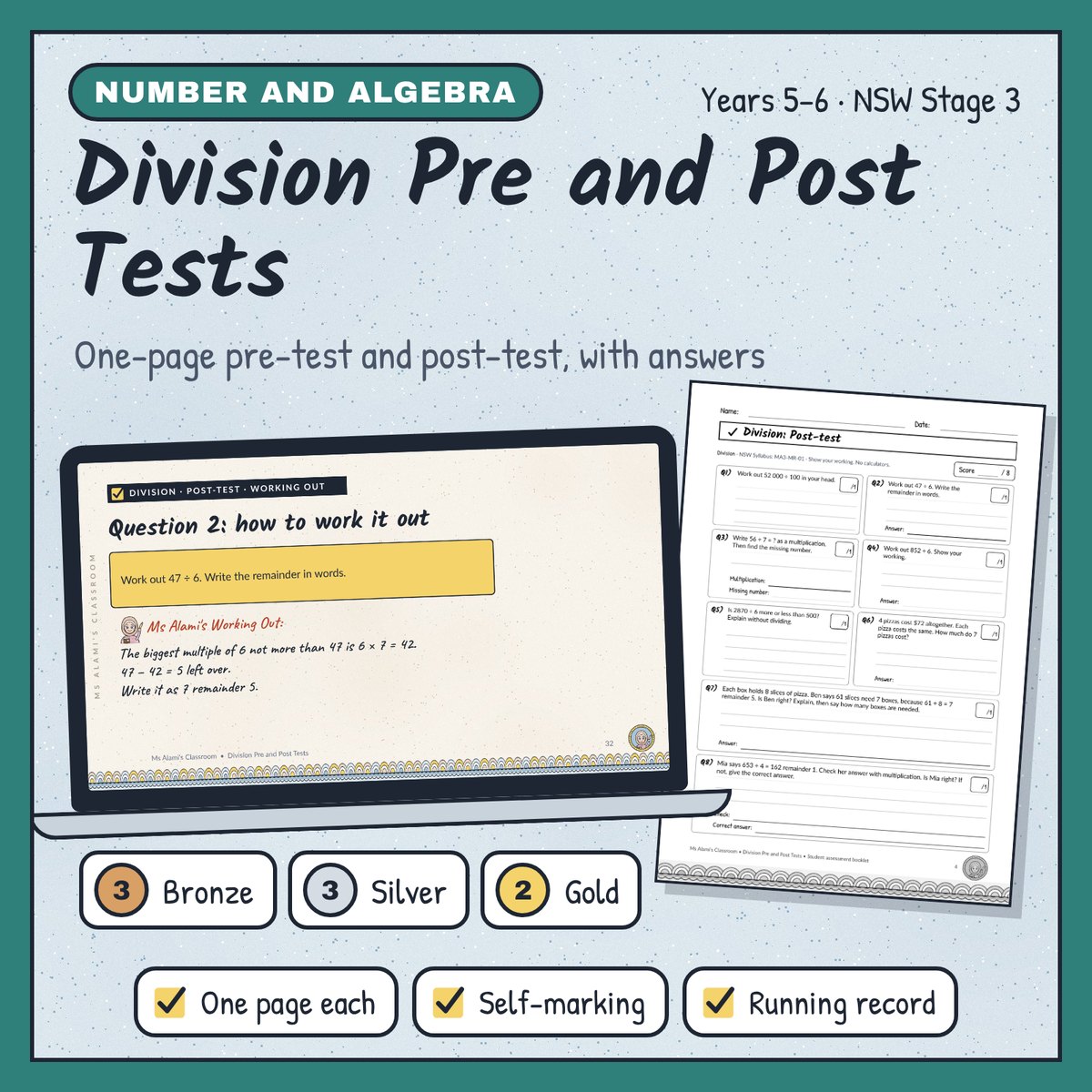
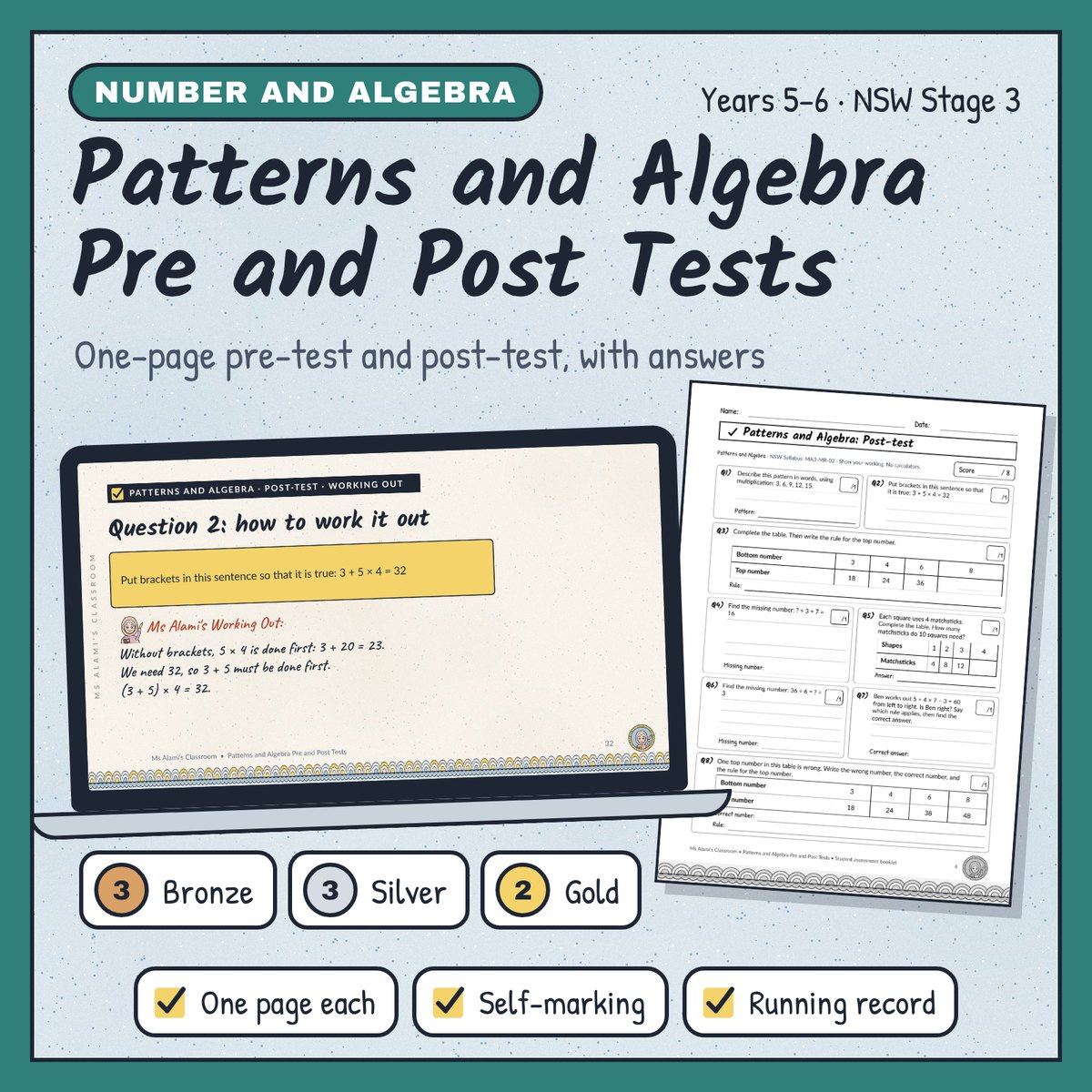
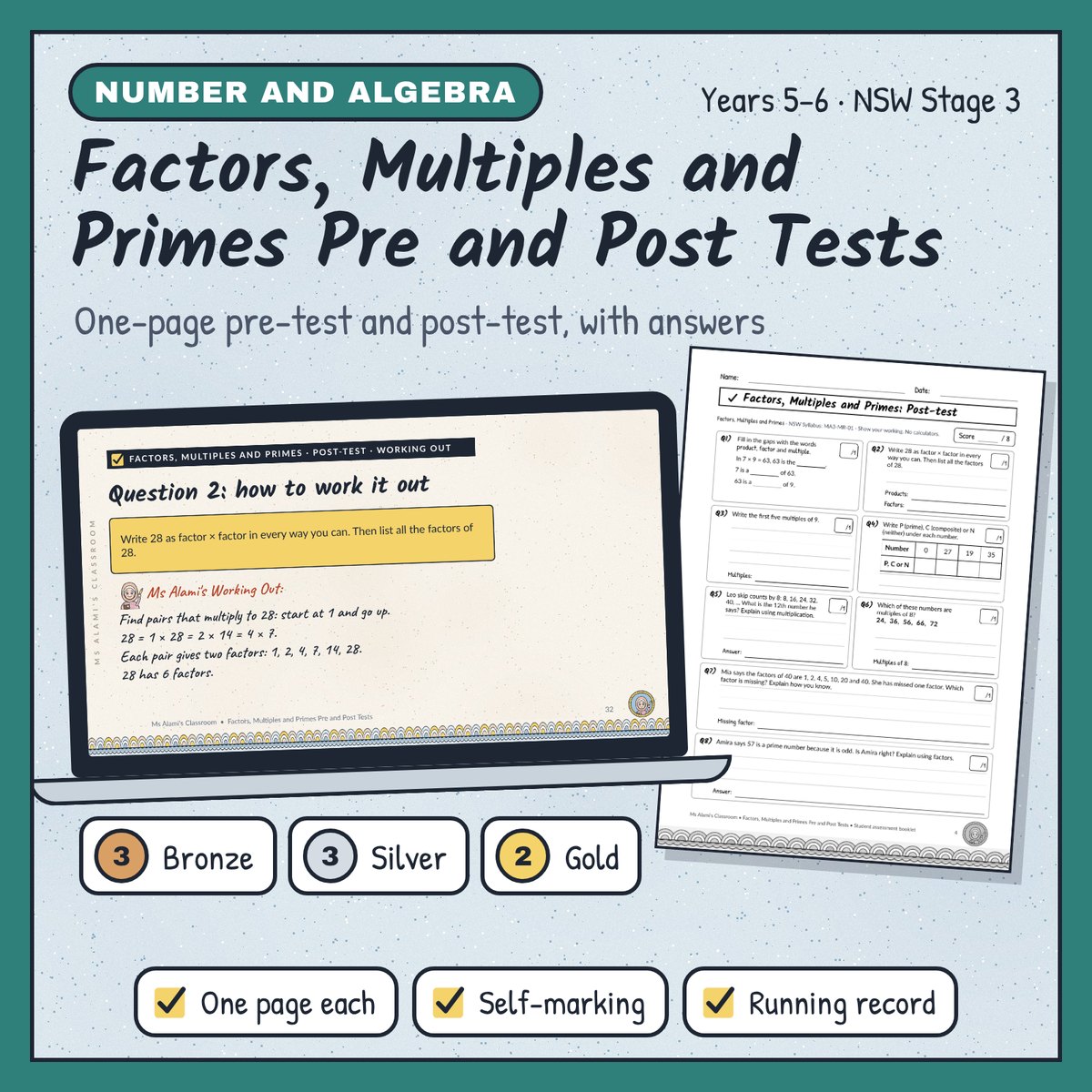
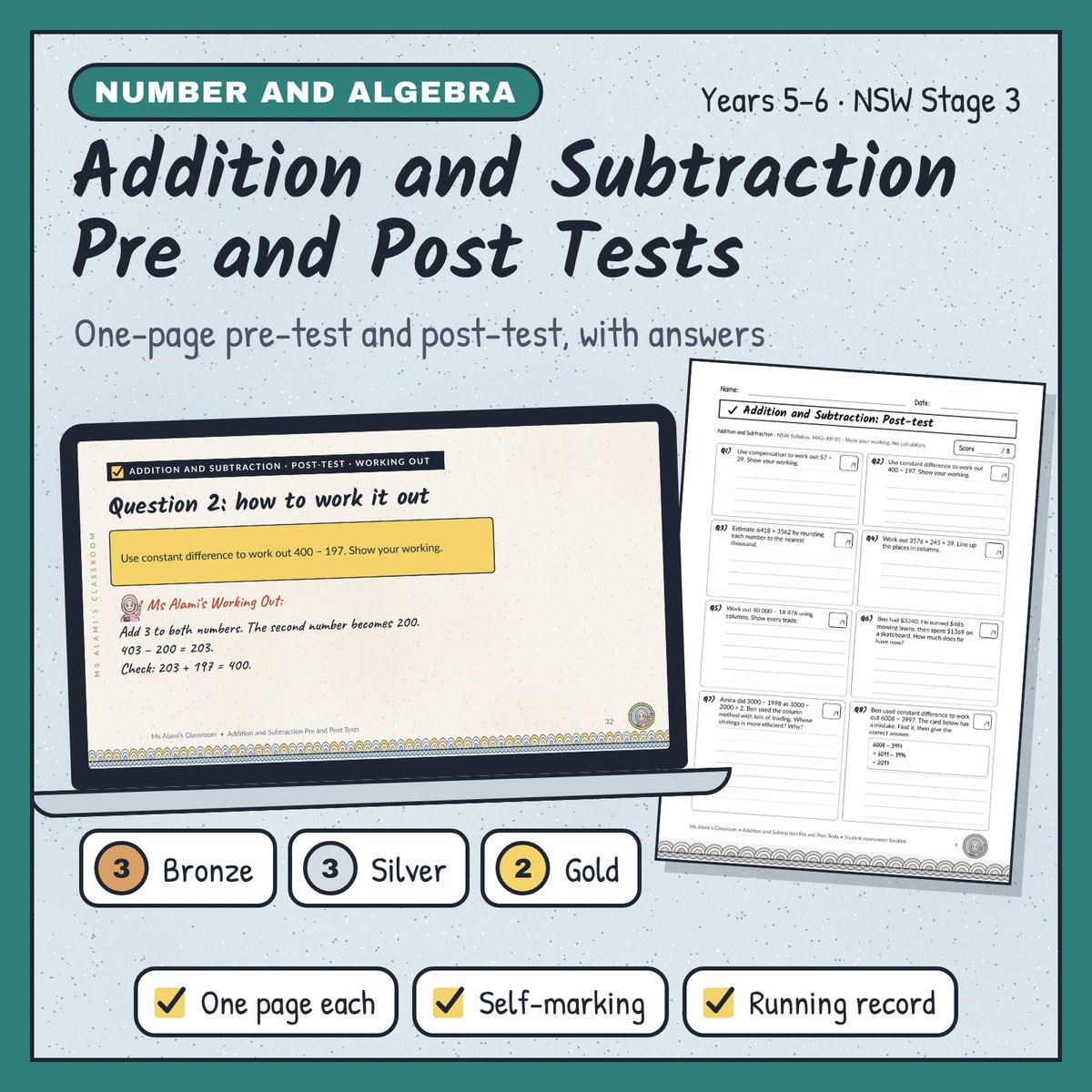
Leo needs tables for 40 students, 6 to a table. He works out 40 ÷ 6 = 6 remainder 4 and says 6 tables, which leaves four students standing. That is question 7 on the pre-test, and it is the one that tells you who understands what a remainder means and who just writes it down.
How it runs
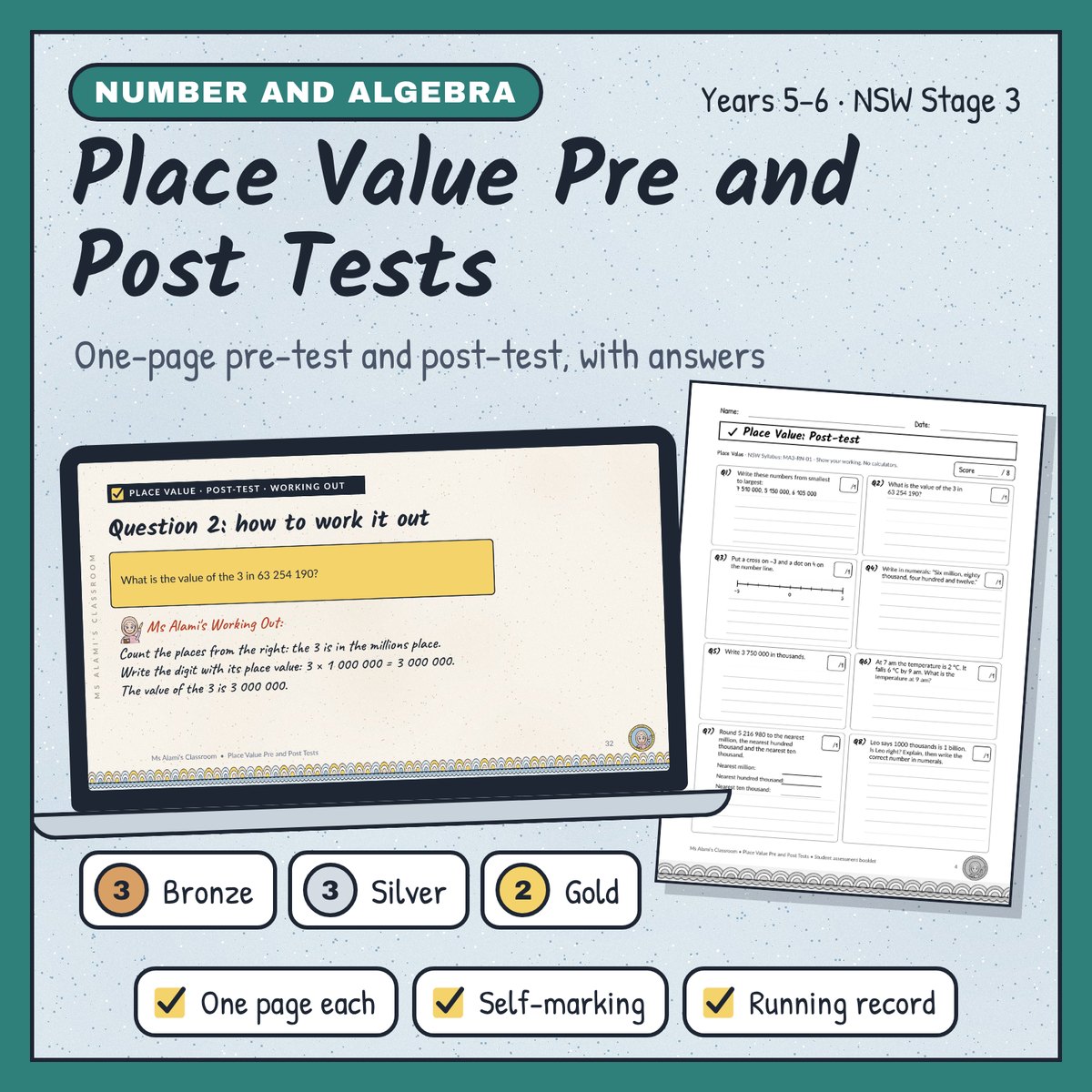
- Before you teach division, run the one-page pre-test. It takes 20 to 30 minutes, with pencils and no calculators. You see what each student already knows before the first lesson, so you can group them.
- Students mark their own test with the answer booklet and a coloured pen. Every answer has a "Mark it right if" line, so they know exactly what earns the mark. Check a sample.
- Go over it with the teacher slides: each question, then a slide that works it out step by step. Answers and common errors are in the speaker notes.
- After the unit, run the one-page post-test. Question 1 on the post-test checks the same skill as question 1 on the pre-test, and so on through question 8, with new numbers, so you can compare them directly.
- Type one total out of 8 for each test into the running record spreadsheet. It works out growth, an A to E level from the post-test, the class average, results for each NESA outcome and a suggested report comment for each student.
Maths covered
NSW Stage 3, MA3-MR-01 (selects and applies appropriate strategies to solve multiplication and division problems). The eight questions, in order:
- dividing by 10, 100 and 1000 in your head
- dividing with a remainder and writing the remainder in words
- writing a division as a multiplication to find the answer
- dividing a 3-digit number by a one-digit number by partitioning
- deciding if a quotient is more or less than a number, without dividing
- a rate problem (find the cost of one, then of several)
- deciding what a remainder means in a word problem
- checking a division with multiplication
Every question matches content taught in my Division with Remainders Worksheets, Multiplying and Dividing Decimals Word Problems and Times Tables Games Bundle. Apart from dividing by 10, 100 and 1000, every division is by a one-digit number, as Stage 3 expects.
Good to know
- The booklets are black and white only, ready to photocopy.
- The student booklet and the answer booklet each come as one PDF and one editable PowerPoint that matches the PDF page for page, so you can change a number, a name or a question before you print.
- Each test mixes three Bronze, three Silver and two Gold questions, roughly easier first. The levels are not printed on the student page, so nobody sees a label. You will find them on the teacher slides.
- Stage 3 outcomes cover Year 5 and Year 6, so one version suits both, and you can run the test whenever you teach the topic.
- If you use Keynote, install the fonts included before you open the PowerPoints.
- All 19 topic tests are in the Maths Pre and Post Tests Bundle: $39 instead of $95, a 59% saving.