
Sausages come in packs of 8 and bread rolls in packs of 6. Ask a Year 5 class how many of each to buy for the school sizzle so nothing is left over, and someone will say "8 packs of each". That gives 64 sausages and 48 rolls. The class sees the problem straight away, and now they want the real answer.
That answer, 24 of each, is the lowest common multiple of 8 and 6. Here is how I build up to it, and to divisibility, in Years 5 and 6.
Start with multiples, and say them as multiplication
A multiple of 4 is 4 times a whole number: 4 × 1, 4 × 2, 4 × 3 and so on. Students often skip count to find them, which is fine for the first few. The NSW syllabus asks for more than that: describing a pattern of multiples "in terms of multiplication rather than addition" (MA3-MR-02). So ask for the 10th multiple of 4, then the 20th. A student who says 4 × 20 = 80 has the idea. A student who adds instead (4 + 20) gets 24.
The hundred chart makes the patterns visible. Colour the multiples of 5 and they make two columns, every one ending in 5 or 0. The multiples of 10 make one column ending in 0. The multiples of 9 run in a diagonal, and their digits add to 9 (up to 90).
Play Fizz Buzz
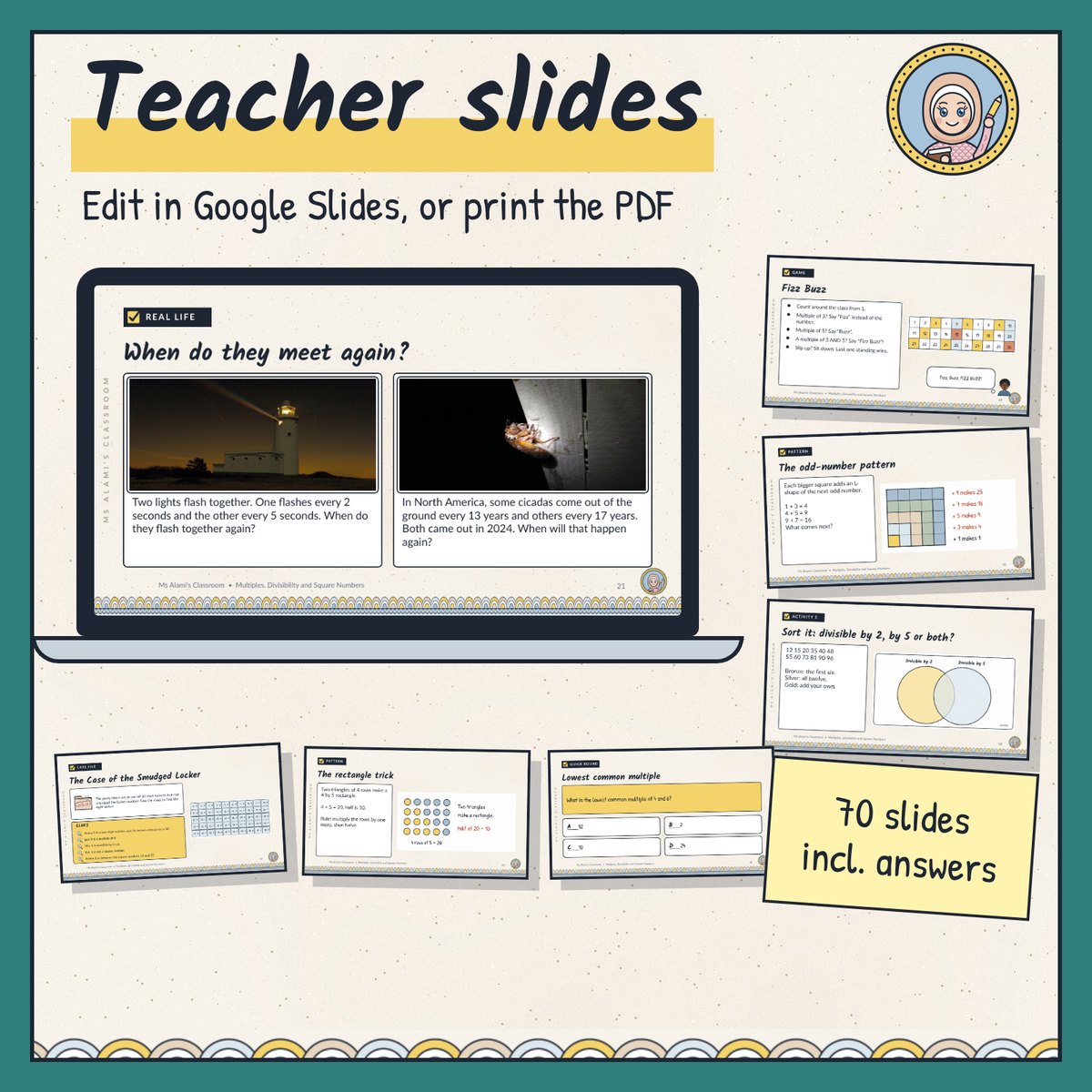
Count around the class from 1. Multiples of 3 say "Fizz", multiples of 5 say "Buzz", and multiples of both say "Fizz Buzz". Anyone who slips sits down. Afterwards, ask which numbers up to 100 were Fizz Buzz: 15, 30, 45, 60, 75 and 90. They are the common multiples of 3 and 5, and every one is a multiple of 15. Students have found common multiples before you have named them.
Common multiples and the lowest common multiple
Back to the sizzle. List the multiples of each number:
- Sausages (packs of 8): 8, 16, 24, 32, 40, 48
- Bread rolls (packs of 6): 6, 12, 18, 24, 30, 36, 42, 48
The numbers on both lists are common multiples: 24 and 48. The smallest, 24, is the lowest common multiple. That is 3 packs of sausages and 4 packs of rolls, with nothing left over.
The quick way: list the multiples of the bigger number (8, 16, 24 …) and stop at the first one the smaller number goes into.
Divisible means no remainder
24 ÷ 6 = 4 with no remainder, so 24 is divisible by 6. 26 ÷ 6 = 4 remainder 2, so 26 is not. There are three ways to check:
- Divide and look for a remainder.
- Use a fact you know: 7 × 8 = 56, so 56 is divisible by 7 and by 8.
- Look at the last digit for 2, 5 and 10. Even numbers are divisible by 2, numbers ending in 0 or 5 are divisible by 5, and numbers ending in 0 are divisible by 10. These are the hundred chart patterns again.
For a whole-class version, everyone stands and gets into groups of 2, then 3, then 4 and 5. When nobody is left out, your class number is divisible by that group size. With 26 students, pairs work (13 groups), but groups of 3 leave 2 people out (26 ÷ 3 = 8 remainder 2).
What about the digit-sum rule?
The tests for divisibility by 3, 4 and 6 (add the digits for 3, check the last two digits for 4) are in the NSW Stage 4 syllabus (MA4-IND-C-01, Indices). They make a good extension for students who are ready, but in Stage 3 the focus is on multiples, known facts and remainders.
Practice questions
1. What is the 8th multiple of 7? 7 × 8 = 56.
2. Which of these are multiples of 6: 26, 36, 46, 54, 60? 36, 54 and 60.
3. What is the lowest common multiple of 4 and 6? 12. (24 is a common multiple, but not the lowest.)
4. Party pies come in boxes of 12 and sausage rolls in boxes of 8. What is the smallest number of each so they match? 24: 2 boxes of pies and 3 boxes of rolls.
5. Two lights flash together. One flashes every 4 seconds and the other every 6 seconds. When do they flash together again? After 12 seconds, then after 24 seconds.
6. Is 96 divisible by 8? Is 100 divisible by 6? Yes, 8 × 12 = 96. No, 100 ÷ 6 = 16 remainder 4.
7. 24 bowlers want lanes with the same number of players. Can they use lanes of 5? Of 6? Lanes of 5: no, 24 ÷ 5 = 4 remainder 4. Lanes of 6: yes, 4 lanes.
8. Gold: find the smallest number bigger than 50 that is divisible by both 4 and 6. 60. The common multiples of 4 and 6 are 12, 24, 36, 48, 60.
Mistakes to watch for
- Mixing up factor and multiple: "24 is a multiple of 48". The multiple is the bigger one, so 48 is a multiple of 24.
- Thinking the lowest common multiple is always the two numbers multiplied together. 4 × 6 = 24, but the lowest common multiple is 12.
- Adding instead of multiplying: "the 20th multiple of 4 is 4 + 20".
- Checking divisibility by 5 with the first digit instead of the last.
Resource that goes with this post
Multiples, Divisibility and Square Numbers has the bowling party opening, Fizz Buzz, the sausage sizzle problem, a full-page hundred chart, a Venn diagram sort, Kai's check and Bronze, Silver and Gold questions on every activity. It is also in the Whole Number Unit Bundle. The next post covers square and triangular numbers.