
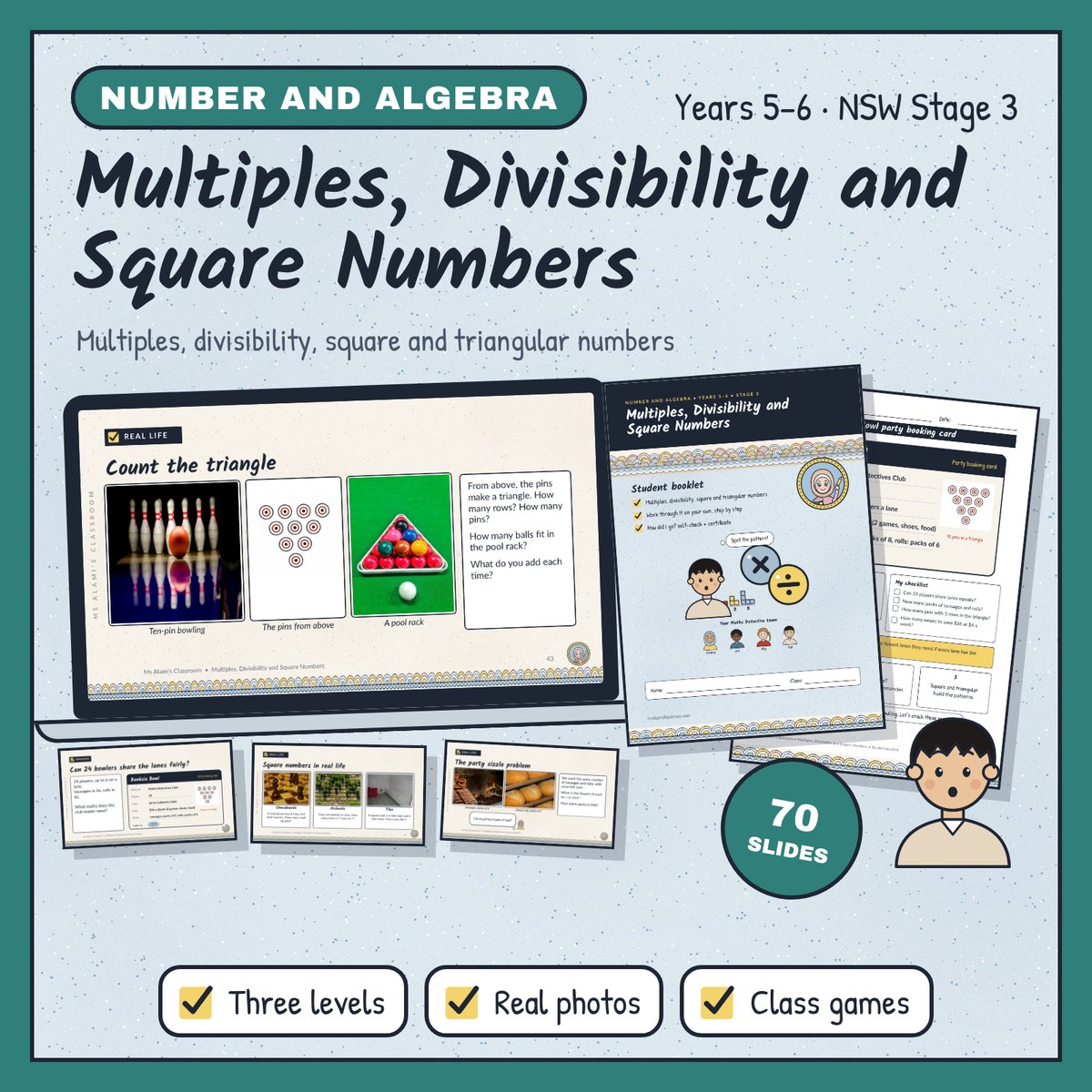
Ask a class how many pins there are in ten-pin bowling and most will tell you 10. Ask what shape they stand in, and how many rows, and you have a triangular number on the board: 1 + 2 + 3 + 4 = 10. A pool rack holds the next one, 15.
Square and triangular numbers are a good way to practise multiplication and patterns at the same time. Here is how I teach them in Years 5 and 6.
Where they sit in the NSW syllabus
Square and triangular numbers are not named as their own content points in the NSW Mathematics K–10 Syllabus (2022). They fit two Stage 3 points: modelling a whole number as a product (a square array is 6 × 6), and using a geometric pattern to make a table of values and describe the rule (MA3-MR-01 and MA3-MR-02). The NSW Department of Education's Stage 3 "Staircase patterns" lesson uses them the same way. Writing 5² and square roots (√25 = 5) is Stage 4 (MA4-IND-C-01), so keep that for students who are ready.
Square numbers are square arrays
A square number is a whole number multiplied by itself. Its dots make a square, with the same number of rows and columns. 3 × 3 = 9, so 9 is a square number, and we say "3 squared". Ask whether 10 is a square number and let students try with counters. 3 × 3 = 9 is too small and 4 × 4 = 16 is too big, so 10 only makes rectangles, such as 2 rows of 5.
Then show the odd-number pattern. Each bigger square adds an L-shape of the next odd number:
- 1
- 1 + 3 = 4
- 4 + 5 = 9
- 9 + 7 = 16
- 16 + 9 = 25
In real life, a chessboard has 8 rows of 8 small squares, which is 64. An orchard planted in 7 rows of 7 has 49 trees.
Triangular numbers grow by one more each row
A triangular number is the number of dots in a triangle where each row has one more dot than the row before: 1, 3, 6, 10, 15, 21, 28 and so on. Put it in a table of values:
- Rows: 1, 2, 3, 4, 5, 6
- Dots: 1, 3, 6, 10, 15, 21
The rule from one number to the next is "add the next row number": 10 + 5 = 15, then 15 + 6 = 21.
The rectangle trick
The syllabus asks students to describe patterns using multiplication, not only addition. Take two copies of the 4-row triangle, turn one around and push them together. They make a rectangle of 4 rows of 5. 4 × 5 = 20, and half of 20 is 10. That works for any triangle: multiply the number of rows by one more, then halve. The 10th triangular number is 10 × 11 = 110, halved, which is 55.
Cup stacking
Plastic cups make it hands-on. A pyramid with 4 cups on the bottom row needs 4 + 3 + 2 + 1 = 10 cups. Groups build pyramids with 1 to 6 cups on the bottom row and fill in a table: 1, 3, 6, 10, 15, 21. Then ask the backwards question: you have 30 cups, so what is the biggest full pyramid you can build? (7 cups on the bottom uses 28 cups, with 2 left over.)
Practice questions
1. Which of these are square numbers: 20, 25, 48, 49, 64, 90? 25, 49 and 64.
2. Which square number is between 70 and 90? 81.
3. What is 1 + 3 + 5 + 7 + 9? 25, which is 5 × 5.
4. What comes next: 1, 3, 6, 10, 15 …? 21.
5. How many balls fit in a pool rack with 5 rows? 15.
6. Use the rectangle trick to find the 8th triangular number. 8 × 9 = 72, and half of 72 is 36.
7. Five people each shake hands once with everyone else. How many handshakes? 4 + 3 + 2 + 1 = 10, a triangular number.
8. Gold: which number below 40, other than 1, is both a square number and a triangular number? 36 (6 × 6, and the 8th triangular number).
9. Gold investigation: add neighbouring triangular numbers (1 + 3, 3 + 6, 6 + 10 …). What do you notice? 4, 9, 16, 25, 36: a square number every time. Turn one staircase around and it fits against the other to make a square.
Mistakes to watch for
- Doubling instead of squaring: "8 squared is 16". 8 squared is 8 × 8 = 64.
- Mixing up the two patterns: "the 5th triangular number is 25". 1 + 2 + 3 + 4 + 5 = 15, and 25 is the 5th square number.
- Forgetting to halve in the rectangle trick.
Resource that goes with this post
Multiples, Divisibility and Square Numbers has the bowling pins and pool rack photos, dot square and triangle patterns, the rectangle trick, cup stacking, The Case of the Smudged Locker and Bronze, Silver and Gold questions on every activity. It is also in the Whole Number Unit Bundle. For multiples and divisibility, see common multiples and divisibility in Years 5–6.