
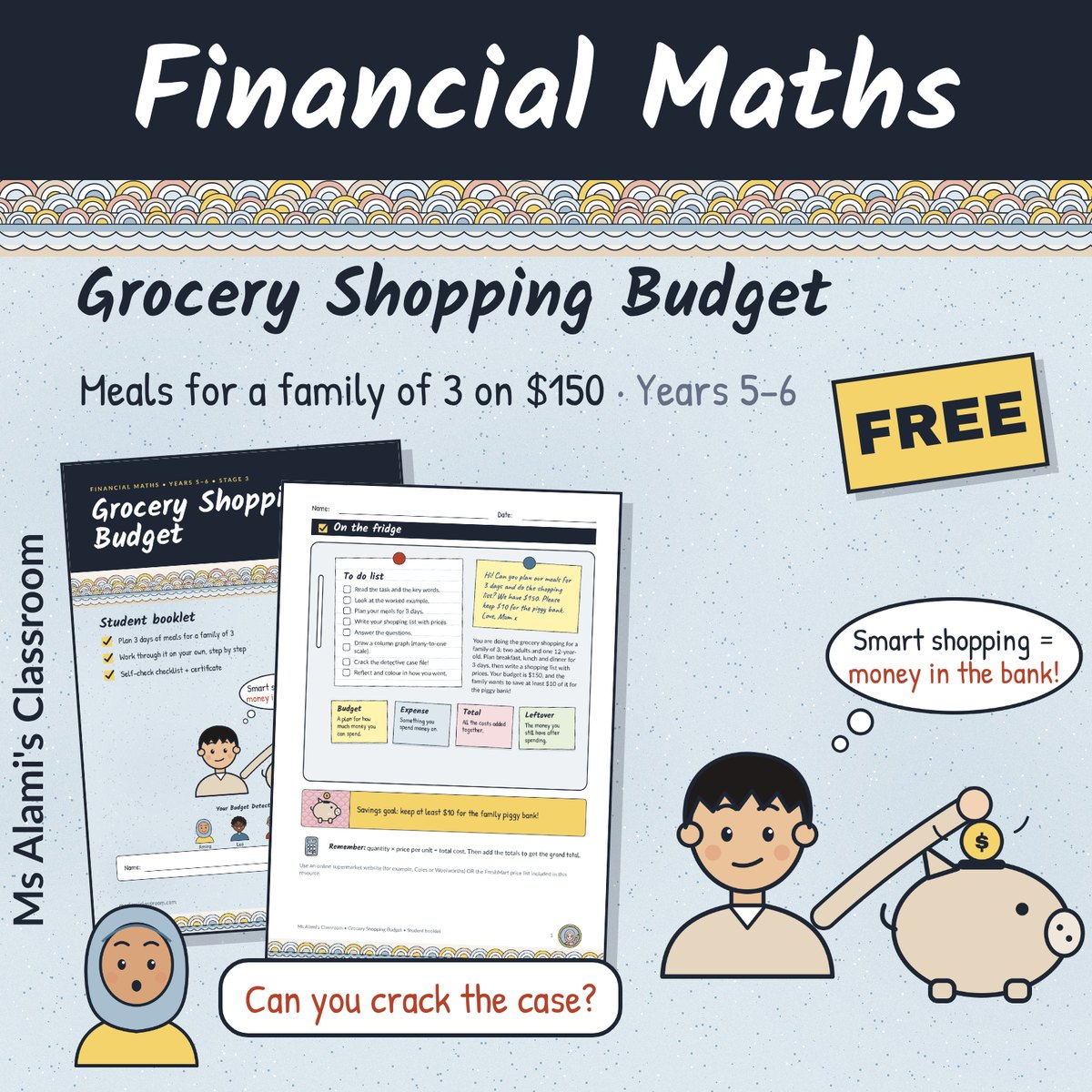
Meal planning is one of the most realistic budgeting tasks you can give a Year 5 or 6 class. Every student has watched someone do the grocery shopping, and most have opinions about what's for dinner. This free activity turns that into a full financial maths lesson.
The task
Students do the grocery shopping for a family of 3: two adults and one 12-year-old. They:
- plan breakfast, lunch and dinner for 3 days
- write a shopping list with quantities and prices
- stay within a budget of $150
- keep at least $10 for the family piggy bank
Real prices or a price list
Students can look up prices on an online supermarket website such as Coles or Woolworths. This shows them that prices change and that brands cost different amounts. If devices aren't available, use the FreshMart price list included in the resource, so everyone works from the same numbers.
The maths students practise
- Multiplying quantity by price, for example 2 packs of pasta at $2.00 = $4.00
- Adding a long list of costs and checking the total against the budget
- Rounding totals to the nearest $5
- Drawing a column graph of spending by food group, using a many-to-one scale
It links to the NSW Stage 3 outcomes MA3-AR-01, MA3-MR-01 and MA3-DATA-01.
How to run it
It takes 2 lessons of 45–60 minutes. In the first lesson, use the teacher slides to introduce the money words and go through the worked example together: a spaghetti dinner for the whole family that costs $15.50. In the second lesson, students finish their plan in the student booklet, check their totals, make their graph and solve the detective case file.
The download includes:
- 21 teacher slides with answers, editable in Google Slides or PowerPoint, plus a PDF
- a 12-page A4 student booklet in colour and in black and white
- an editable PowerPoint copy of the booklet
- teacher instructions
Tips for the lesson
- Ask students to set aside the $10 savings first, then plan with $140.
- Get students to plan dinners first. They cost the most, so the rest of the budget becomes clearer.
- Finish with the reflection question: Why is it useful to plan meals before going shopping?
Download it free
Get the Grocery Shopping Budget. Pop in your email and the link arrives straight away. If your class enjoys it, there are two more tasks that follow the same routine: a school canteen budget and a class trip to the cinema. You can also read more about teaching budgeting in Years 5–6.