
There are 144 facts on a 1 to 12 times tables chart, and most classes have students who know some tables well and others hardly at all. Practising all the times tables together works best when you go in a sensible order, keep it short and make it a game.
The best order to practise the times tables
Not all tables are equally hard. Start with the ones students can work out quickly, then use them as stepping stones:
- Warm-up: the 1s, 2s, 3s, 4s and 10s. × 1 keeps the number the same, × 2 is double, × 4 is double then double again, × 3 is double then one more group, and × 10 is that many tens.
- Core: the 5s, 6s, 7s, 8s and 9s. × 5 is half of × 10. For the 6s, 7s and 8s, start at × 5 and add groups. For the 9s, do × 10 and take one group away.
- Tricky: the 11s, 12s and the hardest facts. × 11 and × 12 start at × 10 and add groups. Give extra goes to the facts most students find hardest: 6 × 7, 6 × 8, 6 × 9, 7 × 7, 7 × 8, 7 × 9, 8 × 8 and 8 × 9.
- Everything: mixed facts from 1 to 12. Once each group is secure, mix them all up so students have to recall, not just count on.
Turn-arounds halve the work. If you know 7 × 8 = 56, you know 8 × 7 too, and the fact family gives you 56 ÷ 7 and 56 ÷ 8 for free. That is why only 78 of the 144 facts on the chart are really different.
A 10-week plan for all the times tables
- Weeks 1–2, Warm-up: the 1s, 2s, 3s, 4s and 10s. Team race with the Warm-up deck.
- Weeks 3–5, Core: the 5s, 6s, 7s, 8s and 9s. Team race with the Core deck, then pairs in the browser game.
- Weeks 6–7, Tricky: the 11s, 12s and the hardest facts. Team race with the Tricky deck.
- Weeks 8–9, Everything: mixed facts from the 1s to the 12s. Team race with the Everything deck.
- Week 10, your own tricky tables: pairs pick the tables they still find hard in the browser game.
Three short games a week (10 minutes at the start of a maths lesson) is enough. Keep the 1 to 12 times tables grid on the wall for students to check turn-arounds and spot patterns, like the square numbers on the diagonal.
Track progress from Bronze to Gold
A tracker shows students how far they have come, which keeps them going. For each table, students tick:
- Bronze: I can count in it.
- Silver: I can say it in order.
- Gold: I can do it mixed up, in a race.
When most of the class has Gold in a group of tables, move on to the next group.
Why a team race works
The NSW syllabus asks Stage 2 students to recall multiplication facts and use fact families (MA2-MR-01), and Stage 3 students to use them to find products, factors and multiples (MA3-MR-01). A Red team vs Blue team race gives every student a reason to recall the fact quickly: one try per card, a point and a hop along the track for a right answer, and a strategy hint for a wrong one before the other team gets the next card.
Ready-made: Mystery Card Race All Tables 1 to 12
If you'd like this ready to play, Mystery Card Race: All Tables 1 to 12 has everything in this plan:
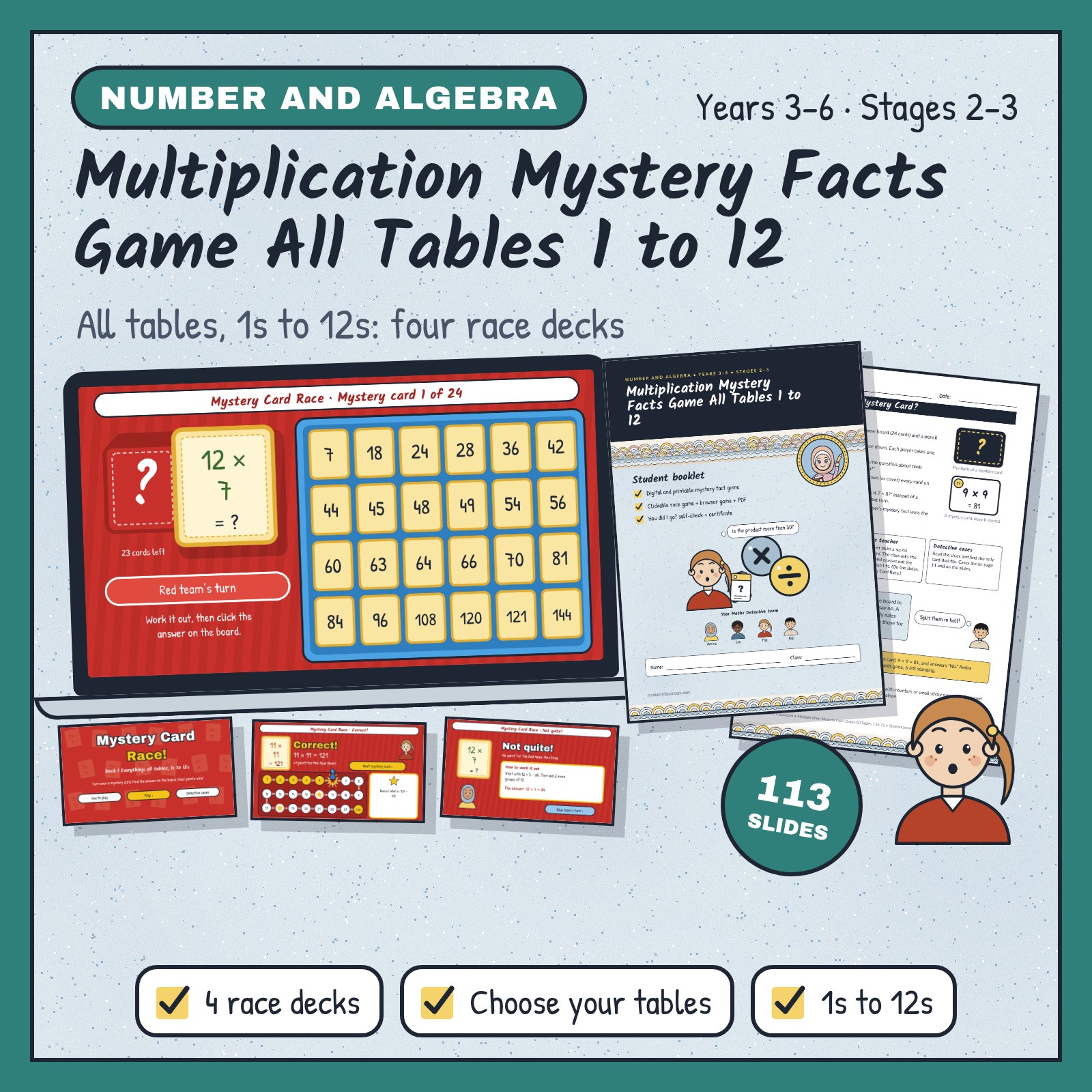
- Four race decks: Everything, Warm-up, Core and Tricky, with sound effects and a hopping counter, for Keynote, Google Slides and PowerPoint.
- A browser game with a table picker: tick any tables from 1 to 12 and every game deals a new deck of 24 cards.
- A printable 1 to 12 times tables grid and the Bronze, Silver and Gold tracker.
For students who need more time on particular tables, there are games for the 2s, 3s and 4s, 6s and 5s, 8s and 7s, 10s and 9s, 11s and 12s and mixed facts. All seven are in the Times Tables Games Bundle.
For tips on running the race itself, read Times Tables Games for Years 3–6: A Team Race Game.