
Give a pair of students a pile of matchsticks and ask them to make separate squares: one square, then two, then three. Ask how many matchsticks they would need for 25 squares. The first answer is usually "keep building". The second answer, once someone looks at the numbers, is "4 times 25".
That move from counting to multiplying is what the NSW syllabus means by describing a pattern "in terms of multiplication rather than addition" (MA3-MR-02).
Step 1: Build it and record it in a table
Set it out like this, with the position on top and the count underneath:
- Squares: 1, 2, 3, 4, 5
- Matchsticks: 4, 8, 12, 16, 20
The top row is the position (how many squares). The bottom row is the number of matchsticks.
Step 2: Say the rule two ways
Students will first say "add 4". That rule works down the list, from one number to the next. Then ask for a rule that works across the table, from the top number to the bottom number: "multiply the number of squares by 4". Both are true. Only the second gets you to the 100th square without counting: 100 × 4 = 400 matchsticks.
Step 3: Go backwards with the inverse
If Ms Alami has 60 matchsticks, how many separate squares can she make? The rule multiplies by 4, so the inverse divides by 4: 60 ÷ 4 = 15 squares. This is the same thinking as solving ☐ × 4 = 60.
Step 4: A function machine
A function machine is the same idea with a box in the middle. A number goes in, the rule happens, and a number comes out. In 3, rule × 6, out 18. Covering the rule and showing only the in and out numbers turns it into a puzzle: in 5, out 35, so the rule is × 7.
Practice questions
1. Describe the pattern 6, 12, 18, 24 using multiplication. What is the 50th number? Each number is 6 × its position. The 50th number is 6 × 50 = 300.
2. A table has top numbers 1, 2, 3 and bottom numbers 5, 10, 15. What is the bottom number when the top number is 12? The rule is multiply by 5, so 12 × 5 = 60.
3. How many matchsticks do 9 separate squares need? 9 × 4 = 36.
4. How many separate squares can you make with 84 matchsticks? 84 ÷ 4 = 21 squares.
5. A function machine multiplies by 8. What comes out when 7 goes in? What went in if 96 came out? 7 × 8 = 56. 96 ÷ 8 = 12.
6. Is 100 in the pattern 7, 14, 21, 28 …? How do you know? No. The pattern is the multiples of 7, and 100 ÷ 7 = 14 remainder 2, so 100 is not a multiple of 7.
7. Gold: squares joined in a row share a side. 1 square uses 4 matchsticks, 2 squares use 7, 3 squares use 10. How many matchsticks for 10 squares? Each new square adds 3 matchsticks. The rule is multiply the number of squares by 3, then add 1: 10 × 3 + 1 = 31.
Mistakes to watch for
- Giving the "add 4" rule when the question asks for the 100th term.
- Mixing up the rows: multiplying the bottom number instead of the top.
- Using the separate-squares rule for joined squares. Joined squares share sides, so the rule changes.
- Forgetting to check the rule against every pair in the table, not just the first one.
Resource that goes with this post
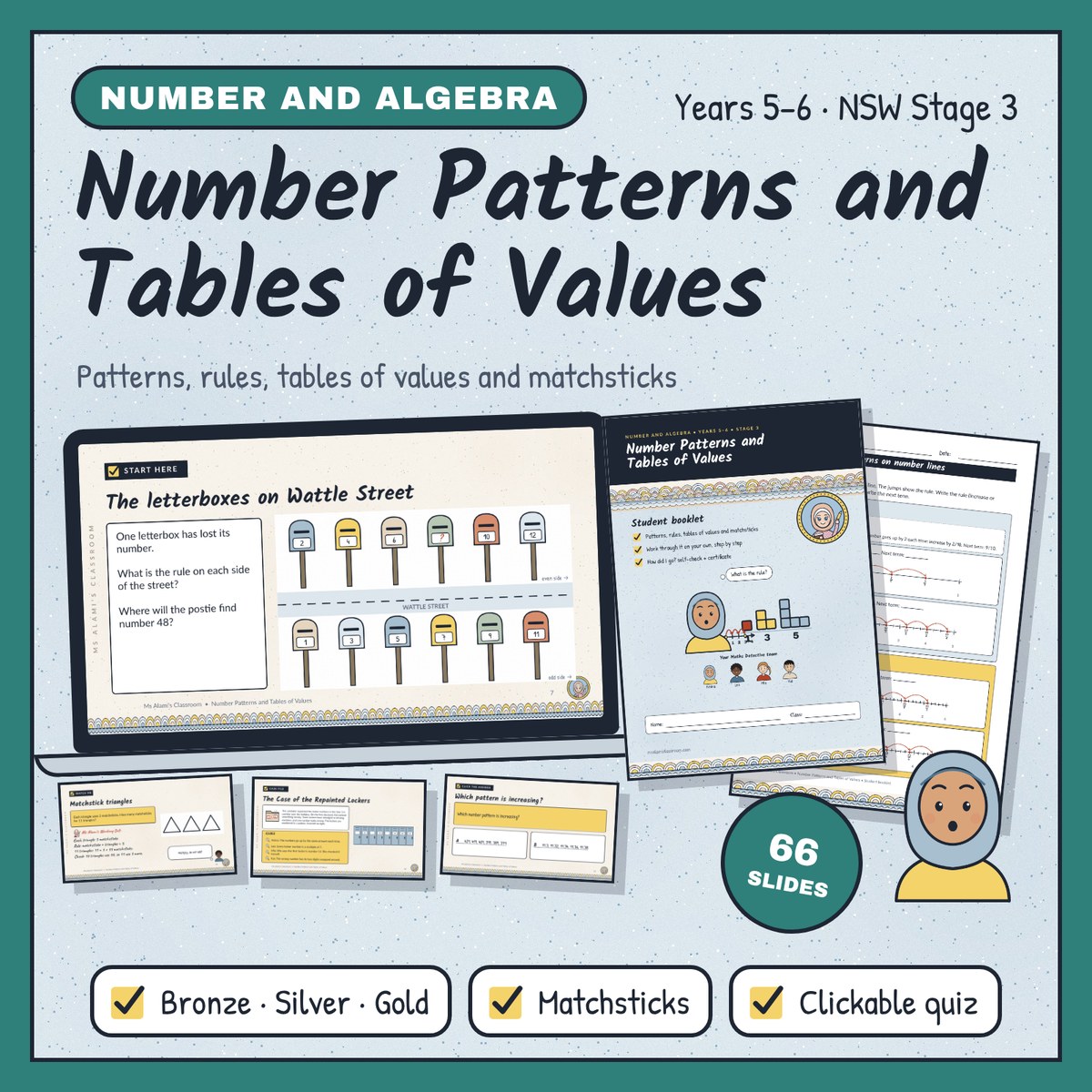
Number Patterns and Tables of Values has the matchstick triangle pattern, tables of values, function machines, the 30th and 100th term, Kai's check of the detectives' tables and Bronze, Silver and Gold questions on every activity. It is also in the Patterns and Algebra Bundle. For the whole unit, see teaching patterns and algebra in Years 5–6.