
Ask a Year 5 class for the 100th number in the pattern 4, 8, 12, 16 and many students start counting in fours. Ask for the rule and you will hear "add 4". Both answers are fine for the 5th number. Neither gets you to the 100th.
That is the shift Stage 3 algebra is about: from "what comes next" to "what is the rule that connects the position to the number". Once students see 4 × 100 = 400, they are doing algebra, even though there is not a letter in sight.
What the NSW syllabus asks for
In the NSW Mathematics K–10 syllabus, patterns and algebra in Years 5 and 6 sit in Multiplicative relations B, outcome MA3-MR-02: students construct and complete number sentences involving multiplicative relations, applying the order of operations to calculations. The content points are:
- use equivalent number sentences involving multiplication and division to find unknown quantities, such as 5 × ☐ = 4 × 10
- complete number sentences that involve more than one operation by calculating missing numbers
- use inverse operations to help solve number sentences
- recognise that division can be recorded as a fraction
- represent and describe number patterns formed by multiples, including a geometric pattern turned into a table of values
- describe a pattern in words, using multiplication rather than addition
- determine a rule that connects the bottom number and the top number in a table
- recognise the need to agree on the order of operations, use brackets, and solve problems with them in real-life contexts
What is Stage 4 in NSW
Using a letter for an unknown (5 + y = 22), indices, and the order of operations with negative numbers are Stage 4. NESA's advice also warns against BODMAS-style memory rules, because the "O" or "I" stands for powers and roots, which Stage 3 students have not met.
The order I teach it in
1. Patterns and the rule
Start with increasing and decreasing patterns in whole numbers, decimals and fractions, then move quickly to patterns of multiples. The key question is always "what would the 100th number be?". Matchstick patterns are the best way in: students build them, count them, and put them in a table. More on that in tables of values and matchstick patterns.
Resource: Number Patterns and Tables of Values.
2. Number sentences that balance
An equals sign means "is the same as", not "the answer goes here". Students who think 6 × 2 = ☐ + 4 means "write 12" have the wrong idea of equals. Equivalent number sentences fix this: work out the side you can, then find the missing number that makes both sides the same. The inverse operation does the rest.
3. Brackets and the order of operations
Write 3 + 4 × 5 on the board and let the class argue. Some will say 35 and some 23. That argument is exactly why we agree on an order. See order of operations for Years 5–6.
Resource: Order of Operations and Number Sentences.
How I keep every student in the same lesson
Algebra is where the gap in a class shows. My answer is three levels on every practice page, all with the same lesson goal:
- Bronze (Beginner): a help box that shows the method with different numbers, and short questions with part of the table filled in.
- Silver (Intermediate): the questions at the level of the syllabus.
- Gold (Expert): find the mistake, work backwards, or make up a pattern for a partner.
Students start at Bronze if they are unsure and move up when they get nearly all of a level right. Then the whole class does the same detective case file together, so nobody sits out the shared task.
Resources that go with this post
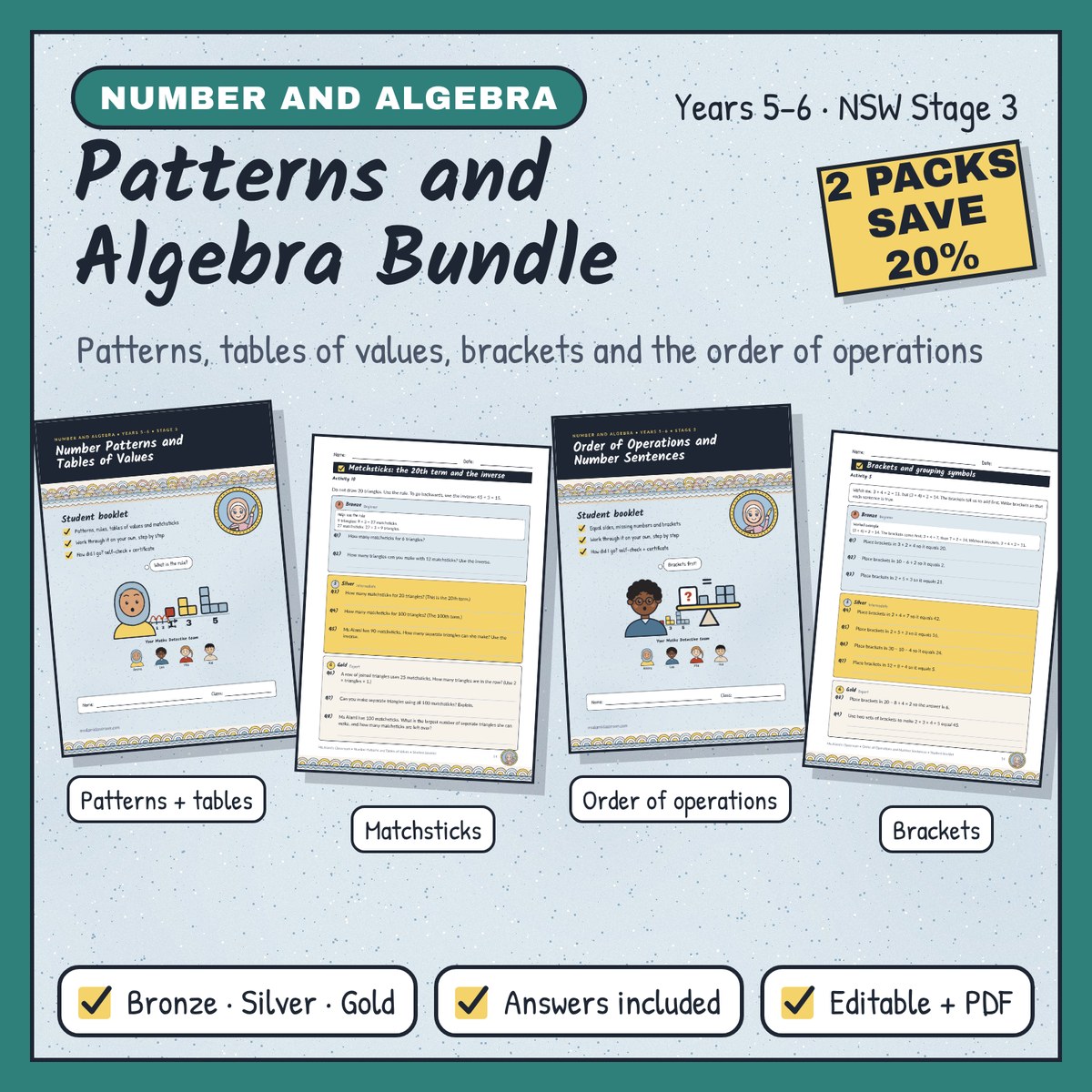
The Patterns and Algebra Bundle has both packs, with teacher slides, student booklets, clickable questions, case files and full answer guides.