
Translation, reflection and rotation activities work well when students have to explain how a shape moved. “It turned” is a start. “It rotated a quarter turn clockwise about the marked point” tells another student how to reproduce the transformation.
Start with exact coordinate points
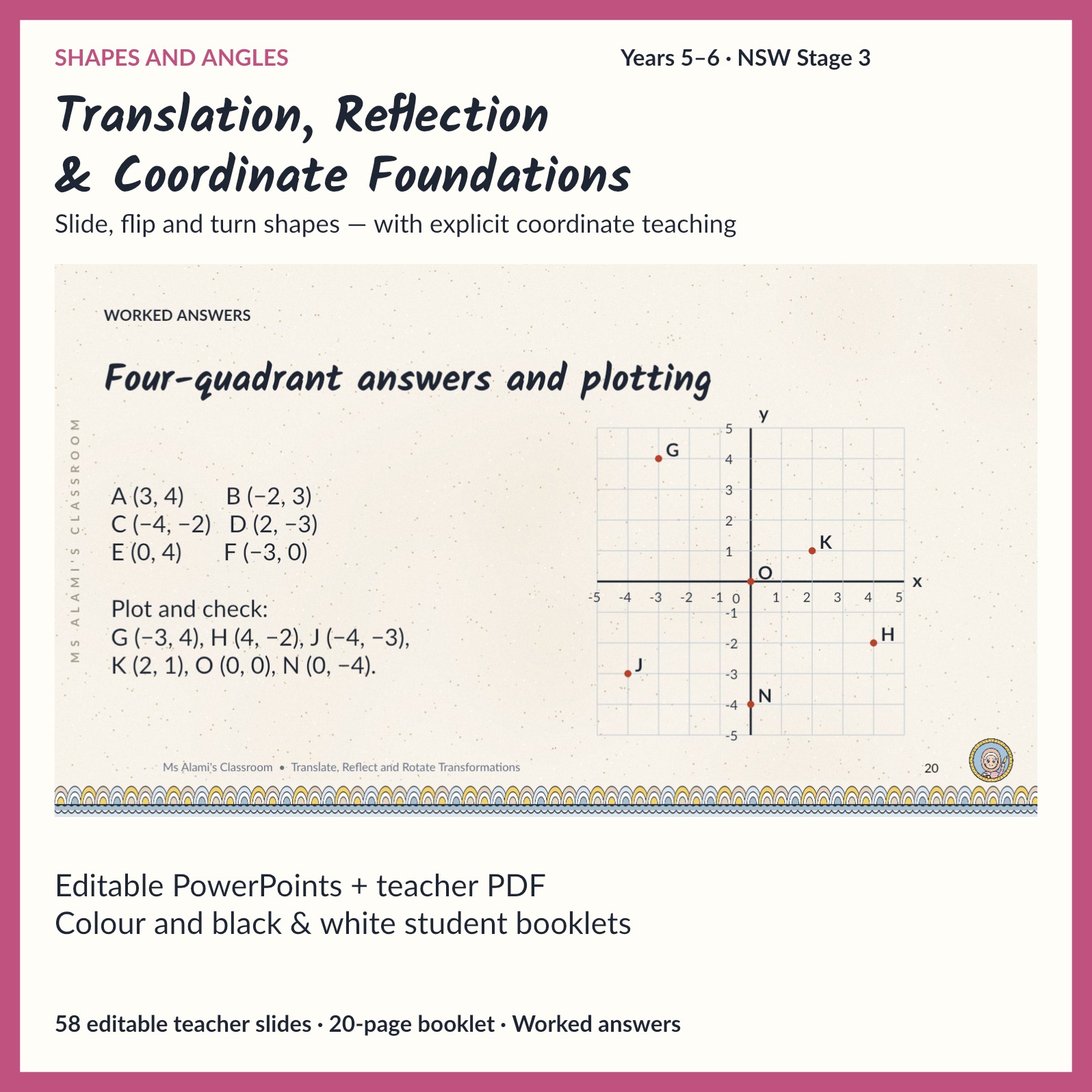
Before transforming points, teach the difference between a map reference such as B2, which names a square, and an ordered pair such as (2, 1), which names an exact intersection. The lines are numbered, not the spaces. The x-axis runs horizontally, the y-axis vertically, and they meet at the origin (0, 0). Read x first, then y.
Start in the first quadrant, then include negative coordinates in all four quadrants. Include points on each axis: a point on the y-axis has x = 0, and a point on the x-axis has y = 0. The updated lesson pack includes six teaching slides and three booklet pages for these foundations, with worked answers.
Translation: every point moves together
A translation slides a shape without turning or flipping it. Ask students to choose a vertex, count its horizontal and vertical movement, then repeat that movement for every vertex.
For example, moving a triangle 5 squares left and 4 squares down changes A (1, 1) to A′ (−4, −3), B (4, 1) to B′ (−1, −3), and C (1, 3) to C′ (−4, −1). Each point follows the same movement. The side lengths and angles stay the same.
Before students join the new vertices, ask them to check that the shape still faces the same way.
Reflection: match the distance from the mirror line
A reflection flips a shape across a mirror line. Students should count the perpendicular distance from each vertex to the line and place its image the same distance on the other side. A mirror can help check the result.
On the coordinate plane, reflecting (3, 2) across the y-axis gives (−3, 2). The point stays at the same height and moves to the same distance on the opposite side. Across the x-axis, it becomes (3, −2).
Use an asymmetric shape such as a flag or an L. A symmetrical shape can hide the difference between a reflection and another transformation.
Rotation: keep the centre fixed
Introduce a quarter turn as 90°, a half turn as 180° and a three-quarter turn as 270°. State the direction and centre of rotation every time.
Tracing paper helps students keep the centre fixed: trace the shape and the centre point, hold that point in place, turn the paper, then draw the new image. Check that corresponding vertices remain the same distance from the centre.
Ask students to compare a clockwise quarter turn, an anticlockwise quarter turn and a half turn of the same L. Their explanations are more useful than a quick guess at the matching picture.
A short quiz that makes students explain
The Translation, Reflection and Rotation lesson pack has a 10-question clickable quiz. Students select an image or mirror line, then use the answer slide to discuss the reasoning. A printable version supports independent work and gives you a record of students’ choices.
Follow the quiz with grid worksheets and a coordinate-plane task. Students can then solve the Tile Mix-up case file, where one reflected tile interrupts a rotation pattern.
Connect transformations to a design task
A canteen splashback gives students a reason to use all three transformations. They design a pattern with 16 tiles and calculate a materials budget. For example, 6 pattern tiles at $6.00 and 10 plain tiles at $3.50 cost $36.00 + $35.00 = $71.00. From a $90.00 budget, $19.00 remains, meeting a $15.00 savings goal.
The pack includes 58 editable teacher slides, a 20-page booklet, colour and black & white PDFs, editable student booklets and worked answers. Its transformation and coordinate work supports NSW Stage 3 MA3-2DS-01 and MA3-GM-01.
For another practical context, see the NSW Department of Education’s sponge art transformations activity. Combine the unit with types of angles and protractor practice and classifying triangles when planning your geometry sequence.
For a related investigation, compare the matching turns of four quadrilaterals in the polygon properties and symmetry pack.