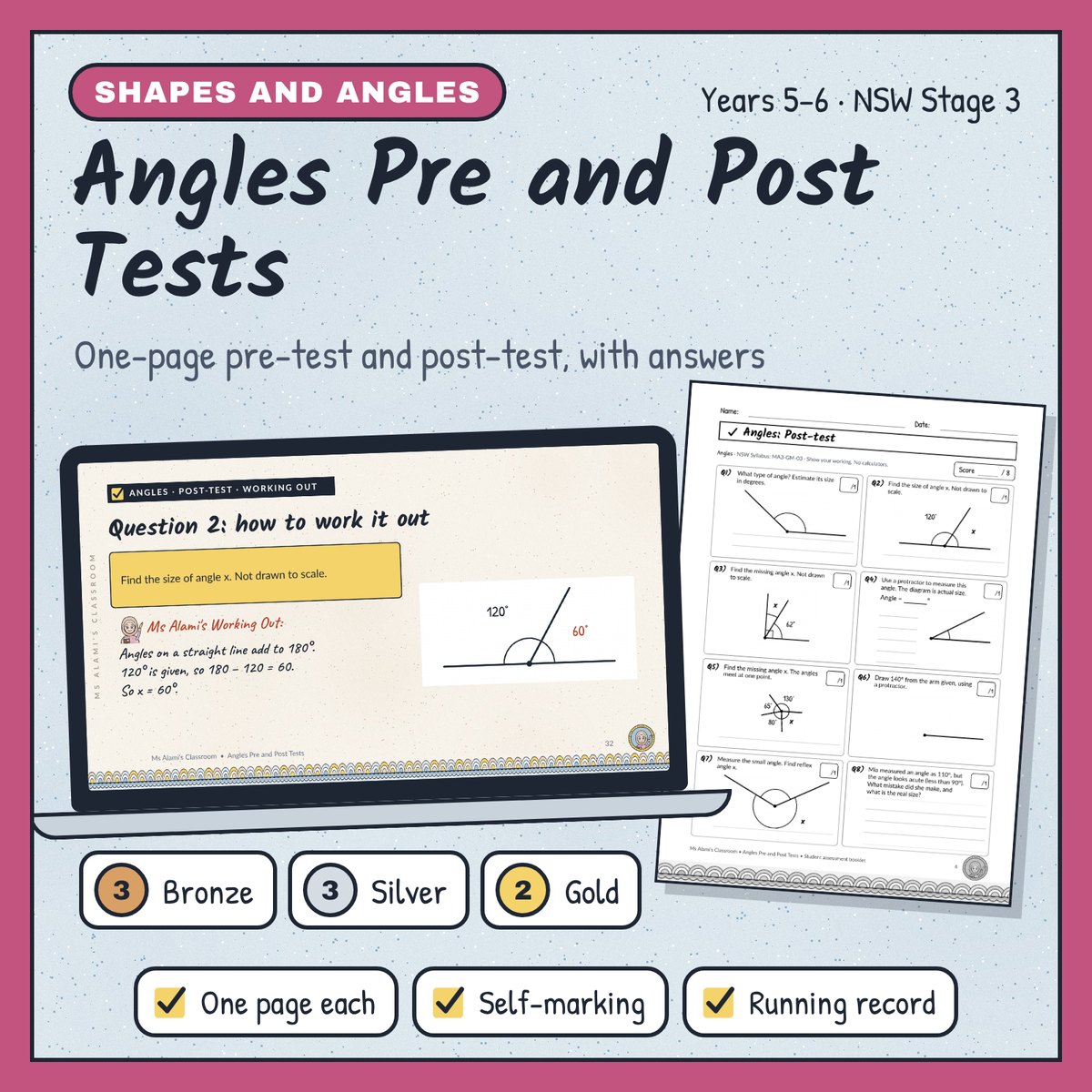
Kai measures an acute angle and writes 130°. He read the wrong scale on the protractor, which is the mistake I see most when students start measuring angles. Question 8 on the pre-test asks students to explain what he did and give the real size. Students who estimate first rarely make that mistake, so question 1 asks for an estimate.
How it runs
- Before you teach angles, run the one-page pre-test. It takes 20 to 30 minutes, with pencils and a ruler and a protractor, and no calculators. You see what each student already knows before the first lesson, so you can group them.
- Students mark their own test with the answer booklet and a coloured pen. Every answer has a "Mark it right if" line, so they know exactly what earns the mark. Check a sample.
- Go over it with the teacher slides: each question, then a slide that works it out step by step. Answers and common errors are in the speaker notes.
- After the unit, run the one-page post-test. Question 1 on the post-test checks the same skill as question 1 on the pre-test, and so on through question 8, with new numbers, so you can compare them directly.
- Type one total out of 8 for each test into the running record spreadsheet. It works out growth, an A to E level from the post-test, the class average, results for each NESA outcome and a suggested report comment for each student.
Maths covered
NSW Stage 3, MA3-GM-03 (measures and constructs angles, and identifies the relationships between angles on a straight line and angles at a point). The eight questions, in order:
- naming an angle type and estimating its size
- finding a missing angle on a straight line
- finding a missing angle in a right angle
- measuring an angle with a protractor
- finding a missing angle at a point
- drawing an angle with a protractor
- measuring a reflex angle
- explaining a protractor scale mistake
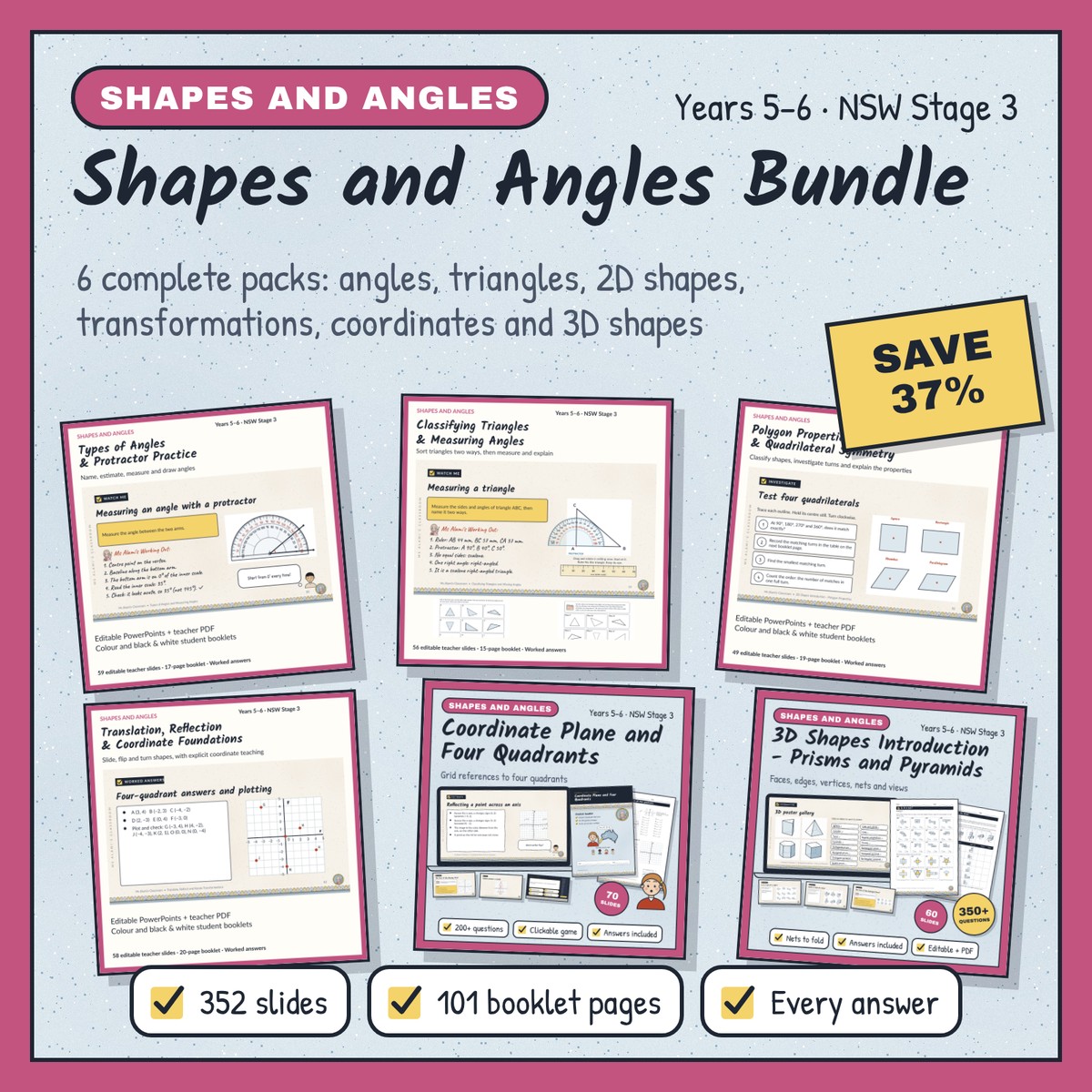
Every question matches content taught in my Types of Angles and Measuring Angles pack.
Good to know
- The booklets are black and white only, ready to photocopy.
- The student booklet and the answer booklet each come as one PDF and one editable PowerPoint that matches the PDF page for page, so you can change a number, a name or a question before you print.
- Each test mixes three Bronze, three Silver and two Gold questions, roughly easier first. The levels are not printed on the student page, so nobody sees a label. You will find them on the teacher slides.
- Stage 3 outcomes cover Year 5 and Year 6, so one version suits both, and you can run the test whenever you teach the topic.
- If you use Keynote, install the fonts included before you open the PowerPoints.
- All 19 topic tests are in the Maths Pre and Post Tests Bundle: $39 instead of $95, a 59% saving.