
Ask a Year 5 class to plot (2, 5) and you'll usually see a few students go up 2 and across 5. Others will draw their dot in the middle of a square, the way they find a street on a map. Both mistakes make sense. Students have used grid maps for years, and nothing has told them yet that the number plane works differently. These coordinate plane activities tackle both habits early, then build up to all four quadrants.
Start with a map, then move to the number plane
Begin with something students already know: a grid map. A reference like C3 names a whole square. It tells you the area, not the exact spot. Then show the same idea on a number plane. The point (3, 2) is where two lines cross, not a space between them.
A quick way to make this stick: hide a counter somewhere in square C3 on a big floor grid and ask a student to find it. They can't, without searching the whole square. Then hide it at (3, 2) on taped lines and they walk straight to it. That's the difference between an area and an exact point.
Questions to ask early:
- Does B2 name a square or a point?
- Where is the origin, and what are its coordinates? (0, 0)
- Are the lines numbered, or the spaces?
Plotting coordinates in the first quadrant
Teach one routine and repeat it: start at the origin, go across first, then up. Say it out loud every time. “Across, then up” fixes most of the swapped-number errors before they start.
Give students plenty of reading and plotting, not just three or four points. A grid with 16 labelled points to read, then 12 more to plot, builds fluency much faster than a single example. Mix in points that sit on an axis, such as (0, 4) and (3, 0), because these are the ones students hesitate over.
Linking coordinates to 2D shapes works well here too. Ask students to plot A (1, 2), B (4, 2) and C (4, 5), the three corners of a square, then work out where the fourth corner must be. They have to count side lengths along the grid lines and reason about the shape, not just plot dots.
Moving into all four quadrants
Once the first quadrant is secure, extend both axes past zero. Left of the y-axis, x is negative. Below the x-axis, y is negative. Students already meet negative numbers on a number line in Stage 3, so connect the two.
A short sorting task helps students think about signs before they plot. Give them a list of coordinates such as (−7, 2), (8, −3), (0, −6) and (9, 0), and ask: which quadrant, or which axis? Points on an axis aren't in any quadrant, and that surprises students every time.
A hidden picture is a good way to practise plotting at volume. Students plot and join a set of points in order across all four quadrants. If they swap a pair, the picture looks wrong straight away, so they check themselves.
Translating and reflecting points
The NSW Stage 3 syllabus asks students to describe how coordinates change when a point is translated or reflected across an axis. Keep it concrete:
- Translating: moving right or left changes x. Moving up or down changes y. A point at (−2, 1) that moves 5 right and 3 down lands on (3, −2). Have students count along the grid, then look for the pattern.
- Reflecting across the y-axis: the point flips left or right, so x changes sign and y stays the same. (4, 2) becomes (−4, 2).
- Reflecting across the x-axis: the point flips up or down, so y changes sign. (4, 2) becomes (4, −2).
Ask students what happens to a point that sits on the mirror line. A point on the y-axis, like (0, 2), doesn't move when it's reflected across the y-axis. Explaining why is a great check of understanding.
What the NSW syllabus asks for
These activities cover NSW Mathematics K–10 Stage 3 outcome MA3-GM-01, “locates and describes points on a coordinate plane”, across Geometric measure A and B:
- recognising that a grid-map reference gives an area and the number plane identifies a specific point
- the lines are numbered, not the spaces, and the origin is (0, 0)
- plotting and reading points in the first quadrant, horizontal position first
- plotting and reading points in all four quadrants
- describing changes to coordinates when a point is translated or reflected across an axis
You can read the full content points on the NSW Curriculum website (Geometric measure B).
Coordinate plane activities you can run with what's in the room
- Floor grid: masking tape on the floor, a beanbag, and students giving each other directions in coordinates.
- Mistake hunt: write five statements on the board, such as “(0, −5) is on the x-axis”, and have students find and fix the wrong ones.
- Mystery point: give three clues (“It's in quadrant III. Its y-coordinate is less than its x-coordinate.”) and let students narrow down a set of points.
- Design a map: students plan a school fete or a campsite on a number plane, then swap and read each other's coordinates.
Resources that go with this post
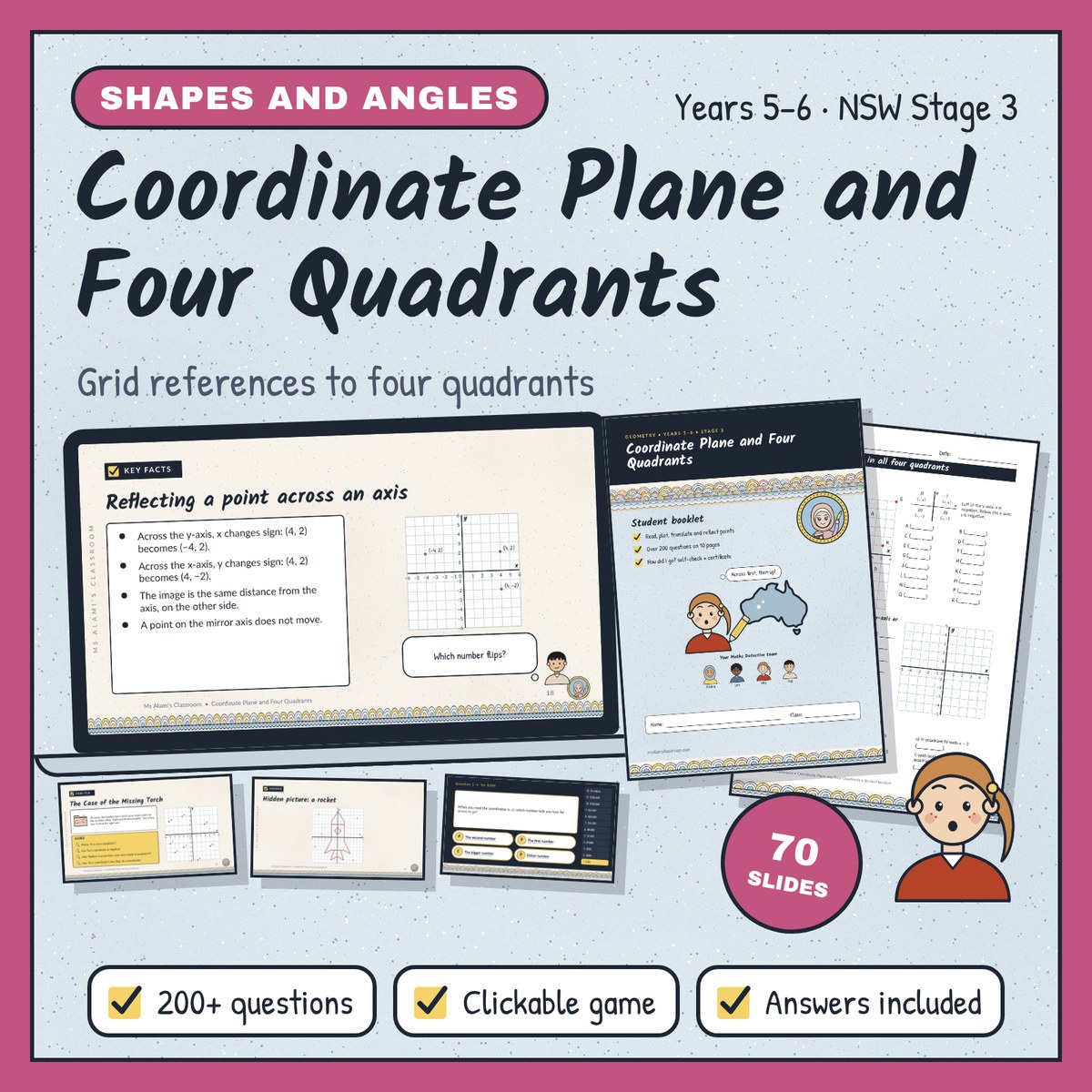
- Coordinate Plane Worksheets: Grid References, First Quadrant and All Four Quadrants: a 13-page booklet with over 200 questions, 70 editable slides, a hidden picture, translation and reflection tables, a case file and a clickable Coordinates Millionaire game.
- Translation, Reflection and Rotation: slides, flips and turns of whole shapes on a grid.
- 2D Shapes and Polygon Properties: quadrilateral classification and symmetry, a natural next step after plotting shapes.