
Ask students what petrol costs and someone will read the sign as "one hundred and eighty-nine dollars" a litre. The sign says 189.9, and the price is in cents. That mix-up is my favourite way into decimal place value, because the numbers are already all around them.
Start with a real decimal
Take a photo of a petrol bowser and the price sign, or draw one on the board. You get:
- dollars and cents on the sale display, such as $78.47
- litres to two decimal places, such as 41.32 L
- cents per litre to one decimal place, such as 189.9
Ask: which digit is in the tenths place of the litres? What is the 2 in 41.32 worth? Why does the price sign have only one decimal place? Students argue about it before you have taught anything, and you find out who already understands tenths and hundredths.
Build the place value chart to thousandths
The NSW syllabus (MA3-RN-01) asks Stage 3 students to work with decimals to three decimal places. I build the chart from the ones column outwards: each place to the right is one tenth of the place to its left.
Have students:
- write a decimal in the chart, in words and in expanded form (2.375 = 2 + 0.3 + 0.07 + 0.005)
- partition a decimal more than one way (0.45 is 4 tenths and 5 hundredths, or 45 hundredths)
- read decimals properly: 2.375 is "two and three hundred and seventy-five thousandths"
That last one matters. Students who say "two point three seven five" every time often don't know what the digits are worth.
Comparing and ordering decimals
The classic mistake is "longer is larger": a student says 0.405 is bigger than 0.5 because it has more digits. Two things help.
Number lines. Draw 0 to 1 split into tenths. Place 0.5, then 0.45, then 0.405. The picture settles the argument.
Zeros as placeholders. Write each number with the same number of places: 0.500, 0.450, 0.405. Now students can compare 500, 450 and 405 thousandths.
Approximating
Stage 3 students approximate the size of a decimal: 1.254 is about 1.25, and 3.96 is close to 4. Leave formal rounding rules to a certain number of decimal places for Stage 4, or label them as extension.
Ten times as large and one tenth as large
Use the place value chart again. When you multiply 0.36 by 10, each digit moves one place to the left: 3 tenths become 3 ones and 6 hundredths become 6 tenths. The answer is 3.6. The decimal point does not move. Say it every time and students stop guessing which way to "move the point".
Then reverse it: one tenth of 3.6 is 0.36, and one hundredth of 3.6 is 0.036.
Fractions to decimals
Begin with denominators of 10, 100 and 1000:
| Fraction | Decimal |
|---|---|
| 7/10 | 0.7 |
| 7/100 | 0.07 |
| 7/1000 | 0.007 |
| 45/100 | 0.45 |
| 424/100 | 4.24 |
Then the benchmark fractions and their percentages: ½ = 0.5 = 50%, ¼ = 0.25 = 25%, ¾ = 0.75 = 75%, 1/10 = 0.1 = 10% (MA3-RN-03). A quick link to chance works well here. The chance of a coin landing on heads is ½, which is 0.5 or 50%.
Mixed numerals as decimals, such as 3 945/1000 = 3.945, are Stage 4 in NSW.
A card game for comparing decimals
Make a deck of 36 cards with decimals to three places. In groups of three or four, each student turns over a card and the largest decimal wins the round. Students must say their decimal out loud correctly to claim the point. It takes ten minutes to set up and gives you a full lesson of comparing practice.
Quick checks
Try these with your class (answers at the end):
- Which is larger: 0.7 or 0.65?
- Write 3 hundredths as a decimal.
- What is 0.48 × 10?
- Order from smallest: 2.05, 2.5, 2.005.
- Write ¾ as a decimal and a percentage.
Answers: 1) 0.7, 2) 0.03, 3) 4.8, 4) 2.005, 2.05, 2.5, 5) 0.75 and 75%.
Resources that go with this post
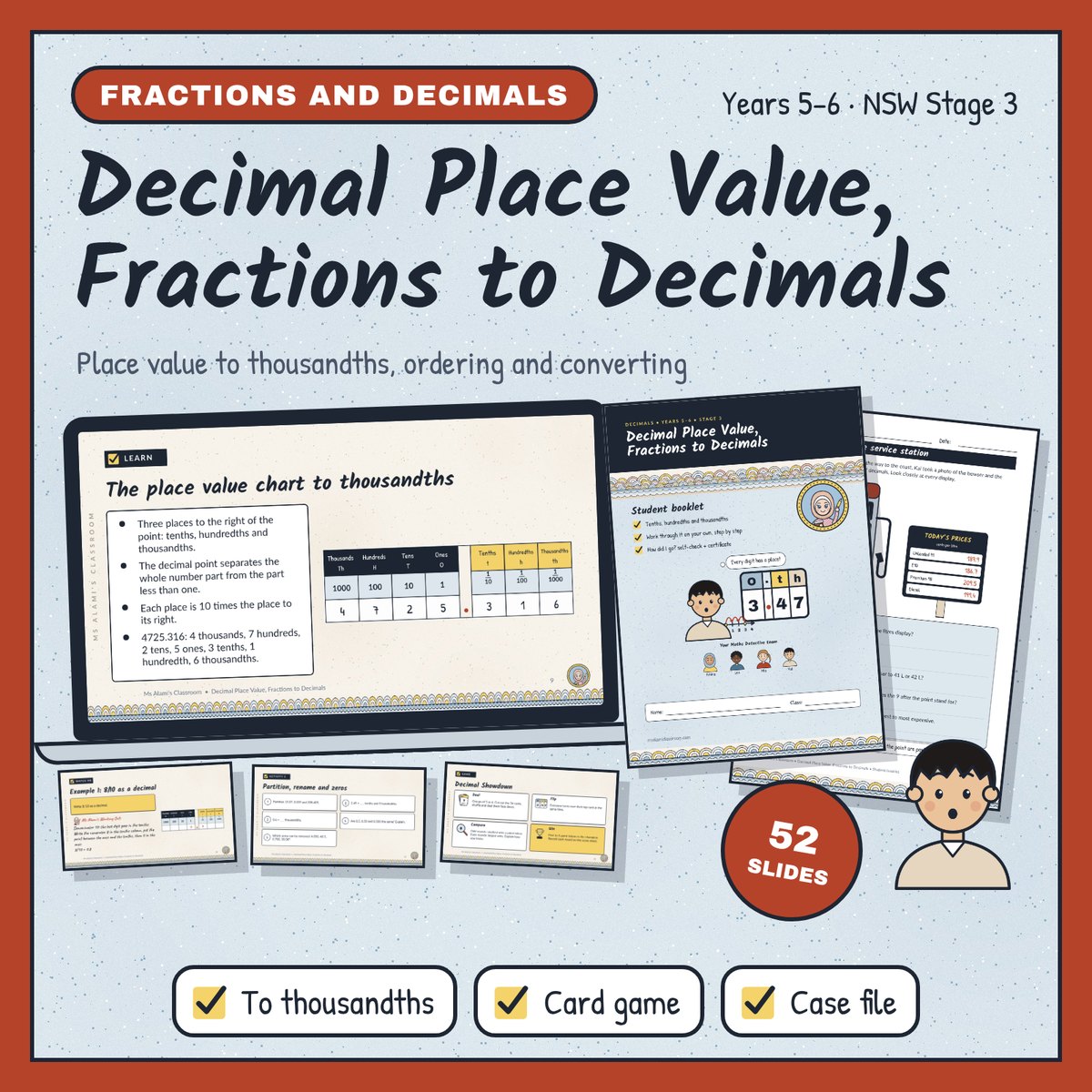
Decimal Place Value, Fractions to Decimals has the petrol bowser opening, a place value chart to thousandths, the Decimal Showdown card game with 36 cards, Bronze, Silver and Gold practice and a detective case file. It is also in the Decimals Bundle.
More on decimals: how I teach decimals in Years 5–6 and decimal word problems with worked answers.