
Give a Year 6 student 18.45 + 22.70 + 9.85 and they will get it right. Hide the same numbers inside a story about pocket money, and half the class stops and asks, "Is it a plus or a take-away?" Decimal word problems are mostly reading problems. Here is how I teach them, with examples you can use straight away.
A routine for every problem
I use five steps, based on Newman's prompts:
- What does it say? Read it twice.
- What is it asking? Say it in your own words.
- What will I do? Choose the operation and estimate.
- Work it out. Show your working.
- Answer in a sentence, with the units.
Step 3 is where the estimate goes. If students estimate first, they catch most of their own decimal point mistakes.
Adding and subtracting decimals (MA3-AR-01)
1. Kai saved $18.45 in January, $22.70 in February and $9.85 in March. How much did he save altogether?
Estimate: about $18 + $23 + $10 = $51.
$18.45 + $22.70 + $9.85 = $51.00. Kai saved $51.00 altogether.
2. In the 50 m freestyle final, Leo swam 37.60 seconds and Amira swam 41.08 seconds. How much faster was Leo?
41.08 − 37.60 = 3.48. Leo was 3.48 seconds faster.
3. A bag of flour has a mass of 2.5 kg. Mia uses 0.75 kg for a cake. How much flour is left?
Write 2.5 as 2.50 so the places line up. 2.50 − 0.75 = 1.75. There is 1.75 kg of flour left.
4. Three relay swimmers take 38.2, 39.65 and 40.08 seconds. What is the team's total time?
38.20 + 39.65 + 40.08 = 117.93. The total time is 117.93 seconds.
Multiplying and dividing decimals (MA3-MR-01)
In Stage 3, keep the multiplier to a one-digit number and use friendly decimals. Changing to cents or centimetres helps.
5. A bookcase has 6 shelves. Each shelf can hold 2.5 kg of books. How much can the whole bookcase hold?
6 × 2.5 = 15. The bookcase can hold 15 kg.
6. Strawberries cost $4.50 a punnet. How much do 3 punnets cost?
3 × 450 cents = 1350 cents = $13.50.
7. A café buys 100 avocados at $1.85 each. What is the cost?
$1.85 × 100 = $185. The digits move two places left; the point stays still.
8. A roll of ribbon is 12.6 m long. It is cut into 10 equal pieces. How long is each piece?
12.6 ÷ 10 = 1.26. Each piece is 1.26 m long.
Remainders and time as decimals (MA3-RQF-02, MA3-NSM-02)
9. Five players share a 12 L drink cooler equally. How many litres does each player get?
12 ÷ 5 = 2 remainder 2, and 2 ÷ 5 = 0.4. Each player gets 2.4 L.
10. A movie runs for 2 hours 15 minutes. Write the time in hours as a decimal.
15 minutes is ¼ of an hour, which is 0.25. The movie runs for 2.25 hours.
Multi-step problems
11. Ethan has $20. He buys a sandwich for $6.85 and a juice for $3.40. How much change does he get?
$6.85 + $3.40 = $10.25, then $20.00 − $10.25 = $9.75. Ethan gets $9.75 change.
12. Tomatoes are $6.80 per kilogram. How much do 100 g cost?
100 g is one tenth of a kilogram. $6.80 ÷ 10 = $0.68. 100 g of tomatoes costs 68 cents.
What is Stage 4
Written methods such as 4.86 × 7 by counting decimal places, multiplying a decimal by a two-digit number, and decimal × decimal are Stage 4 in NSW. They make good extension questions, but label them that way.
Mistakes to watch for
- Adding 3.5 and 1.25 and getting 1.60, because the last digits were lined up instead of the decimal points.
- Writing $13.5 instead of $13.50 in money answers.
- Answers with no units, or the wrong units.
- Dividing when the story needs multiplying, because the student picked an operation from a key word instead of the meaning.
Resources that go with this post
These problems come from the same contexts as my decimal packs, which have Bronze, Silver and Gold practice and a whole-class detective case file:
- Adding and Subtracting Decimals Word Problems
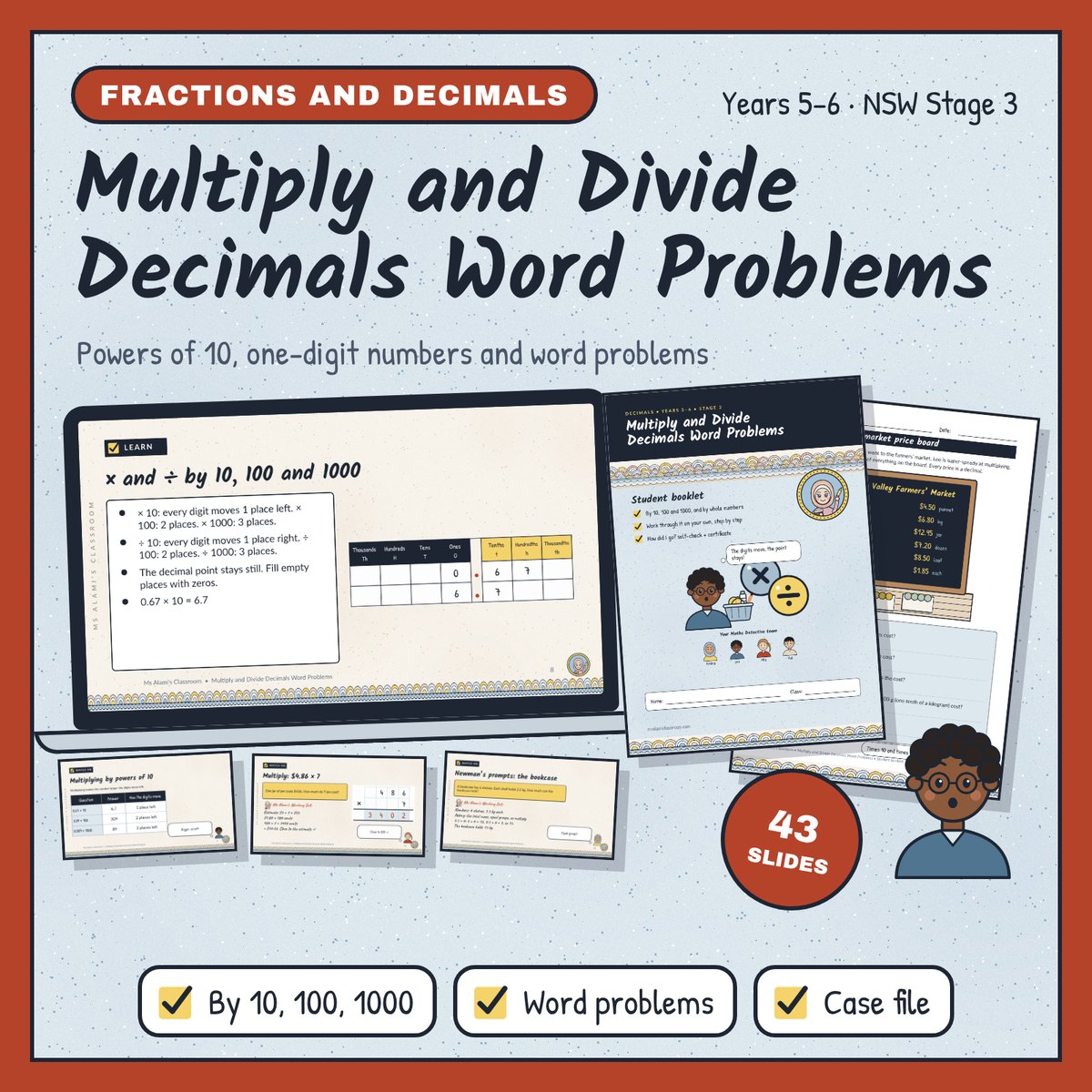
- Multiplying and Dividing Decimals Word Problems
- Decimals Bundle with all three decimals packs
More on decimals: how I teach decimals in Years 5–6 and decimal place value activities.