
Ask a Year 5 class to put 0.5, 0.45 and 0.405 in order, smallest first, and a few students will write 0.5, 0.45, 0.405. Their reasoning makes sense to them: 5 is less than 45, and 45 is less than 405. They are reading the digits after the point as a whole number.
That one habit causes most of the trouble in a decimals unit. Students line up the wrong digits when they add, they "move the point" the wrong way when they multiply, and they write 7 hundredths as 0.7. So I teach decimals in an order where each step fixes the idea underneath the next one.
What the NSW syllabus asks for in Stage 3
In the NSW Mathematics K–10 syllabus, decimals in Years 5 and 6 sit across several outcomes:
- MA3-RN-01 and MA3-RN-02 (Represents numbers): place value to three decimal places (thousandths), comparing and ordering decimals, approximating them, and finding 10 or 100 times, or one tenth or one hundredth, of a decimal.
- MA3-RN-03: per cent means "out of 100", 100% is the whole, and halves, quarters, three quarters and tenths as decimals and percentages.
- MA3-AR-01 (Additive relations): adding and subtracting decimals to three decimal places, with a strategy students can explain.
- MA3-MR-01 (Multiplicative relations): multiplying and dividing decimals by 10, 100 and 1000, multiplying benchmark decimals by one-digit numbers, and estimating to check a calculator answer.
- MA3-RQF-02: a fraction as a division, with the remainder written as a decimal.
- MA3-NSM-02: common time intervals as decimals, such as 2 hours 15 minutes as 2.25 hours.
NESA lists the Stage 3 content for both Year 5 and Year 6, so there is no official split between the two years. I teach the whole sequence and adjust the numbers.
What is Stage 4 in NSW
Some things that appear in older decimal worksheets are Stage 4 in NSW. If you use them, label them as extension:
- writing mixed numerals as decimals, such as 3 945/1000 = 3.945
- rounding to a set number of decimal places (approximating 1.254 as about 1.25 is Stage 3, but formal rounding rules are Stage 4)
- written methods for decimal multiplication and division, such as 4.86 × 7 by counting decimal places, or multiplying by a two-digit number
- decimals beyond thousandths, and recurring decimals
The order I teach it in
1. Place value to thousandths
Start with something real. Petrol prices are perfect because the price per litre already has a decimal in it, and the litres on the bowser go to two places. Ask what the 2 in 41.32 is worth before you teach anything.
Then build the place value chart. I have students say decimals out loud properly: 0.405 is "four hundred and five thousandths", not "zero point four hundred and five". Saying it correctly fixes the ordering mistake faster than any rule.
2. Comparing, ordering and approximating
Number lines do the heavy lifting here. When students place 0.5, 0.45 and 0.405 on a line from 0 to 1, they see that 0.5 is the furthest along. Add a zero so every number has the same number of places (0.500, 0.450, 0.405) and the comparison becomes obvious.
Approximating fits naturally here too: 1.254 is between 1.25 and 1.26 and much closer to 1.25.
3. Ten times as large, one tenth as large
This is where I stop saying "the point moves". The digits move and the point stays still. Show 0.45 × 10 on a place value chart: the 4 tenths become 4 ones and the 5 hundredths become 5 tenths. That gives 4.5. Students who learn it this way can explain why, and they stop moving the point the wrong way.
4. Fractions to decimals and percentages
Fractions with denominators of 10, 100 and 1000 come first: 7/10 = 0.7, 7/100 = 0.07, 7/1000 = 0.007. Then the benchmark fractions: ½ = 0.5 = 50%, ¼ = 0.25 = 25%, ¾ = 0.75 = 75% and 1/10 = 0.1 = 10%. A coin toss is a nice link to chance: the chance of heads is ½, 0.5 or 50%.
5. Adding and subtracting
Model on a hundredths grid before any column method. 0.35 + 0.48 is 35 hundredths and 48 hundredths, so 83 hundredths, or 0.83. Then teach mental strategies such as bridging to the next whole (2.7 + 0.5 = 2.7 + 0.3 + 0.2 = 3.2) and compensation (4.99 + 2.3 = 5 + 2.3 − 0.01 = 7.29). The column method comes last, with the points lined up and zeros filled in as placeholders.
6. Multiplying and dividing
Stage 3 keeps this practical. Multiply friendly decimals by one-digit numbers, and convert to cents or centimetres when that is easier: 6 × $2.45 is 6 × 245 cents = 1470 cents = $14.70. Sharing problems give decimal remainders: 3 ÷ 4 = 0.75.
Three activities you can run tomorrow
- Decimal line-up. Give six students a card each (0.6, 0.06, 0.66, 0.606, 0.065, 0.61). They arrange themselves smallest to largest and the class checks with a number line.
- Receipt detective. Bring in a real supermarket receipt. Students check the total by adding, then work out the change from $50.
- Time as a decimal. Ask how long recess and lunch are altogether, then write it in hours. 30 minutes + 45 minutes = 75 minutes = 1.25 hours.
Common mistakes to watch for
- "Longer is larger": thinking 0.405 is greater than 0.5.
- Writing 7 hundredths as 0.7 instead of 0.07, because there was no zero in the tenths place.
- Lining up the last digits instead of the decimal points when adding.
- Moving the point the wrong way when multiplying or dividing by 10.
Resources that go with this post
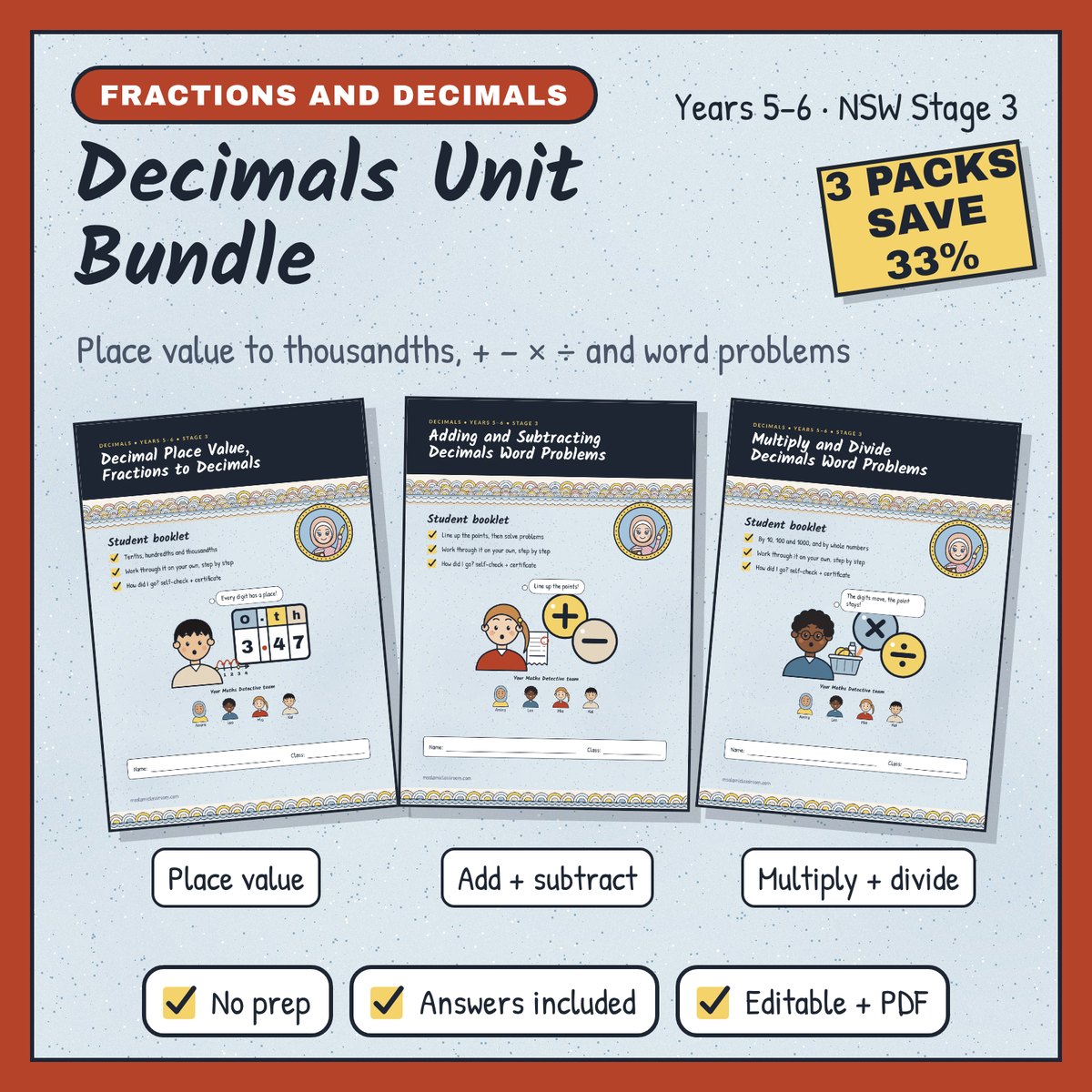
The Decimals Bundle has the whole sequence in three packs, with Bronze, Silver and Gold practice in each:
- Decimal Place Value, Fractions to Decimals
- Adding and Subtracting Decimals Word Problems
- Multiplying and Dividing Decimals Word Problems
More on decimals: decimal place value activities for Years 5–6 and decimal word problems with worked answers.