
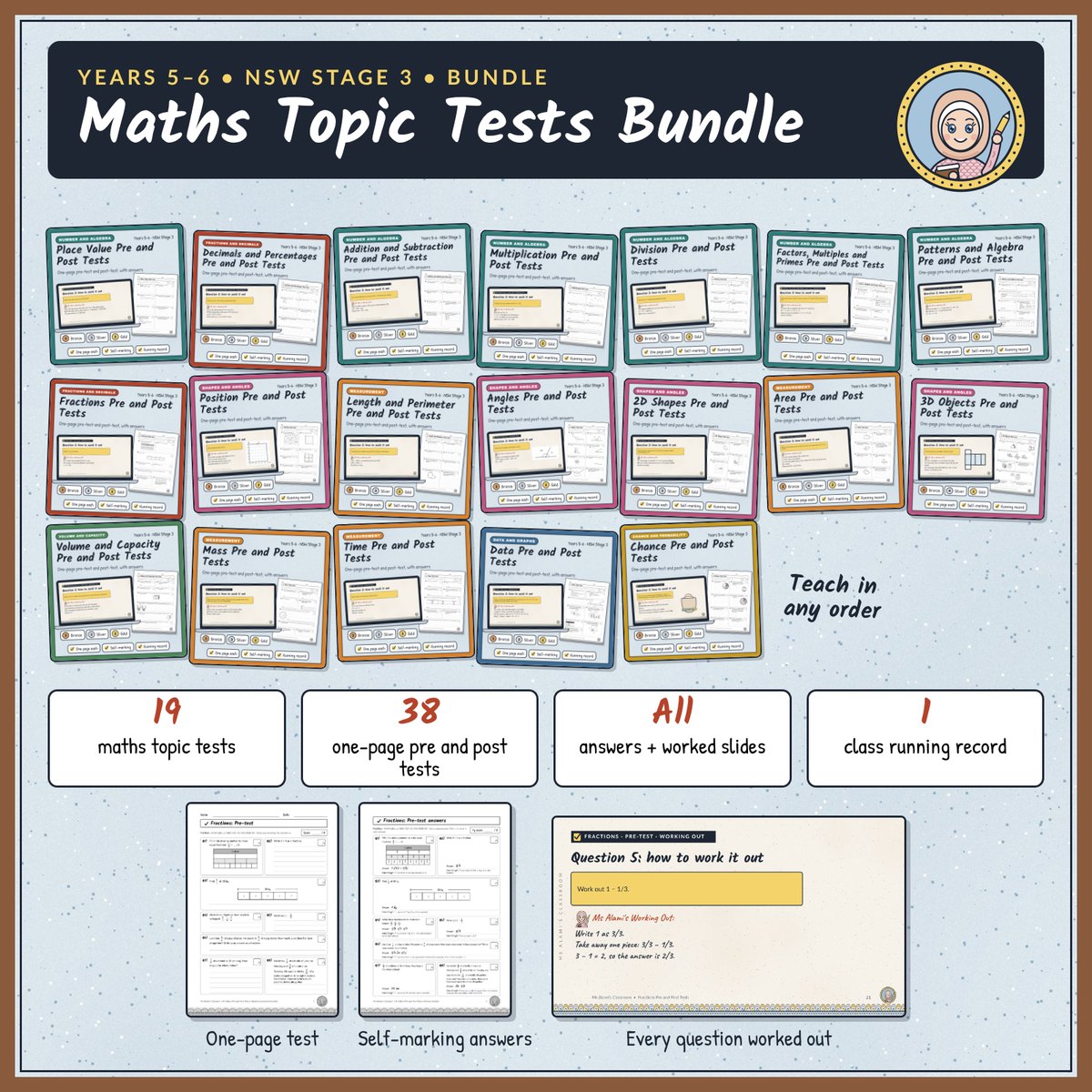
Give a Year 5 class a three-page test on a topic you haven't taught yet and watch what happens at page two. The students who already know it finish early and get restless. The ones who don't know it stop writing, and a blank page doesn't tell you whether they couldn't do it or just gave up. That is why I test each maths topic on one page: eight questions, one mark each, 20 to 30 minutes. After the unit, students do a matching page with the same eight skills and new numbers.
What is on one page
Each test covers the whole topic for Stage 3, from a warm-up question to one that makes students explain their thinking. The division pre-test starts with Work out 36 000 ÷ 100 in your head and finishes with Kai says 878 ÷ 7 = 124 remainder 3. Check his answer with multiplication. (He's wrong: 124 × 7 + 3 = 871, so the answer is 125 remainder 3.)
Question 1 on the post-test checks the same skill as question 1 on the pre-test, and so on through question 8. That is what makes the two pages worth comparing. If a student gets question 4 wrong before the unit and right after it, you know exactly what they learnt.
Marking is simple on purpose. One mark for a correct final answer, with the unit or $ sign where the question needs it. No half marks.
Running them across the year, in any order
NSW outcomes are written for Stage 3, which covers Year 5 and Year 6, so one test suits both years and composite classes. The syllabus doesn't set the order you teach the topics in, and your school's scope and sequence will be different from mine. So every test stands on its own. Run the place value test in Term 1 or Term 3, whenever place value comes up.
Run the pre-test in the week before a unit rather than on the first day. That gives you time to look at the results and plan groups before the first lesson. The post-test goes at the end of the unit, once the teaching is done.
If you teach a topic in Year 5 and again in Year 6, the booklets come as editable PowerPoints, so you can change the numbers for the second round.
How students mark their own tests
Marking a class set of tests for every topic adds up, so students mark their own with the answer booklet. It works like this:
- Pencils away. Pick up a coloured pen.
- Find the answer page with the same name as your test.
- Read the answer and the Mark it right if line for each question.
- Tick it and write 1, or cross it and write 0.
- Add up your score out of 8 and write it on your progress table.
Two rules make it work. Never change an answer while you mark. And if your answer is written a different way (0.5 instead of 1/2) or you're not sure it counts, put a ? next to it and ask your teacher. Check a sample of tests and every question with a ?.
Marking their own test shows students which question they missed and what the right answer looks like, straight away. Then go over the tricky questions with the teacher slides, which show each question followed by a slide that works it out step by step.
From a mark out of 8 to a report comment
Every topic has a running record spreadsheet, and the bundle has one for all 19 topics. You type one total out of 8 for each test, or Abs if a student was away. That is all you enter. The spreadsheet works out:
- growth from the pre-test to the post-test
- an A to E level from the post-test
- the class average for each topic
- results for each NESA outcome
- a suggested report comment for the student you choose
The A to E cut-offs start at A = 7 or 8, B = 6, C = 4 or 5, D = 2 or 3 and E = 0 or 1. Change them to suit your school. The comments come from a comment bank you can edit. For multiplication, a B comment reads: [name] multiplies by multiples of 10 and 100, uses the area model, and multiplies 3-digit by 2-digit numbers. [name] solves word problems and rate problems, and is building skills in multi-step problems.
A one-page test is one piece of evidence. Use it alongside class work and what students tell you, and read every comment before it goes on a report.
Bronze, Silver and Gold on one page
A pre-test where nobody can start tells you nothing, and neither does one where everyone gets 8. So each test mixes three levels, roughly easier first. Most have three Bronze, three Silver and two Gold questions.
- Bronze: one step, a familiar format, friendly numbers.
- Silver: two steps, harder numbers, or a conversion inside the problem.
- Gold: several steps, or explaining, or finding someone else's mistake.
A lot of the Gold questions are mistakes to find. Leo needs tables for 40 students, 6 to a table, works out 40 ÷ 6 = 6 remainder 4 and says they need 6 tables. A student who can explain why that leaves four people standing understands remainders.
The levels are not printed on the student page, so nobody sees "Bronze" next to their name. They are listed on the teacher slides, so when you look at a marked test you can tell whether a student is stuck on the Bronze questions or nearly there on Gold.
What the syllabus asks for
The 19 tests cover all 21 Stage 3 outcomes in the NSW Mathematics K–10 Syllabus (2022), from MA3-RN-01 (place value) to MA3-CHAN-01 (chance). They stay inside Stage 3. A few things that often turn up in Years 5 and 6 resources are Stage 4 in NSW, so they are not on the tests:
- mixed numerals (fraction answers over one stay as fractions, like 9/6)
- the mean, median and dot plots (the data test uses the mode and range)
- algebra with letters (Stage 3 rules are written in words and tables)
- percentage problems beyond benchmark percentages and discounts
Resources that go with this post
- Maths Pre and Post Tests Bundle: all 19 topic tests, the answer booklets, the teacher slides and a master running record for every Stage 3 outcome.
- Division Pre and Post Test: remainders, partitioning, estimating and word problems.
- Fractions Pre and Post Test: equivalent fractions, adding fractions and fractions of quantities.
- Data Pre and Post Test: survey questions, column graphs, timelines and misleading graphs.
- Angles Pre and Post Test: angle types, measuring and drawing with a protractor, and missing angles.