
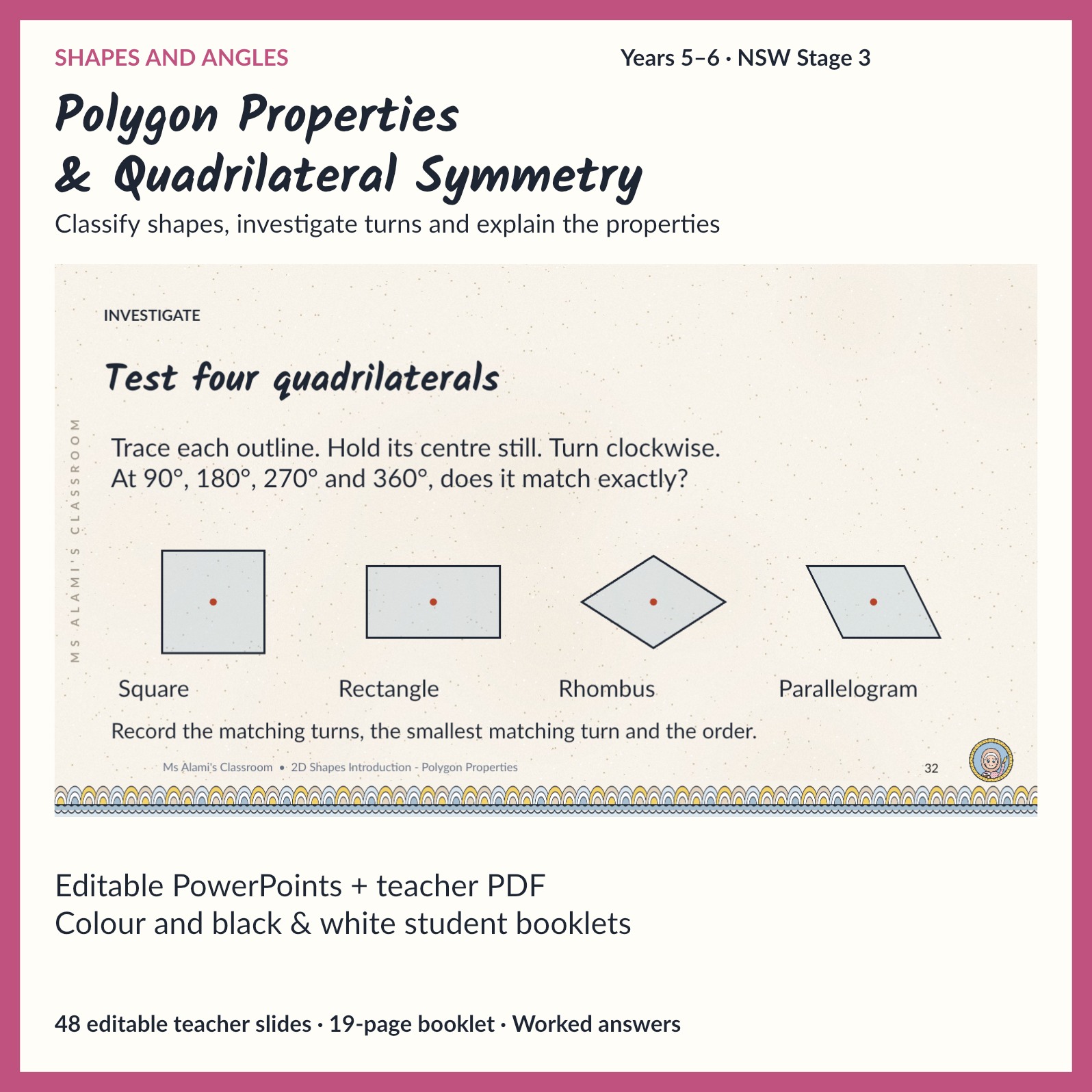
Students often recognise a square or rectangle by its familiar orientation. A rotational-symmetry investigation helps them use properties instead: a shape can turn and still match its original outline.
Start with four clear examples
Use a square, a non-square rectangle, a non-square rhombus and an oblique parallelogram. Ask students to predict which shapes will match after a quarter turn. Record the predictions before testing.
These examples matter. A square is also a rectangle, a rhombus and a parallelogram. Choosing non-square and oblique examples makes the differences visible without suggesting that the shape families are unrelated.
Trace, hold the centre and turn
Trace each shape and mark its centre. Keep the centre fixed with a pencil point, then rotate the tracing paper clockwise through 90°, 180°, 270° and 360°. A match means that every edge fits the original outline, rather than just one corner appearing close.
Students tick the matching turns in a table, identify the smallest matching turn and count the matching positions in one full turn. Include the full 360° return when recording the order.
The square matches at 90°, 180°, 270° and 360°: its smallest matching turn is 90° and its order is 4. The non-square rectangle, non-square rhombus and oblique parallelogram each match at 180° and 360°: their smallest matching turn is 180° and their order is 2.
Ask why four equal sides are not enough
Compare the square with the rhombus. Both have four equal sides, but the non-square rhombus does not match after a quarter turn. Students should use their tracing result and the shapes’ angles to justify the difference.
Ask: “What would have to change for this rhombus to match at 90°?” Students can connect the answer to right angles and to the square’s place in the quadrilateral family.
Separate a turn from a mirror-line test
A line of symmetry is a mirror line; rotational symmetry involves a turn around a centre. An oblique parallelogram offers a useful comparison: it has rotational symmetry of order 2 but no lines of symmetry. A non-square rectangle has two lines of symmetry and rotational order 2, whereas a square has four lines and rotational order 4.
Have students explain the action they tested. “I folded along a line” and “I turned around a centre” describe different investigations.
Connect symmetry to polygon properties
Follow the rotation test with a quadrilateral properties table. Check equal sides, parallel sides, right angles, diagonals and lines of symmetry. Then use true-or-false statements and a family tree to discuss claims such as “every square is a rectangle.”
The 2D Shapes, Polygon Properties and Symmetry pack includes 48 editable teacher slides and a 19-page booklet, with printable tracing shapes, a turn-recording table and worked answers. A clickable shape-poster gallery, polygon sorting, dot-paper drawing and the Missing Mosaic Tile mystery extend the investigation. Colour and black & white PDFs and editable student booklets are included.
The classification and symmetry activities support NSW Stage 3 MA3-2DS-01. The pack labels its optional polygon angle-sum material as Stage 4 extension. For the syllabus context, see NESA’s Stage 3 two-dimensional spatial structure content.
Continue with translation, reflection and rotation activities, which now include explicit coordinate foundations before students transform points on the plane.