
Ask a Year 5 class how many edges a triangular prism has and you'll usually get three answers: 6, 9 and 12. Some students only count the edges they can see. Others count the same edge twice as they turn the object in their hands. Teaching 3D shapes in Years 5–6 is mostly about fixing that: counting faces, edges and vertices carefully, naming prisms and pyramids by their base, and connecting a solid object to its net and to its views.
Start with real objects, not pictures
Before any worksheet, put a box, a tin, a party hat, a tennis ball and a tent-shaped chocolate box on each table. Ask students to sort them: flat faces only, or a curved surface? Then sort the flat-faced ones again: two matching ends, or one base with a point on top?
That second sort is the whole idea of prisms and pyramids:
- A prism has two identical, parallel bases joined by rectangles.
- A pyramid has one base, and triangles that meet at a point called the apex.
- Both are named by the shape of their base: a hexagonal prism has hexagon bases, a square pyramid has a square base.
Ask students whether a cube is a prism. It is (a square prism), and arguing about it is a great way to check they understand the definition rather than the picture.
Counting faces, edges and vertices without double counting
Model one routine and repeat it: count the top, then the bottom, then the sides. For a pentagonal prism that's 5 edges on the top, 5 on the bottom and 5 joining them, so 15 edges. Vertices are 5 on the top and 5 on the bottom, so 10. Have students mark each vertex with a dot of playdough or a sticky dot as they count it.
Once students have filled in a table for six or seven prisms and pyramids, the patterns jump out:
- A prism with an n-sided base has n + 2 faces, 3n edges and 2n vertices.
- A pyramid with an n-sided base has n + 1 faces, 2n edges and n + 1 vertices.
Then turn the patterns into riddles: "I am a prism with 18 edges. What am I?" (A hexagonal prism, because 18 ÷ 3 = 6.) Students who can answer these without drawing have really understood the structure.
Nets of 3D shapes
The NSW syllabus asks students to decide whether a diagram is a net of a closed 3D object, to sketch nets, and to name prisms and pyramids from their nets. Cube nets are the best place to start. There are 11 different nets of a cube, and plenty of six-square shapes that look like nets but aren't.
A quick rule students can test: five squares in a row will never fold into a cube, and neither will a 2 by 2 block of squares. Give students printed hexominoes to cut out and fold, and let them prove which ones work. After that, move to prisms and pyramids: a strip of rectangles with a base on each side, or a base with triangles around it.
Folding a triangular prism and a triangular pyramid from nets with the same triangle is a lovely comparison. Both start from a triangle, but one has a uniform cross-section and the other comes to a point.
Top, front and side views
Use interlocking cubes. Build a small model, put it on a sheet of paper with "front" written on one edge, and ask students to draw what they see from the top, the front and the right side. Agree the conventions first: in the top view, the back row goes at the top of the drawing, and in the right side view the front of the model is on the left.
Then flip the task. Give students the three views and ask them to build the model. This is harder, and it's also in the Stage 3 content: constructing models of 3D objects from drawings of different views. It shows students that one view alone isn't enough, because two different models can have the same front view.
Skeletal models
Straws and balls of playdough (or toothpicks and Blu Tack) make skeletal models that show only the edges and vertices. Add a budget to make it a money task: if straws cost 10c and playdough balls cost 20c, how much does it cost to build a square pyramid? (8 straws and 5 balls, so $1.80.) Students quickly notice that the models with the most edges and vertices cost the most.
What the NSW syllabus asks for
These activities cover NSW Mathematics K–10 Stage 3 outcome MA3-3DS-01, "visualises, sketches and constructs three-dimensional objects, including prisms and pyramids, making connections to two-dimensional representations", across Three-dimensional spatial structure A and B:
- compare properties of prisms and pyramids, and name them by the shape of their base
- visualise and sketch top, front and side views
- decide whether a diagram is the net of a closed 3D object, sketch nets, and name prisms and pyramids from their nets
- create skeletal models of prisms and pyramids
- construct models of prisms and pyramids from drawings of different views
Cross-sections that aren't parallel to the base are Stage 4 content, so in Stage 3 keep slicing to the idea that a prism has a uniform cross-section and a pyramid doesn't. You can read the full content points on the NSW Curriculum website (Three-dimensional spatial structure A).
3D shapes activities you can run with what's in the room
- Shop shelf sort: collect boxes and packaging and have students label each one as a prism, a pyramid or neither, with its name.
- Mistake hunt: write five claims on the board, such as "A cone is a polyhedron" or "A square pyramid has 5 vertices", and have students find and fix the wrong ones.
- Mystery solid: give clues one at a time ("It has flat faces only. It has two identical bases. Its faces plus its vertices make 20.") and let students narrow it down.
- Cereal box net: open out an empty cereal box and look for the faces that match.
Resources that go with this post
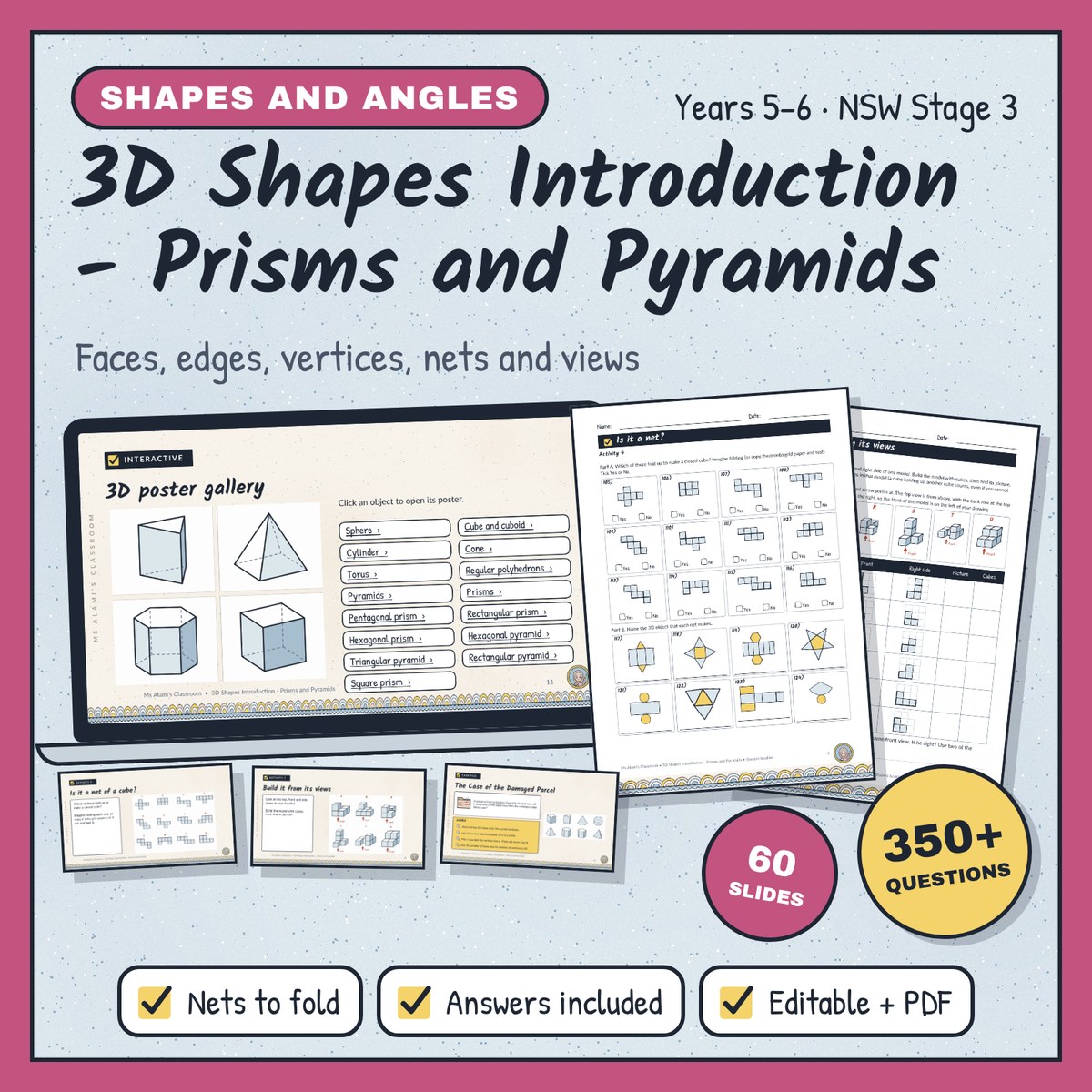
- 3D Shapes Worksheets: Prisms and Pyramids, Faces, Edges and Vertices, Nets and Views: a 17-page booklet with over 350 questions, 60 editable slides with a clickable 3D poster gallery, cube nets to test, cut-out nets to fold, building from views, skeletal models on a budget and a detective case file.
- 2D Shapes and Polygon Properties: the 2D shapes that make up every face and base.
- Volume and Capacity Unit: Rectangular Prisms: the natural next step once students know their prisms.