
Write 3 m 4 cm on the board and ask the class to write it in metres. You will get 3.4 m and 3.04 m, and both groups will be sure they are right. That one question tells you most of what you need to know before you start a length and area unit.
Length, perimeter and area are the measurement topics students can see, walk, pace and touch. They are also where small slips (a missing zero, two sides instead of four, cm multiplied by m) quietly turn into wrong answers for years. Here is how the NSW syllabus sets them out for Years 5 and 6, and the order I teach them in.
What the NSW syllabus asks for
Length and perimeter: MA3-GM-02
In the NSW Mathematics K–10 syllabus, length sits in Geometric measure A and B, outcome MA3-GM-02: students select and use the appropriate unit and device to measure lengths and distances, including perimeters. The content includes:
- recognising the need for a unit longer than the metre, and that 10 × 100 m = 1 km
- estimating and measuring lengths and distances with different devices
- the equivalence of whole-number and decimal representations of length, such as 1.25 m = 125 cm
- converting between metric units of length, and converting to the same unit to compare
- explaining the relationship between the size of a unit and the number of units needed
- perimeters of common shapes, including regular polygons, and which side lengths are needed
- rectangles with the same perimeter can have different dimensions, and comparing perimeters of rectangles with the same area
Area: MA3-2DS-02 and MA3-2DS-03
Area sits in Two-dimensional spatial structure A and B. Part A covers hectares and square kilometres (one hectare is the area of a 100 m square) and the area of rectangles in cm², m² and km², written in words as length × width. Part B covers composite figures such as L-shapes, the area of a parallelogram by rearranging it into a rectangle, and the area of a triangle compared with a parallelogram with the same base and height.
What is Stage 4 in NSW
Area formulas written with letters (A = lw, A = ½bh), converting between units of area such as km² to hectares or cm² to m², trapeziums, kites and circles are Stage 4. In Years 5 and 6, students write their methods in words. If you want to stretch strong students, keep the Stage 4 work clearly labelled as an extension.
The order I teach it in
1. Units and decimals
Start with real things: a bee in millimetres, a pencil in centimetres, a swimming pool in metres, a road trip in kilometres. Then move to decimal lengths on a tape measure, because 1.52 m is much easier to understand when it is your own height. More on this in converting units of length.
2. Measuring and comparing
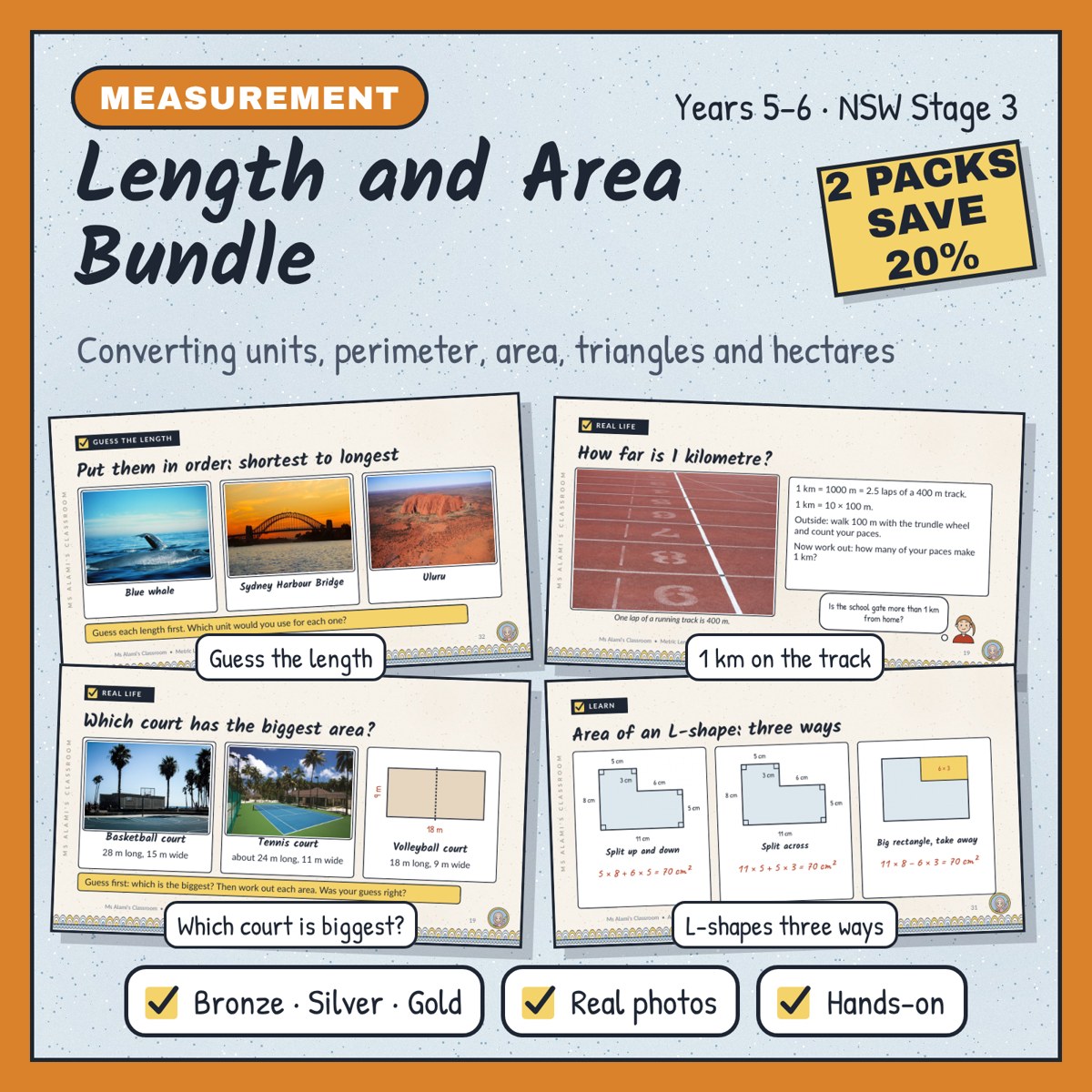
Go outside. Walk 100 m with a trundle wheel, count paces, and work out how many paces make 1 km. Do a standing long jump, measure it in centimetres and write it in metres. Order lengths only after changing them to the same unit.
3. Perimeter
Perimeter is the distance around. Students add every side first, then find the shortcut for rectangles: 2 × (length + width), in words. Regular polygons follow naturally (a stop sign is a regular octagon), and L-shapes make students find the missing sides before they add.
4. Area of rectangles
Make a square metre on the floor with metre rulers and see how many students fit inside. Then count tiles in rows, and the rows become length × width. Check that both sides are in the same unit before multiplying.
5. L-shapes, parallelograms and triangles
Find one L-shape three ways and check the answers match. Cut a parallelogram and slide the piece across to make a rectangle. Copy a triangle, turn the copy and see the parallelogram. More on this in area of triangles and parallelograms.
6. Hectares and square kilometres
Finish with the big spaces: school grounds, farms, national parks and states. More on this in how big is a hectare?.
Keeping every student working
Every practice activity in my packs has three levels. Bronze has a help box with a worked example using different numbers, Silver is at the syllabus level, and Gold asks students to explain, find mistakes and work backwards. Students start at Bronze if they are unsure and move up when nearly all their answers are right.