
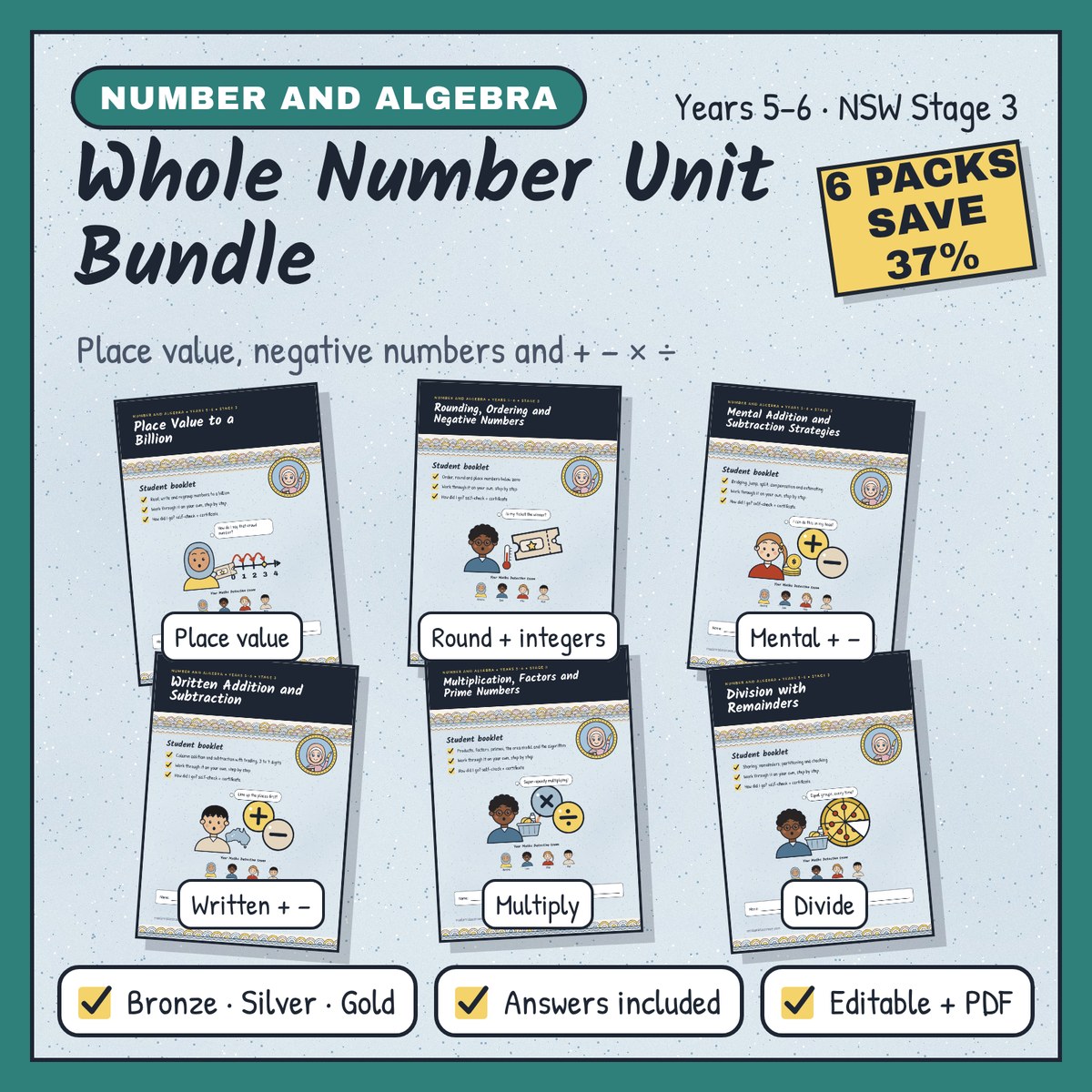
Every year I meet Year 5 students who can do a column subtraction but cannot tell me what the 4 in 3 450 000 is worth. They have learnt the steps without the place value underneath, and it catches up with them as soon as the numbers get big or a zero turns up in the middle.
So my whole number unit starts with place value and keeps coming back to it. Each step uses the one before, and every pack has the same habit running through it: estimate first, then check.
What the NSW syllabus asks for in Stage 3
In the NSW Mathematics K–10 syllabus, whole numbers in Years 5 and 6 sit across three main outcomes:
- MA3-RN-01 (Represents numbers): place value to a billion, regrouping and partitioning, ordering and rounding large numbers, and integers on a number line.
- MA3-AR-01 (Additive relations): mental and written strategies for addition and subtraction, estimating, choosing when to use a calculator, and multistep word problems.
- MA3-MR-01 (Multiplicative relations): factors and multiples, prime and composite numbers, the area model and partial products, the multiplication algorithm, and division with remainders.
MA3-MR-02 covers number sentences, order of operations and number patterns. I teach order of operations and patterns in a separate Patterns and Algebra unit, so it does not need repeating in a number unit.
NESA lists the Stage 3 content for both Year 5 and Year 6, so there is no official split between the two years. I teach the whole sequence and change the size of the numbers.
What is Stage 4 in NSW
Older worksheets often include these, but they are Stage 4:
- adding, subtracting, multiplying and dividing negative numbers, and ordering them (MA4-INT-C-01)
- prime factorisation, divisibility tests and index notation (MA4-IND-C-01)
- highest common factor (MA4-FRC-C-01)
Long division by a two-digit number by hand is not in the Stage 3 syllabus either. Students divide by two-digit numbers with a calculator.
The order I teach it in
1. Place value to a billion
Students name the place value houses (ones, thousands, millions, billions) and see that each house repeats hundreds, tens and ones. The big idea is that 1000 thousands is 1 million and 1000 millions is 1 billion. Then they regroup: 163 480 is 1634 hundreds and 8 tens, or 16 348 tens. More on this in place value activities for Years 5–6.
Resource: Place Value to a Billion.
2. Ordering, rounding and negative numbers
Once students can read big numbers, they can compare them place by place and round them. Rounding is what makes estimating possible, and estimating is how students check every calculation that follows. This is also where integers come in, on a number line and in real contexts. See teaching negative numbers in Year 6.
Resource: Rounding, Ordering and Negative Numbers.
3. Mental addition and subtraction
I teach six strategies: bridging through ten, jump, split, compensation, constant difference and adding on. The point is not to collect strategies but to choose the efficient one. 1000 − 637 is much quicker by adding on than by column subtraction. See mental strategies for addition and subtraction.
Resource: Mental Addition and Subtraction Strategies.
4. Written addition and subtraction
Column methods for 5- to 7-digit numbers, with trading, including across zeros. Students estimate first and use place value to find errors in other people's working.
Resource: Written Addition and Subtraction.
5. Multiplication, factors and prime numbers
Arrays make factors, multiples and prime numbers visible. Then the area model leads to partial products, and partial products lead to the algorithm, so the written method makes sense. See prime and composite numbers for Years 5–6.
Resource: Multiplication, Factors and Prime Numbers.
6. Division with remainders
Students divide by one-digit numbers using fact families and partitioning, then spend real time on what a remainder means in a story. See division with remainders word problems.
Resource: Division with Remainders.
7. Multiples, divisibility, square and triangular numbers
Fizz Buzz and a sausage sizzle problem turn multiples into common multiples, and "nobody left out" becomes "divisible with no remainder". Then students build square and triangular numbers as dot patterns and describe them in a table of values, which links to MA3-MR-02. See common multiples and divisibility and square and triangular numbers.
Resource: Multiples, Divisibility and Square Numbers.
How I differentiate
Every pack ends with Show what you know in three levels: Bronze (Beginner), Silver (Intermediate) and Gold (Expert). Students start at the level that suits them, and the whole class works on the same detective case file at the end, so nobody is left out of the shared task.
The full unit
The Whole Number Unit Bundle has all seven packs in this order, with teacher slides, student booklets, games and full answer guides.