
Geometry is the unit that gets squeezed. It's often left for the end of term, then rushed into two weeks of worksheets. But the Stage 3 shapes and angles content builds on itself in a clear order, and when you teach it in that order each topic makes the next one easier. Here's the sequence I use for Year 5 and 6 geometry, what the NSW syllabus asks for at each step, and an activity you can run for each.
The teaching order: angles first, 3D last
Angles come first because almost everything after them depends on angles. Students can't classify a triangle as obtuse-angled, check a quadrilateral's right angles or describe a quarter turn until they can name and measure angles. A sequence that works:
- Types of angles and measuring with a protractor
- Classifying triangles
- 2D shapes, quadrilaterals and symmetry
- Translations, reflections and rotations
- The coordinate plane
- 3D shapes: prisms, pyramids, nets and views
Allow one to two weeks for each, depending on your class. Most Year 5 classes need longer on the protractor and the coordinate plane, and most Year 6 classes can move faster through 2D shapes.
1. Angles and protractors
Start with the idea that an angle is an amount of turn, not the length of the arms. Show two angles of the same size with very different arm lengths and ask which is bigger. Then use benchmarks: is it more or less than a right angle? More or less than a straight line? Students who estimate first catch most protractor mistakes, especially reading the wrong scale.
Stage 3 students measure and draw angles up to 360°, so teach reflex angles properly: measure the inside angle and subtract it from 360°. Finish with angles on a straight line (180°), angles at a point (360°) and adjacent angles that make a right angle (90°).
Try this: draw two straight lines crossing on the board. Ask students to point to the vertex, trace each pair of arms and name every angle they can see.
For more ideas, read teaching types of angles and protractor skills.
2. Classifying triangles
Every triangle has two names: one from its sides (equilateral, isosceles, scalene) and one from its angles (acute-angled, right-angled, obtuse-angled). A right-angled isosceles triangle is a great one to discuss, because it surprises students that it can be both.
Try this: give pairs a set of paper triangles, a ruler and a protractor. They sort the triangles by sides, then sort the same triangles again by angles, and record both names for each one.
More detail: classifying triangles by sides and angles.
3. 2D shapes and quadrilaterals
This is where students learn that shapes can be classified in more than one way. A square is also a rectangle, a rhombus and a parallelogram, because it has all of their properties. A quadrilateral family tree makes this visible. Add regular and irregular polygons, parallel and perpendicular lines, and line and rotational symmetry.
Try this: students trace a square, a rectangle, a rhombus and a parallelogram, hold the centre with a pencil point and test quarter turns. Which shapes match after a quarter turn? (Only the square.)
The full investigation is in quadrilateral rotational symmetry.
4. Translations, reflections and rotations
Students describe slides, flips and turns using the correct words, and see that a transformation changes a shape's position and orientation but never its size. Cutting a parallelogram and sliding the triangle across to make a rectangle is a lovely hands-on task, and it sets up area later on.
Try this: a tile or wrapping-paper pattern. Students decide whether each tile was translated, reflected or rotated from the one before.
More activities: translation, reflection and rotation.
5. The coordinate plane
Begin with grid references on a map, where B3 names a whole square, then move to the number plane, where (3, 2) names one exact point. Teach "across, then up" and practise in the first quadrant before extending the axes into all four quadrants. In Year 6, students describe how coordinates change when a point is translated or reflected across an axis.
Try this: tape a grid on the floor and have students give each other directions in coordinates.
More activities: coordinate plane activities for all four quadrants.
6. 3D shapes: prisms, pyramids, nets and views
Students compare prisms and pyramids, name them by their base, count faces, edges and vertices, decide which diagrams are nets, sketch top, front and side views and build models from their views. Straws and playdough skeletal models are a favourite.
Try this: five squares in a row never fold into a cube. Give out paper hexominoes and let students prove which ones do.
More detail: teaching 3D shapes, nets and views.
What the NSW syllabus asks for
The Stage 3 shapes and angles content sits in four outcomes of the NSW Mathematics K–10 syllabus (2022):
- MA3-GM-03: measures and constructs angles, and identifies the relationships between angles on a straight line and angles at a point
- MA3-2DS-01: investigates and classifies two-dimensional shapes, including triangles and quadrilaterals based on their properties (this is also where translations, reflections and rotations sit)
- MA3-GM-01: locates and describes points on a coordinate plane
- MA3-3DS-01: visualises, sketches and constructs three-dimensional objects, including prisms and pyramids, making connections to two-dimensional representations
Each focus area is split into A and B parts. Many schools teach part A in Year 5 and part B in Year 6, but the order is flexible. Angle sums of triangles and polygons, and vertically opposite angles, are Stage 4 content. You can read the full content points on the NSW Curriculum website.
Resources that go with this post
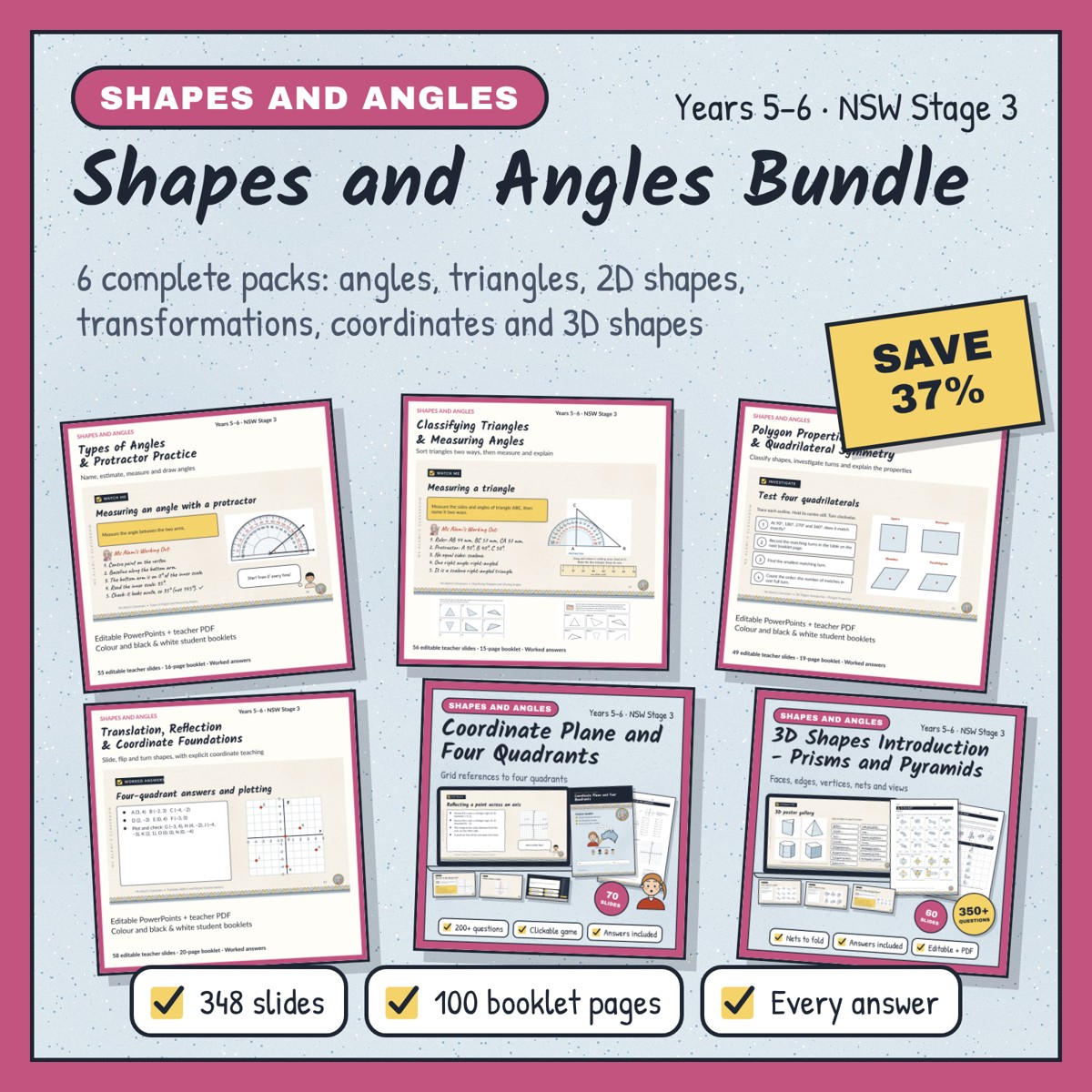
- Shapes and Angles Bundle: all six packs in teaching order in one download, with 348 editable teacher slides, 100 booklet pages and worked answers.
- Types of Angles and Measuring Angles
- Classifying Triangles Worksheets
- 2D Shapes and Polygon Properties
- Translation, Reflection and Rotation
- Coordinate Plane Worksheets
- 3D Shapes Worksheets: Prisms and Pyramids